
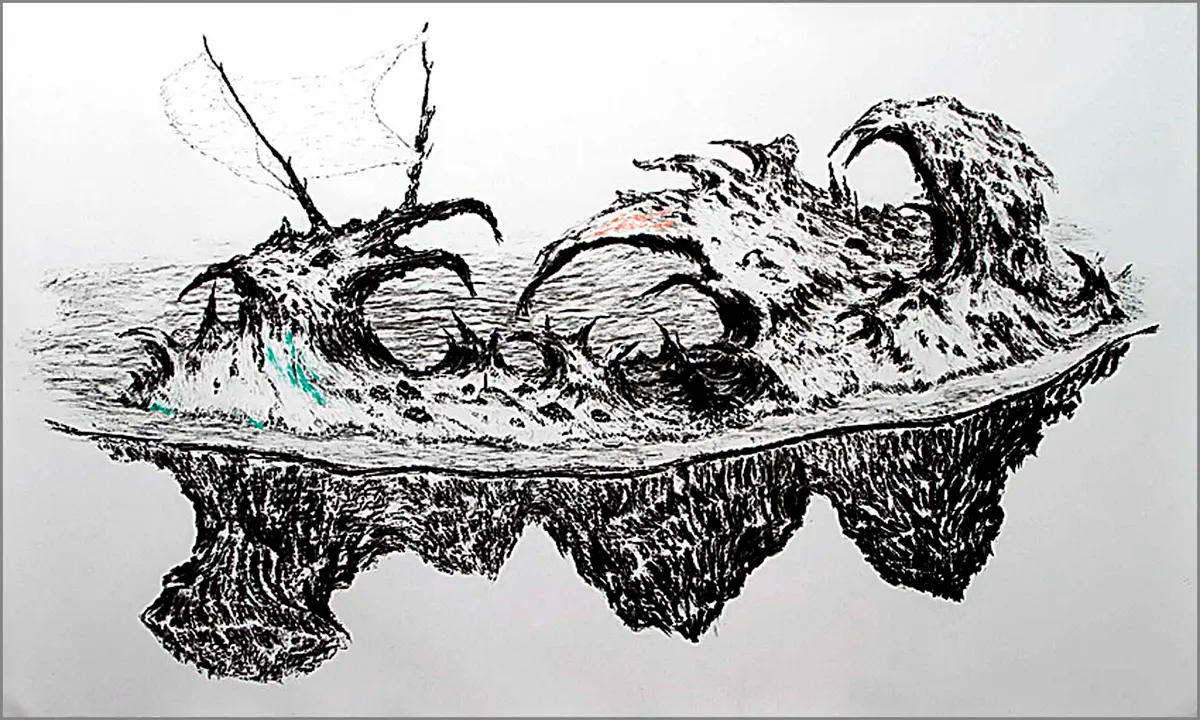
How would smoke move if it were water? What would happen if the fire had no weight? What does a chaotic frozen sea, its waves petrified, look like? What is happening with that bird that no longer has ahead? These are some thoughts-all in vain, as they are impossible where what already was cannot once again be-that result from a concatenation of drawings and paintings reflecting Matías Duville's glimmering creativity. Questions like those, about transformation and modification, destruction and reconstruction, are the starting point for a series of works situated between figurative and abstraction that seems like the product of a dream, one that speaks of impossible journeys and desolate landscapes.
Whistle is the title of the show presented at Nueveochenta gallery, comprised of 12 works, mostly large-format paintings, and drawings that not only highlight the artist's conceptual imagination, but also his reflections and investigations about the use of different materials, from pens, charcoal, and acrylic to masonite and plastic, among others. This admixture of materials generates great traction between the development process and the actions represented, resulting in a variety of images that emerge on different supports.
The title, Whistle, makes reference to the artist's own entry into the animation genre, a row of houses outfitted with chimneys that blow smoke to generate a night melody. "At times it is as if the houses were literally whistling. I remember being in the studio, drawing when I had the idea of handling this village as if the chimneys were a flute's holes."
Duville is a teller of stories, and his stories are infused with physics and chemistry. The show, curated by Sonia Becce, has to do with the expansion of the map: it creates disconcerting surfaces that resemble cartographies in relief, opens geographical areas that for the artist are a journey into creativity, where he has an opportunity to generate his own natural transformations, journeys that he can express via draftsmanship: "now I want this stone to come over and rise in flight-now I want the water to move like fire-now the river will freeze"
The show makes clear the influence that nature exerts on Duville, something that has always been present in his drawings; supernatural, strange phenomena bring into his drawings ideas arising from different places, resulting in a seemingly purposeless experiment in natural chaos, creating landscapes or abstract images that are the product of the mixture of nature and chaos. Instead of feeling like someone who produces his works, Duville feels like someone who deconstructs and constructs. This series of works is influenced by the search for a distant, yet existing, place. In the development of these works, the artist made some drawings as a kind of mental preparation, as if imagining the Alaskan landscape; then he traveled and produced another series of drawings on-site, and it was in this second exercise that a great shift occurred, a kind of real borderline that gives the work direction to different sites. As a result, the second, field-based series is deeply emotional and individualized, whereas the first group of works, done intuitively, influenced each other. Despite their being static drawings on paper, Duville's work possesses a cinematic quality: each presents a sort of road movie with the particularity of being unpredictable, with multiple and simultaneous beginning that leaves a touch of anxiety in the viewer. The images transform into short memories of known events that disintegrate to be rebuilt in a different way.
The artist seeks the convergence of the iconography he posits in his works and the way in which these works are defined. His art proposes a combination of the natural and the supernatural, fiction, and reality, which turns his works into dream-like scenes. Scenes that are built on the basis of creation and destruction, transformation always latent, with fantasy as a product of mental projections conjoined to reality such as we know it.
DIANA MARCELA CÁRDENAS