Viewers of Regina Silveira’s work have become familiar with surprises. Contradictory as this sentence may seem, it precisely describes Desaparencia, as well as Silveira’s oeuvre in general. Her surprises are earnestly elaborated; they come from the author’s conceptualism-based reflection and are structured through a vast range of vectors, some of which are Silveira’s interest in space, her shifting of perspectives, her modification and subversion of the viewer’s Spatio-temporal experiences, her underscoring of very diverse aspects of reality, and in some cases… ideological deconstruction. In terms of her materials, Regina Silveira uses paper, plastic, pencil, vinyl decals, and wood. She has also used threads for embroideries, and porcelain. Regarding her technique, she starts from printmaking and drawing, which she has developed and pushed forward into updated pathways, deconstructing their uses and results with attention to the inclusion of new supports, and breaking with the orthogonality of the original formal prints to create fictive perceptions, jungles, and labyrinths. Similarly, in terms of technique, she brings to the fore the always uncertain duality of the print: the relationship between positive and negative.
This Brazilian artist works on the system of deformation/elongation of solids, be it geometric bodies or everyday objects. This can be applied in a practical way of teaching, an activity that the artist enjoys. In bringing it into the creation of her works, Silveira generates an aesthetic of her own. Although, if one thinks of points of reference, the history of art connects her to Leonardo and Warhol, to conceptualism, and to a certain aspect of Concrete poetry, all of which can be perceived in this New York show. In general, Silveira creates site-specific projects, drawings, objects, prints, and photography. While the other elements have been explained, it bears mentioning that the reference to Leonardo comes from the well-considered projection of light in this incursion between drawing and three-dimensionality. Concerning Warhol, the reference is to Silveira’s approach to elements of the popular-urban, such as the decals.
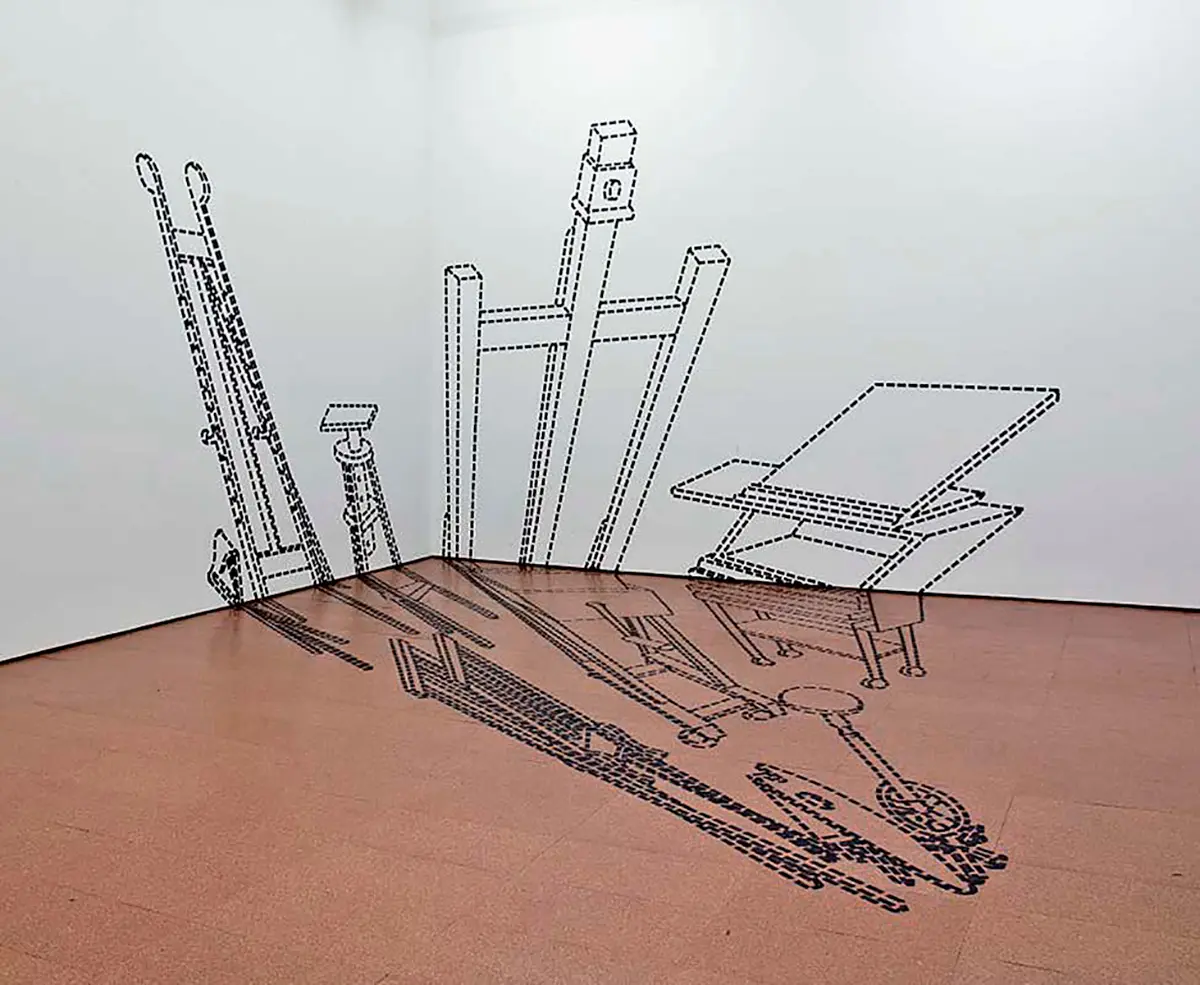
Entering the exhibition, the viewer finds two different visions: the work process and the installation per se. Four works based on drawing and one object are presented in the left wall of the gallery, and the installation occupies one corner of the exhibition space. Such museography promotes in the visitor an impulse towards comparison and a ping-pong movement of the head. In the installation, the final result brings forward not only the deformation of shapes but, created as it is on the basis of dotted lines, it establishes another level of perceptual unpacking. A specific “between the lines” reading emerges in connection to the visual art. It can be a direct, drastic, and limited interpretation: these elements, previously expendable in the work of a painter, are no longer so today, or only to a lesser degree. Or, rather, less final coeval readings that refer to the alternation between easel works and ephemeral art, or with site-specific work, or greater interest in the visual stamp—less formal and less confirming—of the dotted lines in contrast to filled ones.
Regina Silveira demonstrates her ability to work with various aspects of the Baroque. Be it by saturation, by the creation of horror/humor with insects that invade the space—as in Mundus Admirabilis, from 2008-10—or through this synthesis of tensions in a composition that comes across as sharp, unstable, less visible and resolved, in a multitude of diagonals. In this installation, however, we don’t find the usual “shadows” featured in Silveira’s work. Light and transparency predominate, as does the contrast (the Baroque factor) between the warm zone of the floor in a melon hue and the wall painted in an office-like shade of gray. Silveira offers a comparison between realities that are as tangible as they are evanescent. In graphite, ink, marker, and collage on architectural paper, the artist presents a Preparatory drawing for Desaparencia (Study). This work comprises a collage of two scenes of that furniture for artists, the drawing of the same furniture and other items, some notes by the artist in red and green ink, and a large diagonal line across the entire paper sheet.
The gallery only uses this first space for its exhibitions. As an exception for this occasion, there is one work by Silveira in the other area, closer to the street, with a view to the recently inaugurated second portion of the High Line—a stupendously recovered space of New York urban history. Here, the artist sketches a shadow in the unreal perspective of how the gallery’s window is projected onto the wall as if seen from the High Line. Created using the usual black decal, the window’s handles are functional even as they allude to small birds (perhaps nourished by the strong interplay of open space and natural light that the artist underscores here.) As a corollary, this exhibition creates an ironic, critical, and playful situation, and once again extends the concept of space, by referring to events both inside and outside the gallery.
GRACIELA KARTOFEL