
Since the mid-1990s, Román Vitali (Rosario, Argentina, 1969) began to stand out in the Argentinian art scene. From the beginning, his work was recognized because of a unique characteristic: an attempt to pave away into the world of sculpture by resorting to an outrageously fragile and feminine technique. Vitali would thread colored acrylic beads like the ones girls use to create costume jewelry. Using nylon thread to string the beads, Vitali constructed semi-rigid structures that emitted a gleam from the material itself; created small representational or abstract pieces that began to impose their presence because of their appealing pop-like expressiveness. It is necessary to point out that Vitali was not the sole artist from his generation to embrace-meaningfully and with the dignity-a technique more closely associated with the crafts. But not all artists achieved the level of sophistication Vitali attained, as he compellingly demonstrated in each one of his exhibitions.
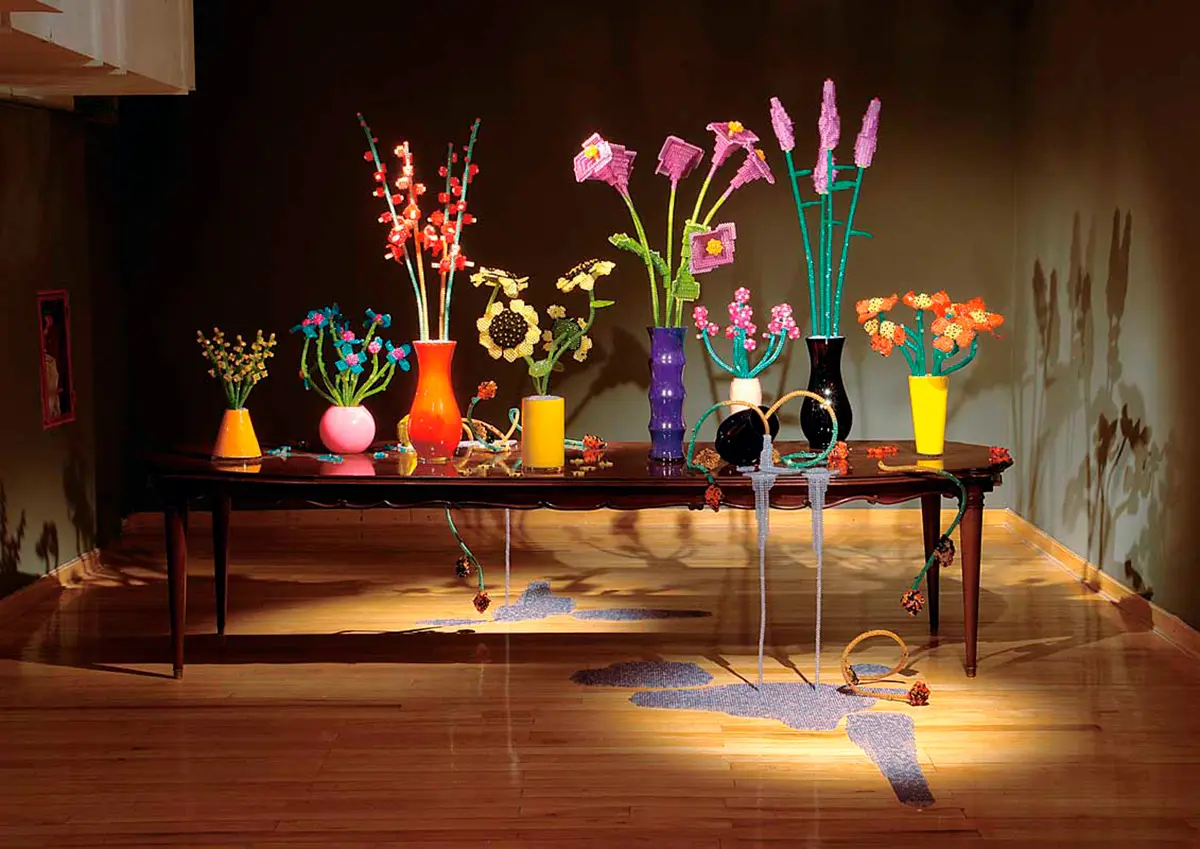
His most recent show occupies the entire main exhibition hall at the Galería Ruth Benzacar. Titled On Top of It, It Snows Inside, the exhibition consists of a collection of pieces that, independently, function as possible brief narrations and, collectively, render a story that at its core eludes a linear structure and univocal interpretations. Each object woven by Vitali contains vestiges of a real and/or a metaphorical drama that could occur in the context of a familiar salon: in the piece titled La Culpa es de las Flores (The Flowers are Guilty) some flowers fall from their vases; human heads hang from the walls like trophies in Los Cazados I y II (The Hunted I and II; the legs of a sofa stand unstably on top of a pile of books right next to Caza I y II (Hunting I and Hunting II), small pools of blood that dye the floor red. The deliciously narrative-prone-a constant characteristic that has accentuated his works of recent years-Vitali presents staged works that reclaim elements used in previous exhibitions, such as the woods/tree/log, in which the artist explores new combinations always supplemented with data from nature. In Muñeco de Nieve (Snowman) a snow figure melts in a corner of the exhibition room. And in another section, a fire attempts to sizzle without much success in Tarde o Temprano Íbamos a Tener Problemas con el Fuego (Sooner Or Later We were Going to Have Problems with Fire). A couple of works have apparently been robbed of their content and turned into just frames in Cuadros Robados I y II (Stolen Works I and II). It is the eruption of the sinister that stirs the apparent promise of the comfort of a fire ignited within, while coldness inhabits the exterior. In Vitali's mind, something has been tampered with and thus ... It Snows Inside, as decorative objects are covered in frost, while people dress like ghosts. There is nothing that can bring back even a little bit of tranquility, not even the intrinsic gleam from the translucent acrylic the works are made with.
That which may resemble a corset to some artists, to Vitali represents a catalyst of possibilities. He insists on using the same material year after year and, in doing so, he has found a way of making his proposal increasingly more complex, as he pushes the boundaries of the technically possible. In the process, he must find the answer to the following practical question: how to represent smoke, snow, water, sparkles-from fire-using solid materials? But most importantly there are also conceptual questions to be answered: How can one tell stories through sculpture? How to ensure that such stories are conveyed to the public without resorting to didactic approaches or provoking simplistic readings? Unconcerned with the weight of fashion and its demands to entertain certain tendencies or movements in vogue, Vitali works, in the same manner, the snow of his most recent pieces do: he impregnates everything he touches, as he rarefies an environment that is more internal than external.
EVA GRINSTEIN