
For the third solo exhibition by Saúl Kaminer (México, 1952) at the Thessa Herold Gallery, the organizers decided to present 28 works that cover a long creative period. There are paintings, ceramics, bronze sculptures, and cut-out woodworks created between 1976 and 2010. It is a selection that appropriately showcases the evolution of this Mexican artist’s work. Accompanied by a catalog, this non-chronological mini-retrospective allowed viewers to be introduced to original work that, as it has evolved through the years, has established a permanent dialog between narrative and space, while conveying Kaminer’s unapologetic love for painting. The simultaneous practice of sculpture (aluminum, iron, glass, cardboard, wood, and bronze), ceramics, and painting (oil and acrylic); the cross between formal, thematic, and narrative inquiries; the overlapping of existential reflections and cultural and spiritual roots; and the immersion into a double culture (Mexican and French)1, nourished in different moments the development of a personal and free discourse that does not subscribe to the demands of fashion trends or to the prevailing conceptual proposals in vogue, but one that is closely connected to the tempo of his own physical and mental rhythm. On the other hand, Kaminer reading is a crucial element that he uses to extract and then forge the essence of the conceptual and sensible plot in his works that is continuously flourishing, as the artist endeavors to establish a connection between artistic life and real life.
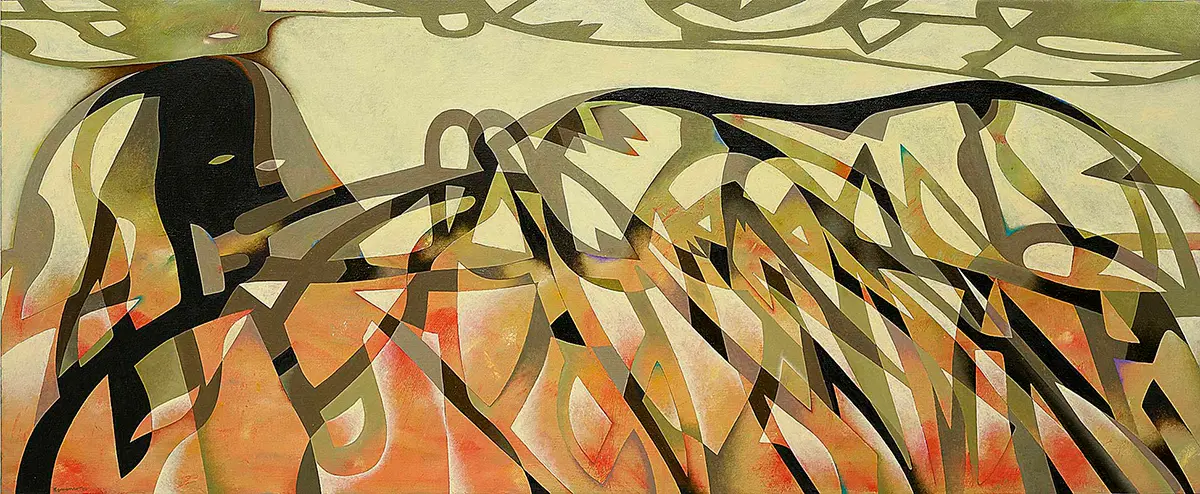
Beginning with his early works from the 1970s—in which the influence of surrealism is evident in paintings like Souffle Animal (Animal Breath, acrylic on canvas, 1976); ceramics and bronze sculptures like Tatou (1979); and even the recent works dominated by the erasing of the figures in favor of the interaction between lights and shadows, like La Lutte Avec L’ange (The Battle with the Angel, oil on canvas, 2010); and in the narrative and symbolic works from the 1980s and 1990s, like La Tormenta (The Storm, oil on canvas, 1988), it is possible to observe Kaminer’s strong attraction to nature and the establishment of a relationship that is singularly familiar. The creation of a mythic or real animal world—the subject in all of his imaginaries—subscribes to the invisible framework that structures the space.
While the exhibition underscores Kaminer’s reliance in a world in which fiction allows him to be introspective and to gaze and reflect upon everything else through a figuration often oneiric in nature, it also leads the alert observer to other dimensions—one among these, the most evident one being the material and symbolic opening of the space conveyed in the works in the first exhibition room. Three paintings: Forêt Intérieure (Interior Forest, acrylic on canvas, 1980); La Lutte Avec L’ange (The Battle with the Angel, oil on canvas, 2010); and the tondo entitled L’ombre de la Terre (The Shadow of Hearth, oil on canvas, 2011), welcome viewers to the exhibition and fill it with meaning. Here the questioning of representation was set in motion. It began in 1980 with a sort of stylized interweaving of abstract forms from which cords, hooks, heads, and fish skeletons emerged as the space became crowded. Then, twenty years later, it would lead to Kaminer’s use of translucency, depth, and that web-like rendering that is the basis of his constructive dimension.
In one of his most recent works—the aforementioned tondo—the web-like superimposition of forms and their shadows rendered in predominant greens, reds, and blacks, generates a universe of chiaroscuros that is at once structured and unstable, permeable and opaque, limpid and mysterious: Nonetheless, this work continues to embrace previous searches that suggest aquatic and cosmic realms. On the other hand, the air is the element that viewers are able to perceive above all things. A new breath animates the forms, a puff that comes from within, from the fire on the earth, from the deepest place within the self. The figure has been blurred and replaced by an observing and declaratory ghostly figure. With respect to the small steel and brass sculpture entitled El Tiempo y la Montaña (Time and the Mountain, 2009)2—5.51 × 19.68 × 15.74 in.—it confirms the close relationship between painting and sculpture present in Kaminer’s work.
Essentially organized around figurative works from the 1970s to the 2000s, the second exhibition room takes us into other realities. Two small oils on tondos entitled L’équilibriste (The Acrobat, 1992) and Après l’incendie (After the Fire,1994), illustrate Kaminer’s imaginative spirit. In the large canvas La Costellation du Grand Mystère (The Constellation of the Great Mystery, 2008), the thick color treatment is integrated into the geometric domain. But most notable are two works created in different periods and in different mediums: the painting entitled Sueño de un Animal Desollado (Dream of a Skinned Animal, 1985), which evokes Pre-Columbian myths and rituals; and, most significantly, his last stoneware sculpture entitled La Maison de la Baleine (The House of the Whale, 2010), in which the interplay between geometry—broken and cross-linked lines—and rounded forms, underscore the very light and yet highly structured mass that expands like a smooth and subterranean architecture. With his most recent works, Saúl Kaminer invites us to enter into a world in which the narrative increasingly gives way to meditative reflection.
NOTES
1. “Être et devenir”, (Being and Becoming), an interview by Christine Frérot, in Parcours intercultural, Peisaj publishing, Montreal (Quebec), 2010.
2. Mockup for a 14-meter wide by the 4-meter high sculpture that will be constructed in Mexico in 2011.
CHRISTINE FRÈROT