
Brazilian photographer Valdir Cruz is best known for portraits of Yanomami people, Makuxi, Kaxinawa, and more. Continuing in the spirit of honoring and preserving, he trained his lens on nature in the regions of Bonito and Raizes in the state of São Paulo. Sponsored by the government in an effort to document endangered trees, Cruz created an arboreal bestiary in oversized tritone photographs.
Promoting ecology through art, Cruz’s compendium references multiple inspirations. Audubon, John Muir, Edward Curtis, and Walker Evans are touchstones. Echoes of traditional devotional imagery add an extra dimension of interpretive possibility.
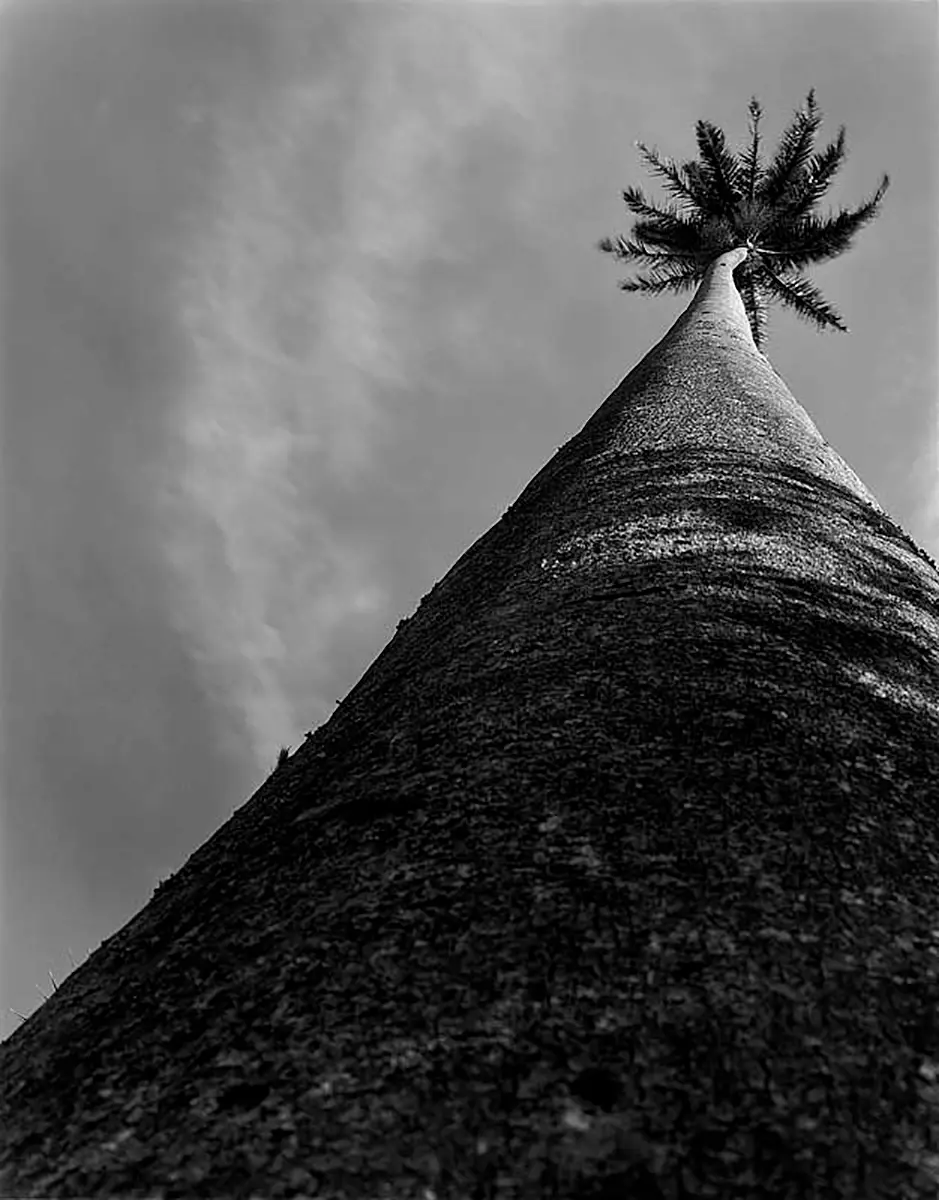
Rare trees, withered and gnarled, keep reaching. Regal, even imperious, the iconic relics loom, imparting notions of wisdom, perseverance, and complicity—human traits to be sure, but traceable in these distant relatives. Exuding personality and resistance, a lightning-scored and bark-stripped torso stands against the odds, a repository of time.
Several water scenes are included where silvery light hovers on a pool of reflective depth. Under the surface, a school of fish is arrested mid-stream, in an endlessly eternal fractal pattern.
Themes of singularity and struggle couple with dynamic handling of form and scale. The restrained palette concentrates the impact, increasing punch and power as Cruz imbues his mute subjects with infinite compassion. Emotion and life cry out in these sculptural images, evocatively antiqued and rarified by being represented in black and white. Cruz captures monumentally the “eyeless thing” staring at us.
Traveling over 16,000 kilometers, Cruz was accompanied on his trek by a small team including a botanist and guides. One instantly estimates the age of each tree and more subliminally recognizes the distance covered since the last shot. Time and space are conflated. The epic sense of the hunt is evident as each image unpacks its detail and uniqueness.
Hunting (and its embedded heroism) has always been the stuff of legend. Here, Cruz redirects the hunt and redefines heroism. These trophies give life to their subjects rather than taking them.
While the supreme object is still survival and continuance, our relationship with nature must be to nurture as opposed to conquering. What needs to be conquered are people’s insensitive attitudes about our station in life. These photos are a vital bridge to that understanding. They reconnect us with our roots.
Sticking with the metaphor of roots, James Enyeart wrote that Cruz’s “photographs reveal that nature and humanity are one, rooted in a symbiotic relationship of irrefutable consequence,” in the photography journal Nueva Luz (Volume 12 #3).
Metaphors such as roots are laden with mythic symbolism and inherent reverence. Cruz performs a feat of transference as he animates layers of subjectivity, so the specimens are revealed like characters in a play. It’s as if the artist’s interior landscape had been apprehended and ingrained onto the image.
Encircled by sere grass, an old Ipê-amarelo tree rises, its forest neighbors long were gone. Stark branches appeal, uplifted. A band of late blossoms is left in the crown of the still leafless spring limbs. Vines cover its husky trunk. It is a succinct and noble icon of lonesome, suffering glory. The anthropomorphism registers against a grid of abstract equations. Vertical and horizontal, singular and infinite, darkness and light dance in taut duets.
In an elemental interplay of forms, a Palmeira-Imperiale cuts up from right to left in a bold diagonal swath. Atop the tall palm, a spray of leaves sprouts out like feathers on an exuberant headdress. They erupt from the receding pinnacle in exultation. In the upper left quadrant opposite, a wispy cloud curves, as if in a parenthetical dialogue. The vertiginous vantage creates a suspended confusion between comedy and peril, between isolation and communion.
“The hand of artifice has consecrated the all-powerful gaze,” praises Lélia Rita Euterpe de Figueiredo Ribeiro in the introduction to Bonito, (one of two books chronicling Cruz’s project). The “all-powerful gaze” exemplified in these photographs offers us glimpses of our inner selves in terms we can subscribe to.
Finally, Cruz enables a viewer to conjure the sensation of being observed. Activating the field of vision, he creates a novel experience of projection and sentience.
In a foreword to Raizes (the second book), the author Ignacio de Loyola Brandão demonstrates an associative prowess in delightfully imaginative and poetic personifications of the trees. , The royal palm tree comes out from the earth and touches the sky, turning into a giant royal scepter that imposes itself majestically.
It is tempting to ascribe such characteristics to all of Cruz’s woodland friends, wizened denizens, and stalwart giants alike. Whimsy aside, underneath the beauty and mystery, Cruz presses morality. He courts prophecy as he records and dignify the accelerating vanishing act of species. The images, both lush and stark, remind us of our temporality. In the immortal words of Pete Seeger, this haunting work should “ring out a warning.”
JEFFREY CYPHERS WRIGHT