
Two adjectives came to mind as I ended my visit to the Lyon Biennale: Theatrical and literary. Of course, the works on exhibit differ vastly from each other and fit well with what is expected nowadays from a mega-exhibition of contemporary art in terms of concepts, media, and languages. Yet, one is left with the impression that theatricality and literariness dominate the general tone of the event. And I say “impression” because it is not a question of the dramatic or literary as such permeating the Biennale, but a more diffuse, expanded if you will, the experience of their presence. This effect should probably be attributed to the preeminence given by Victoria Noorthroon—this edition’s Argentinean curator—to Latin American art, and specifically to Latin American artists for whom literature and/or the theater are of crucial importance. The most noticeable example is Colombian artist Bernardo Ortiz, who took over the façade of the La Sucrière building that directly faces the river with El artista del hambre, which superposed on said façade the text of Kafka’s story of the same title (“A Hunger Artist”) and a gray screen that referred to the cage into which the hunger artist was thrown. And perhaps not just him, if we are to credit the unsigned text about Ortiz’s work in the Short Guide, where we read the following: “Through Ortiz’s work, Kafka’s story serves as a framework for the exhibition as a whole, influencing the way in which the audience approaches the works of other artists shown inside the building.” The other work by Ortiz included in the Biennale is a veritable homme de lettres cabinet. It is called Sin título and consists of an entire gallery at Lyon’s Museum of Contemporary Art devoted to the exhibition, with a librarian’s minute attention to detail, of the drawings, texts, and even reading in the diary (more intellectual than emotional) Ortiz has been “writing” for the past two years.
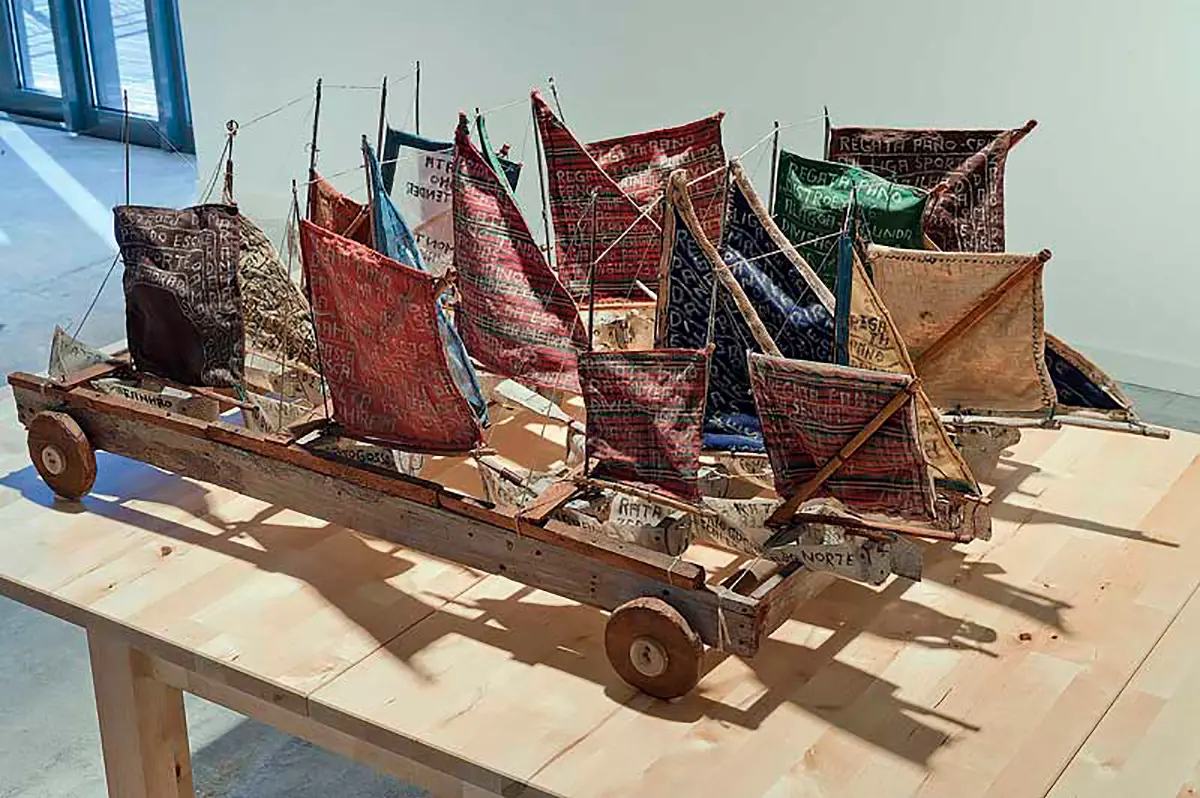
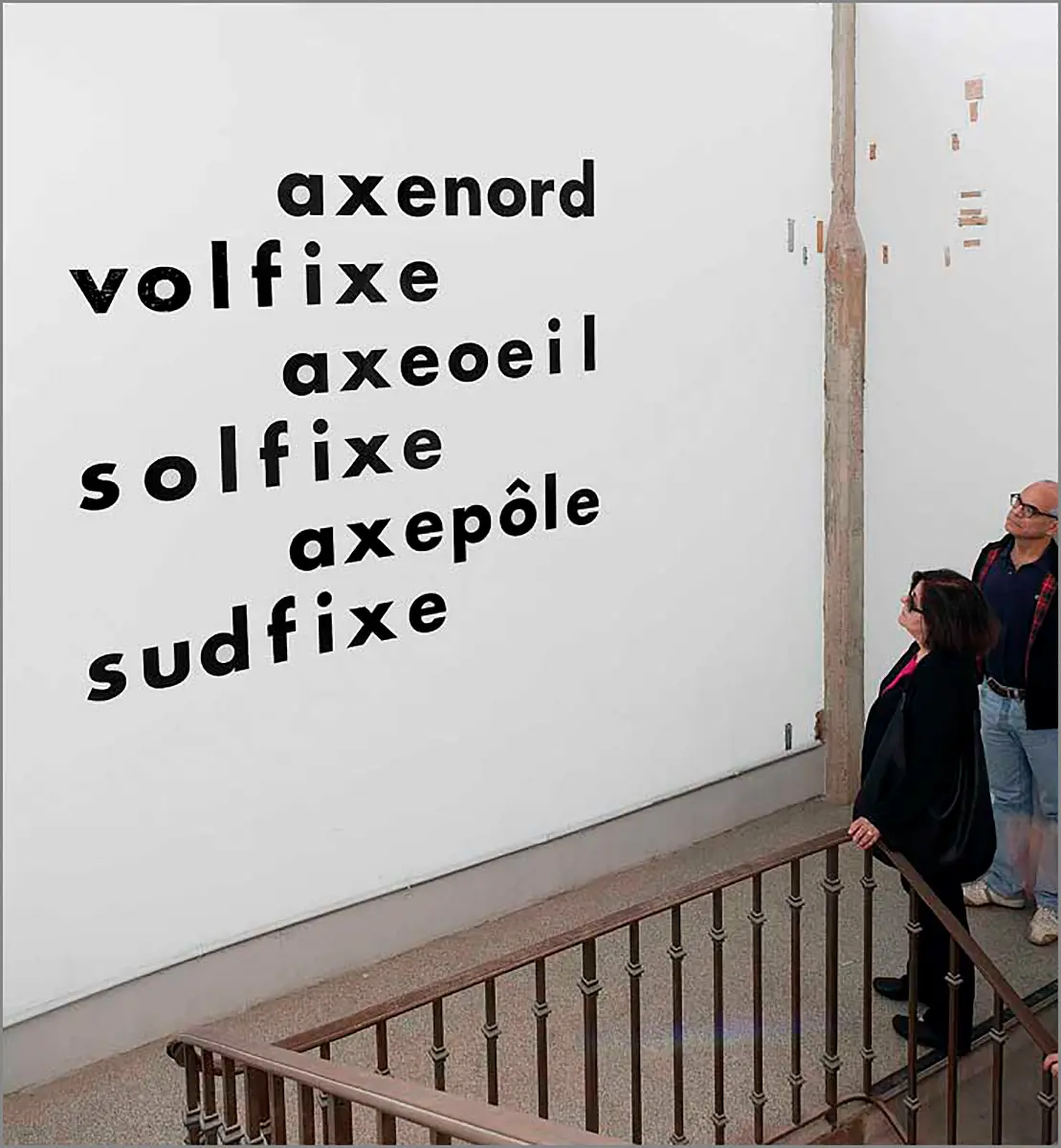
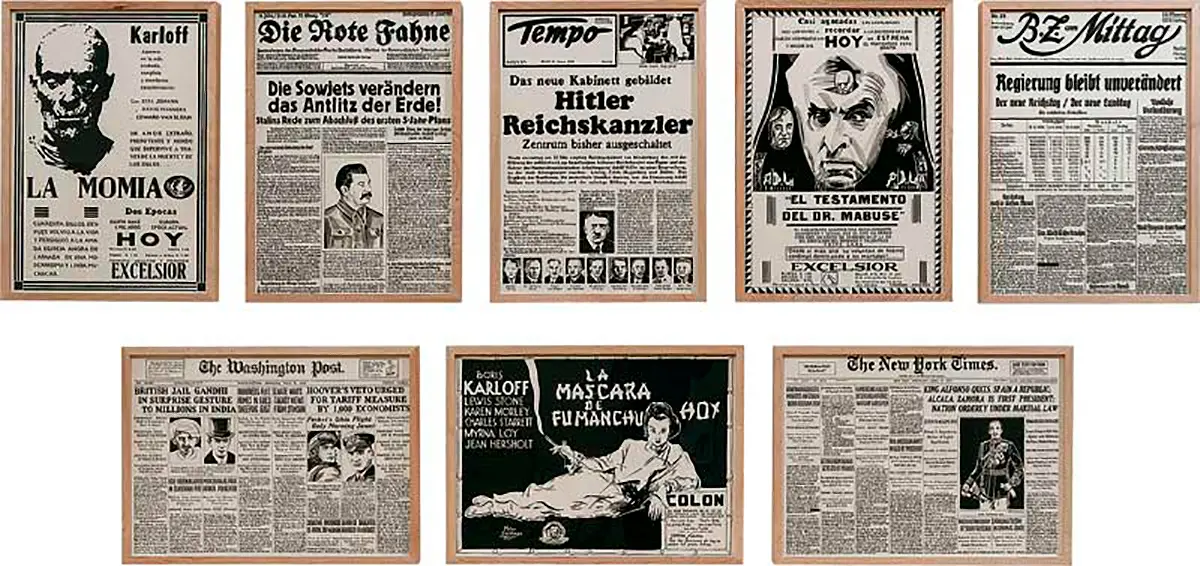
Also adding to the literary veneer in this biennial the visual poems created by Brazil’s Augusto de Campos, painted on the majority of the walls at La Sucrière. Also the drawings by Peruvian artist Fernando Bryce, who presented, at the Museum of Contemporary Art, a series of faithfully hand-made copies of newspapers from the 1930s, under the title L’Humanité. And, of course, the extraordinary selection of works by self-taught Brazilian artist Arthur Bispo do Rosário, who in the course of the 50 years lapsed between his commitment to the Colonia Juliano Moreira in 1938 and his death, in 1989, created one of the most impressive bodies of work in Brazilian art, entirely apart from the geometric constructive tradition that is the distinctive characteristic of the country’s production. Equally central to Bispo’s oeuvre is the writing of a journal recording the names of each person he met or had some contact with throughout his life, as well as the aleatory collecting of objects and remnants normally discarded during our everyday lives. The selection exhibited in one of the spaces at La Sucrière included a Nineteenth-Century jacket and some seemingly endless lists of names written on tablets and fabric.
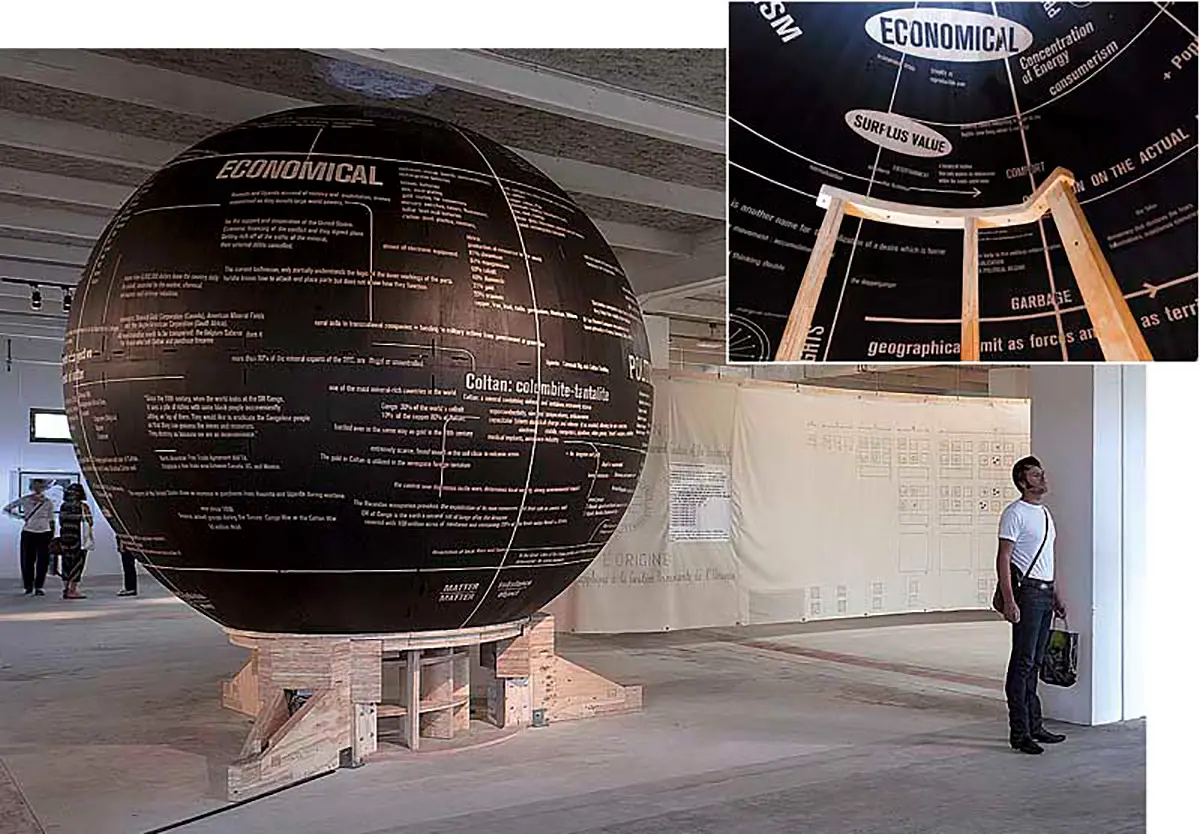
For the articulation of his Perikhórein Knot—the title could be translated as “interior path”—Mexican artist Erick Beltrán found support on the concept of the encyclopedia. It consists of a large penetrable sphere that seeks to provide, like a globe or those celestial spheres of the Renaissance and the Baroque, an image of the contemporary “world system”. On the sphere’s exterior planisphere names and situates the events and phenomena that come together in the image: “brick industry”, “law of land regime”, “real state bubble”, “urban expansion”, “private interest to the detriment of the public good”, etc. Visible inside was the intricate network that connects the most powerful multinational with various countries and with the world’s centers of political and economic decision-making. The obverse and reverse of a world that is equally jumbled and chaotic on both facets.
Also to be noted in this section is La recontré entre Écho e Narcisse, an audiovisual installation by the Brazilian poet and performer Leonora de Barros, as well as Dominique Petitgand, a French artist who exhibited a similarly audiovisual installation titled À la merci, in which a small boy dictated, word by word and even syllable by syllable, a text that an adult was to repeat at the same pace, and which rolled, in manuscript, on a screen. Also, Robert Filliou, who wrote in long and captivating panels a series of reflections, quotations, and digressions around an Investigation on the Origins of the application of the Equivalence Principle to permanent creation.
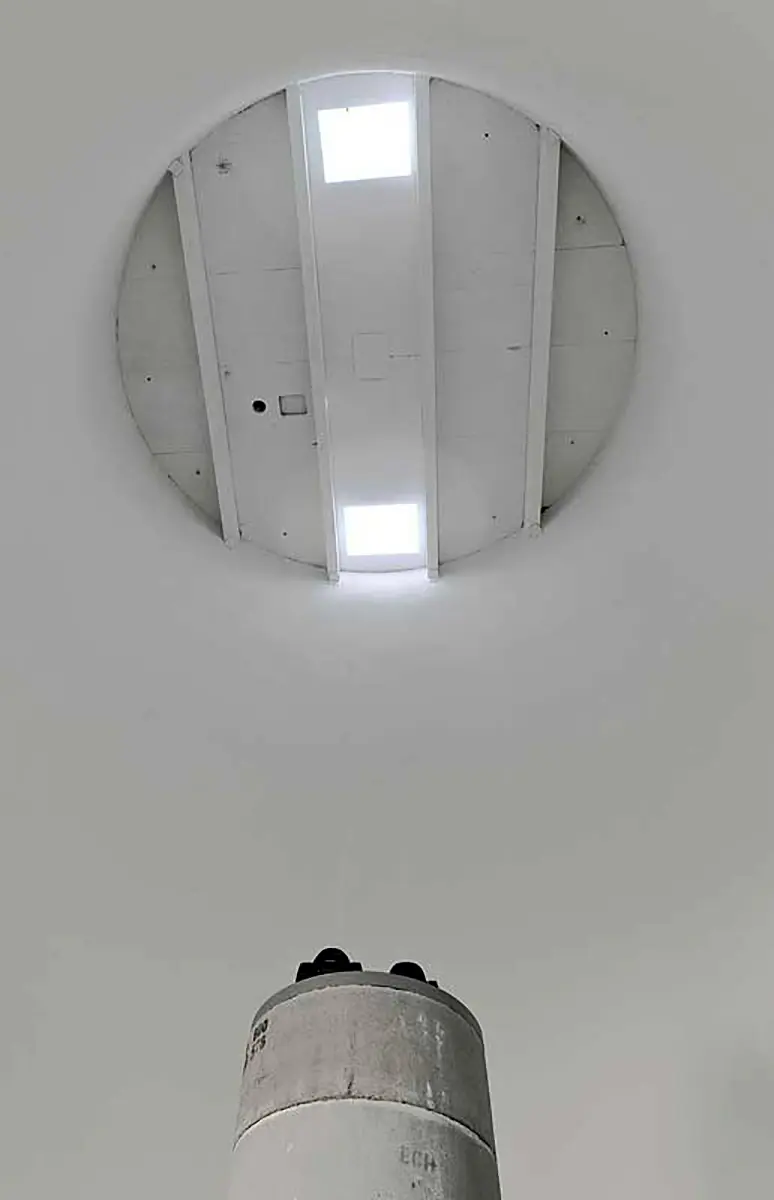
The entry into the theatrical, so to speak, came with German artist Ulla von Brandenburg, who unfolded, right next to the main entrance to the La Sucrière building, a sequence of hanging banners clearly stage-like in their intention. These semi-open curtains announced a theatrical function never to take place. Or at least not as a conventional performance. Immediately after Brandenburg’s curtains, Polish artist Robert Kusmirowski offered an interpretation of the diffuse theatricality I mentioned above, in the shape of a powerfully stage-crafted installation. To create it he took advantage of a large iron cylinder, part of what must have been a boiler back when La Sucrière was in fact a sugar manufacturing plant, and transformed it into an unexpected archive. An anachronistic, dust-covered, disarticulated archive that could perfectly serve as the stage for a theater piece by Tadeusz Kantor, the Polish author who brought to the scene a Mitteleuropa in the process of vanishing after WWII.
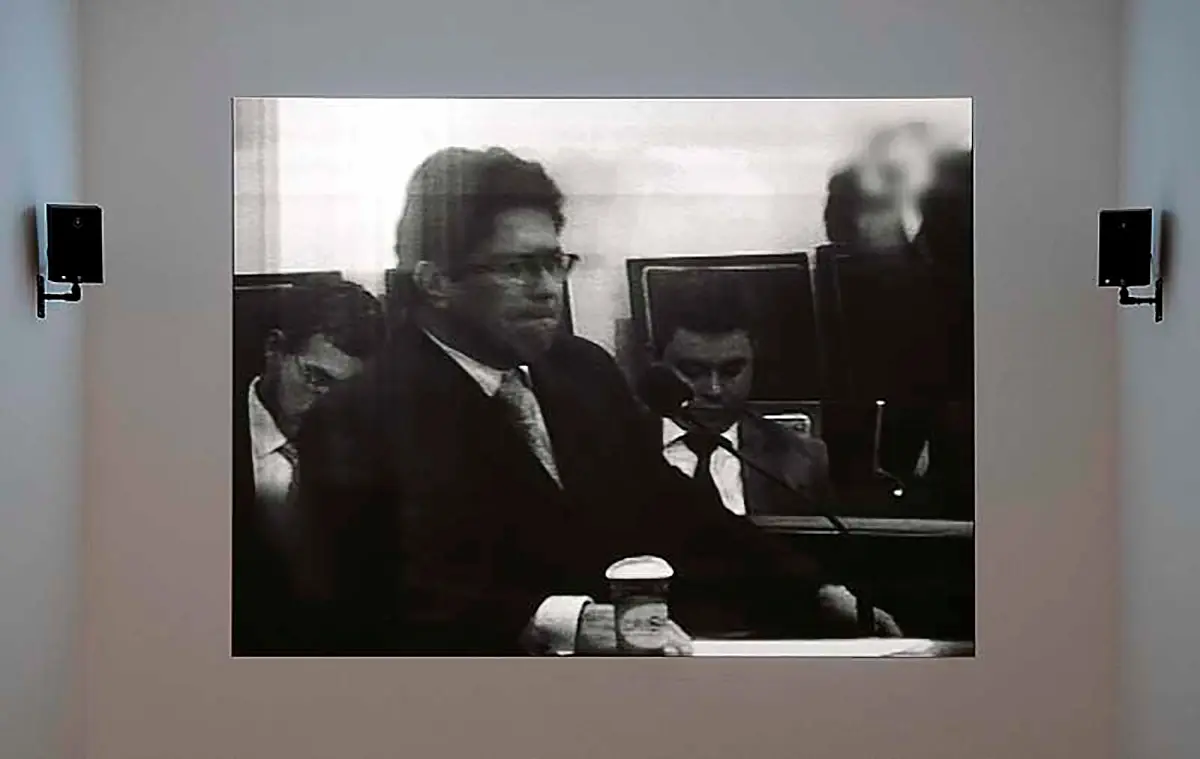
At the Museum of Contemporary Art, José Alejandro Restrepo presented his video El arte de la retórica manual, where a speaker—perhaps a parliamentarian in the exercise of his craft—accompanied his emphatic discourse with exuberant hand gestures, the true focus of the work, as corroborated by the reproduction of two planks for the engravings that illustrated John Bulwer’s book Chirologia or The Natural Language of the Hand, expressly selected by the Colombian artist to be included in the volume published by the Biennale in lieu of a catalog. The anthropologist-like gaze Restrepo has exercised for two decades on Colombian culture came to illuminate now its marked parliamentarianism and what it has of maniacal exploitation of the thesis presented by Montaigne in his Essays and quoted in the Short Guide: “We use our hands to question, promise, call, say goodbye, make deals, pray, supplicate, reject, enquire, admire, retell, confess, lament, frighten, express embarrassment, doubt, instruct, give orders, incite, encourage…”, etc. As Montaigne asks, rhetorically: in the face of such wealth of expressiveness, why should hands “feel envious of the tongue?”
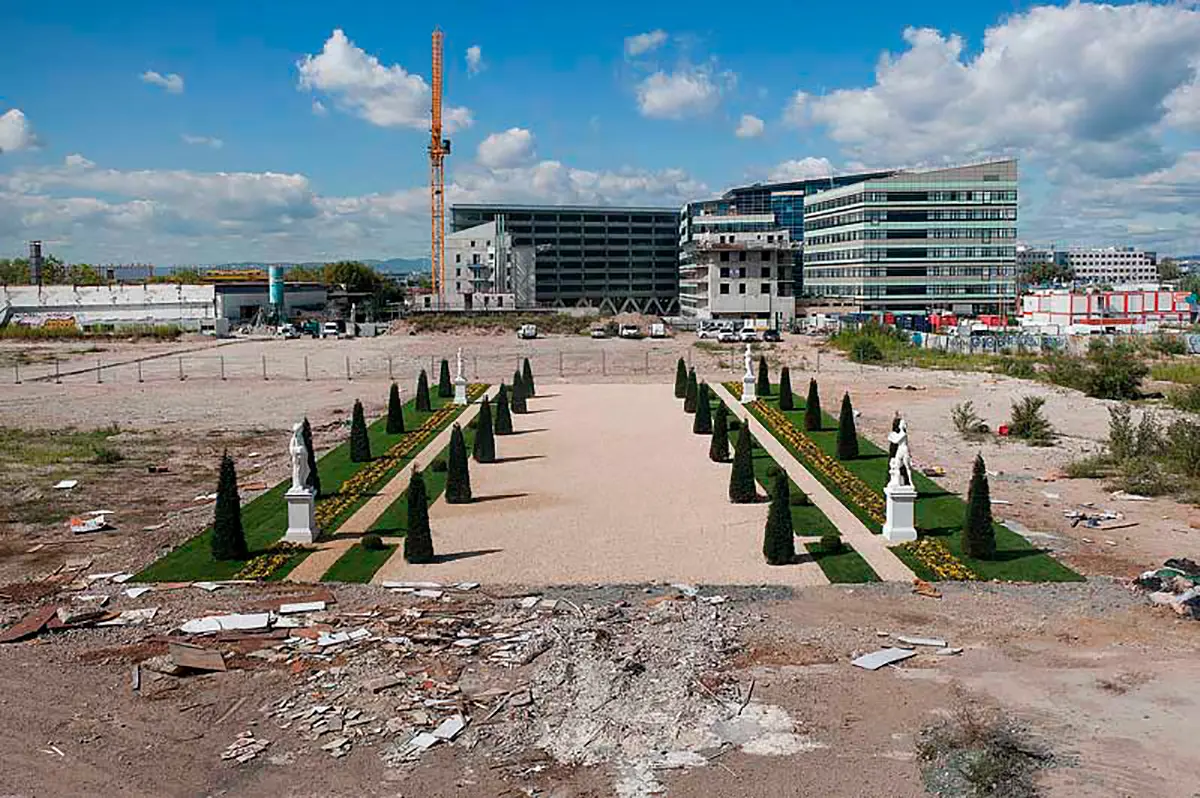
Jorge Macchi, from Argentina, is basically a visual poet, in the tradition of the Futurists. “Words in freedom”, of the Letterist International, and of the Brazilian Concrete poets, with Haroldo de Campos and the already mentioned Augusto the Campos at the helm. But the most potent work he presented at this Biennale was openly theatrical, or at least scenographic. It was located outside the T.A.S.E factory, a blighted manufacturing plant in exurban Lyon that served as one of the Biennale’s four official sites. It was titled Marienbad and paid evident homage to Alain Resnais’ 1961 film Last Year in Marienbad. And, to be more precise, to the French-accented gardens of the crepuscular, palatial hotel where the film’s protagonist couple strolled or gazed through windowpanes in sumptuous halls as the increasingly more anxious woman listened to the impersonal retelling of her alleged encounter in Marienbad the previous year with the unknown man who demanded the dissolution of her marriage and the fulfillment of her promise of being his alone. Macchi reproduced one section of that garden, copying statues, and carefully trimmed bushes. But his installation owed a significant part of its intensity to the contrast between its glacial geometric emphasis and the building of the factory in ruins. Macchi’s work made it inevitable to evoke a Europe whose cultural legacy and industrial past have been endangered by the current crisis. But one could also be reminded, as I was, that in 1936 Marienbad hosted an International Psychoanalysis Seminar where a young, unknown physician lectured on the role of the mirror stage in the formation of the self. The physician’s name was Jacques Lacan, and it is impossible to exaggerate either the importance of that paper in the development of his thought or the weight that his name and his work carry in Argentina’s heavily psychoanalytical, heavily psychoanalyzed culture.
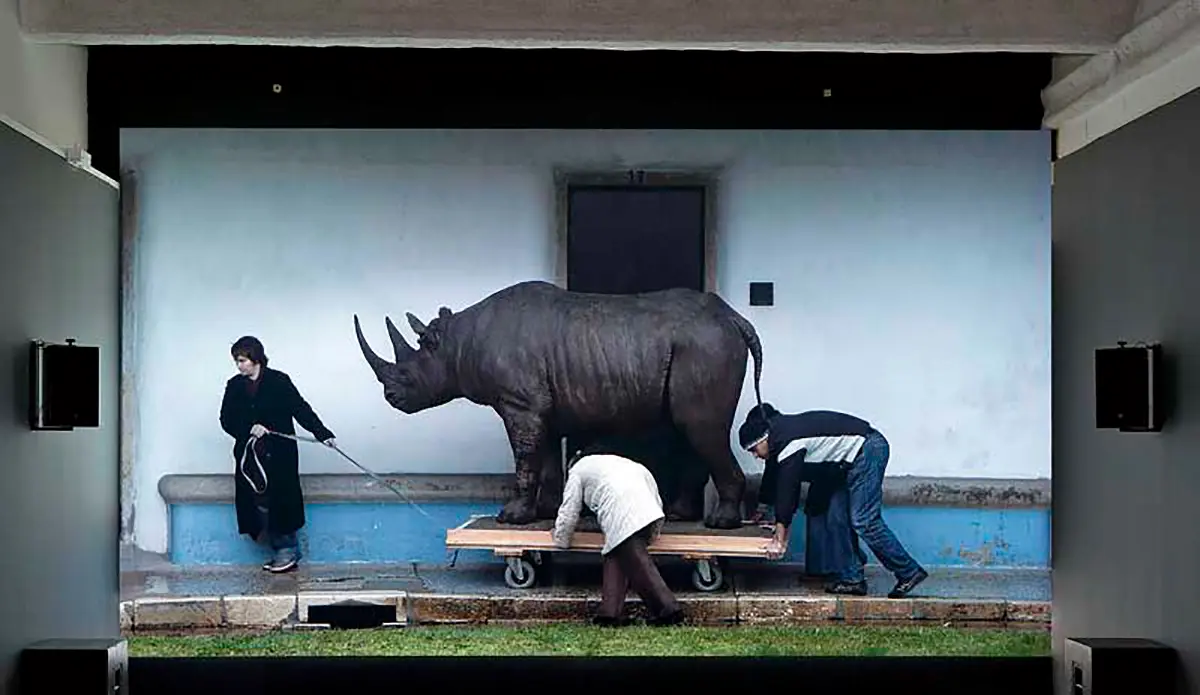
South African artist Lucey Rose moved towards the carnivalesque in the midst of this drive towards theatricality with her video Lucie’s Fur: The Prelude, a feminist revision of the Book of Genesis wherein Adam is deprived of the privilege of being the first human being in favor of Lucy, the hominid female whose ancient remains were discovered in Africa in 1974 and is widely deemed the “mother of humanity” because of her antiquity. Venezuelan artist Javier Téllez also presented an outstanding video, titled O Rinoceronte de Dürer, which indeed included a life-size replica of a rhinoceros and had it circulate, mounted on a wheeled platform and pushed by two operators, around the facilities of what today is the Miguel Lombarda Hospital, formerly Lisbon’s largest psychiatric institution, built-in 1986 to hold insane criminals according to Jeremy Bentham’s panopticon model. Téllez asked patients to imagine and represent stories of those mental patients in the psychiatric hospitals' old cells, and superimposed on his recordings of those sketches, voices reading Bentham’s texts as well as Plato’s parable of the cave.
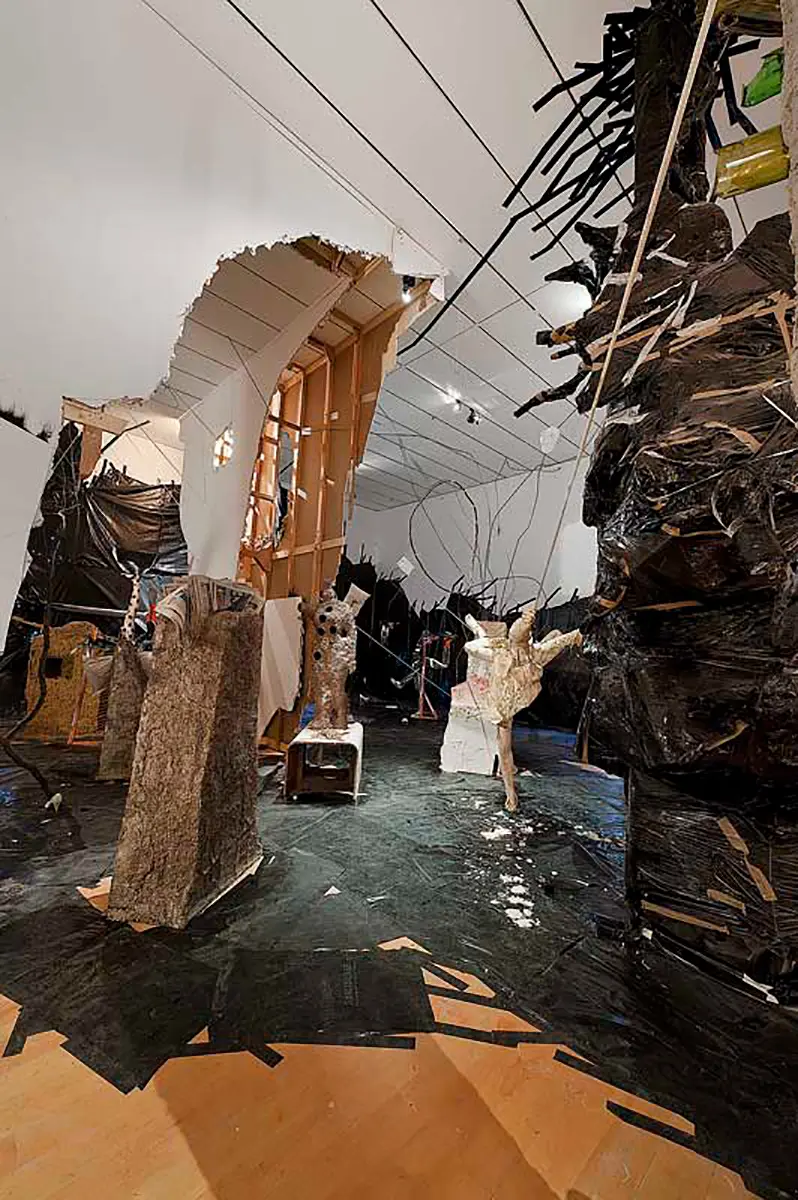
Finally in this section, I must call attention to Brazilian filmmaker and playwright Daniela Thomas’ staging of Breath, a brief, bleak piece by Samuel Beckett, composed in 1969.
It must be noted, also, that in terms of installation, the Latin American contribution was equally impressive. Diego Bianchi, from Argentina, took over an entire gallery at the Museum of Contemporary Art with a combination of artist’s workshop and merzbau in the manner of Kurt Schwitters, while Eduardo Basualdo, also from Argentina, installed in one of the amplest spaces in La Sucrière his El silencio de las sirenas, dominated by a large, irregularly shaped pond that visitors were able to enter at will.
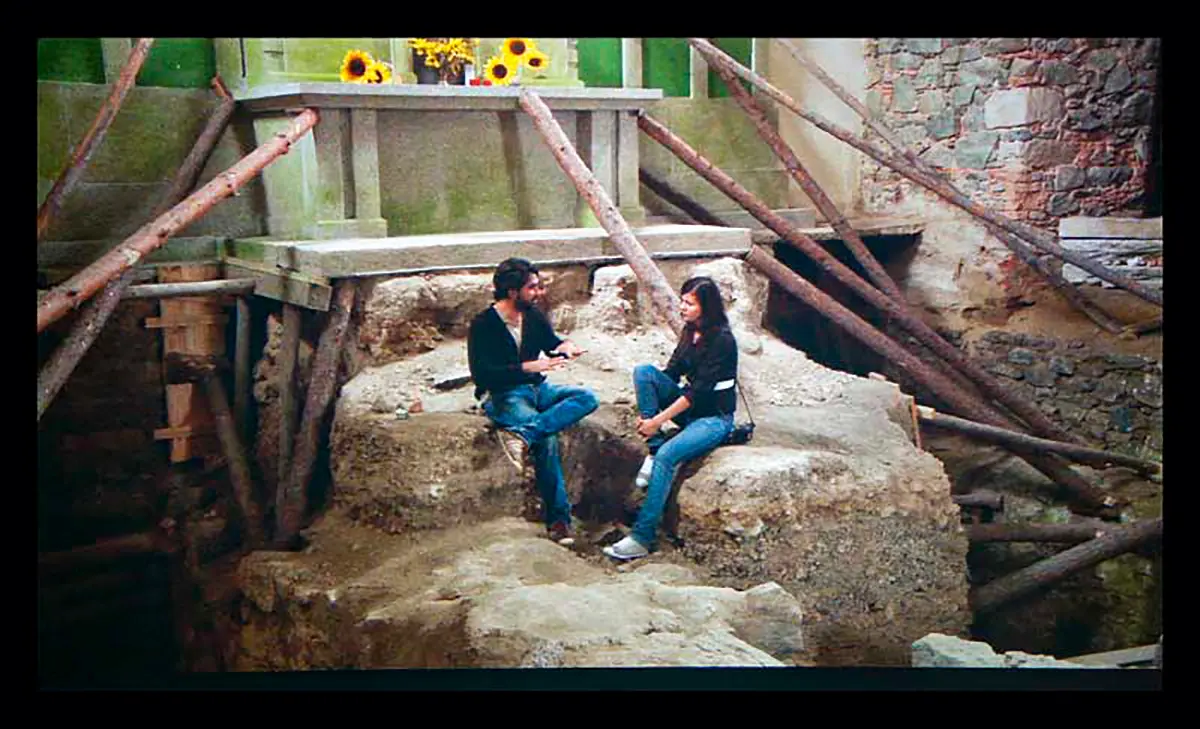
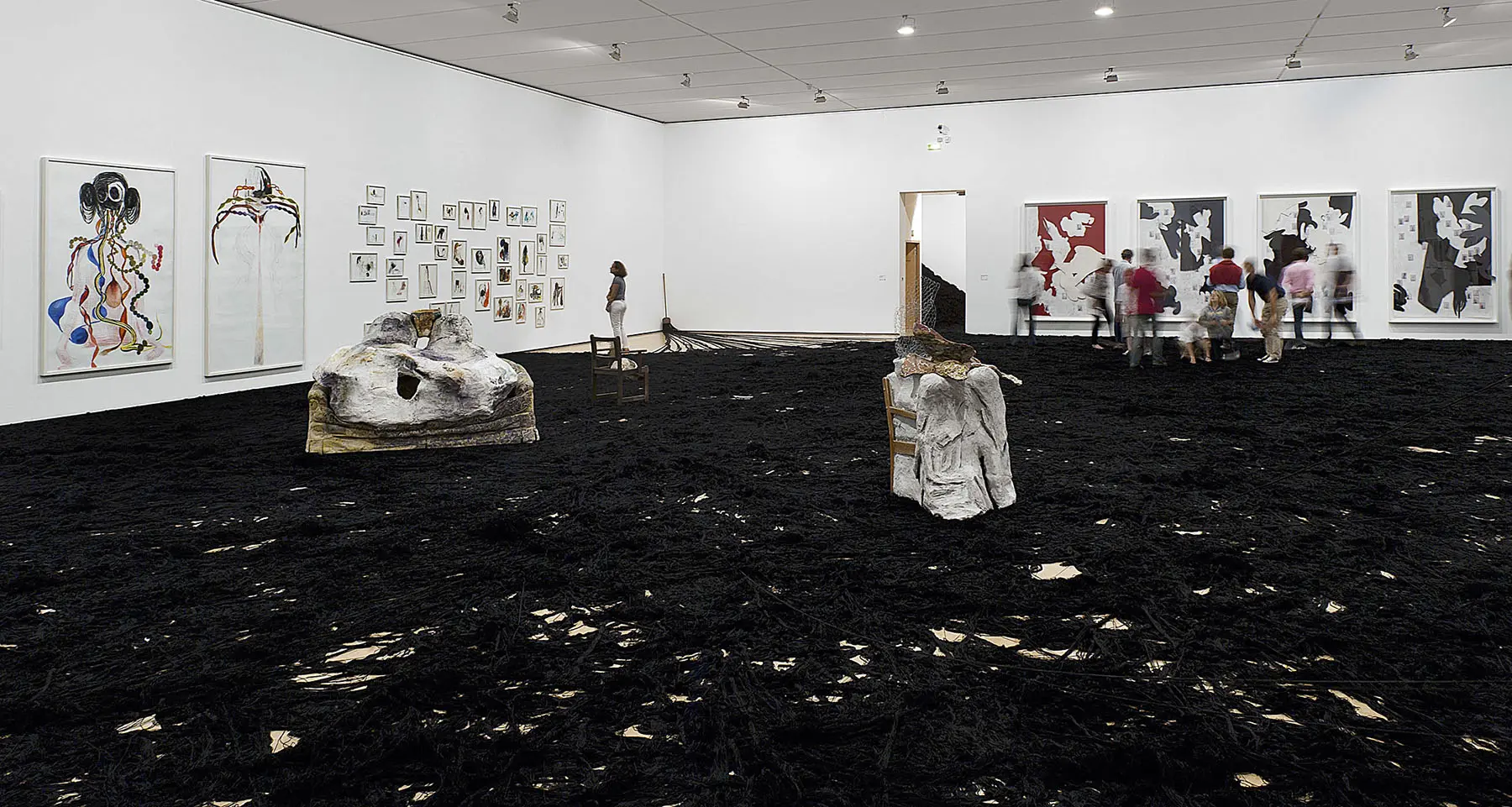
Even more impressive was A Bruxa, an installation conceived in 1979 by Cildo Meireles and executed in 1981 as an invasion of the three levels of the São Paulo Biennial’s main site with 2,500 km of black thread. For this Biennale, it became the unfolding in a big gallery at the Museum of Contemporary Art of 6,000 km of the thread of the same color, after a negotiation between the curator and the artist that resulted in some room left there for the exhibition of the work of other artists.
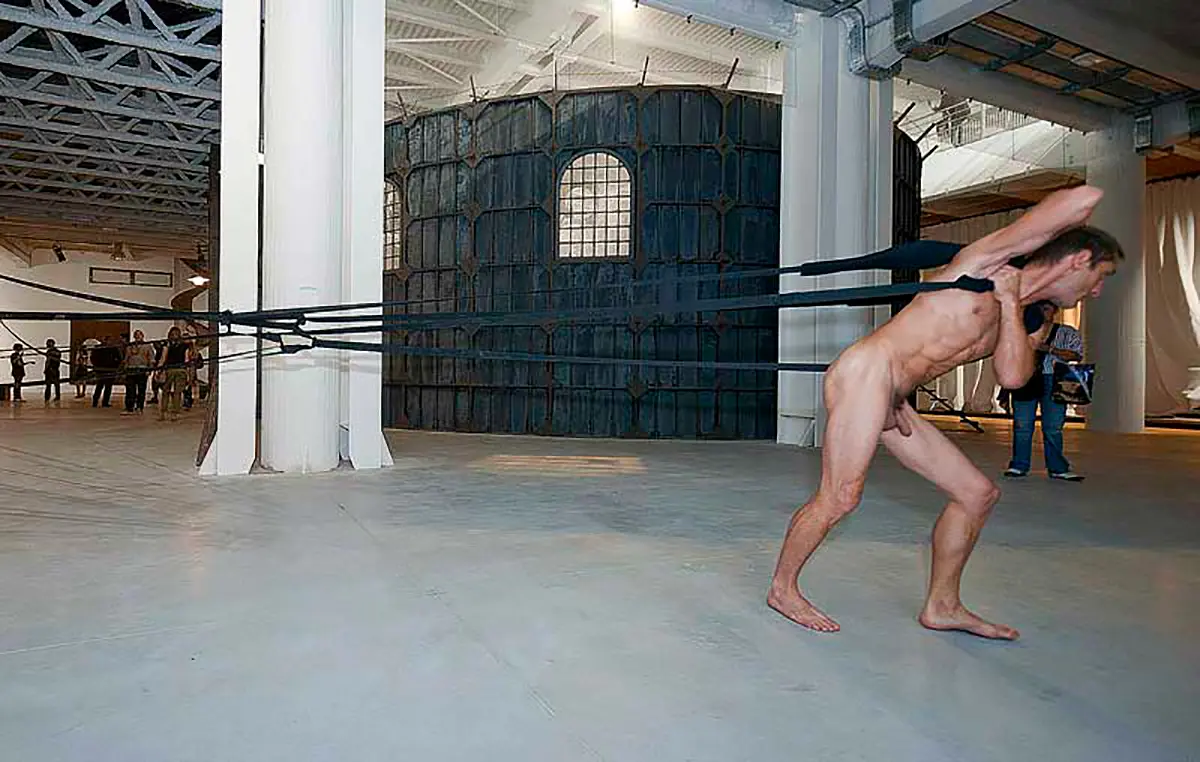
Brazilian artist Laura Lima presented a very original mixture of installation and performance in Puxador, at La Sucrière. It is part of her long-duration project Men=flesh/Women=flesh. If thanks to Cubism and to relativity space ceased to be an empty, inert container and became a field of forces in conflict, what Lima did was to propose a new image for this concept, through the figure of a nude athlete who, during the inauguration, pulled with all his might from a set of cables tied to different points of the space he occupied, thus threatening to break the dynamic equilibrium between weights and counterweights that keeps the architecture of the La Sucrière open. By the way, the same dynamic equilibrium was challenged by Argentinean artist Luciana Lamothe in a completely different way in Plan, attached to a wall of the Museum of Contemporary Art.
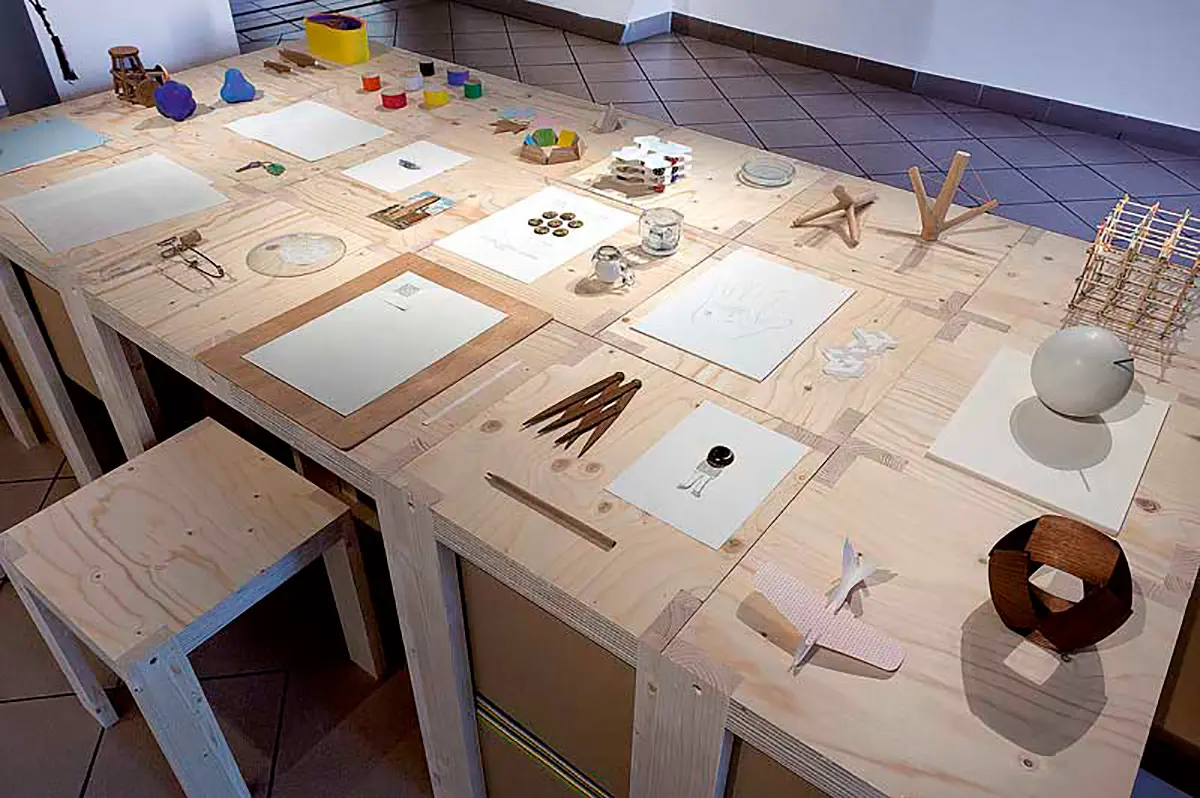
In this chapter—let’s call it “spatial”—we must note that Colombian artist Nicolás Paris was given singular relevance. At the Beaux-Arts palace housing the Bullukian Foundation, located in the city’s historic quarter, Paris’ work was exhibited alongside that of the two most important visionary architects of the Twentieth Century: Richard “Bucky” Fuller and Yona Friedman. And what was surprising was that the device of the table, drawings, and scaled models of Euclidian geometric volumes displayed by Paris worked well as a symbolic or topological pivot point between the work of the inventor of Geodesic Domes (Fuller) and the architect of the models for a versatile “moveable architecture”, Yona Friedman. (It bears mentioning also that this was Nicolás Paris’ European summer, with his important participation in the Venice Biennale and here in Lyon.)
Two concluding observations: First, a note about the works exhibited in this Biennale by Colombian artist François Bucher. He had two feature-length films that signal a point of inflection in his career, a deepening and radicalization of the commitment to audiovisual discourses that his previous work had already demonstrated, using mostly video as his support. These new films are, however, a greater challenge for the viewer. La nuit de l’homme, which puts in play mediums separated by oceans and continents yet with access to the same information about a secret hidden in the pyramids of Egypt, a secret that is at the same time the only possible antidote against the catastrophic end of the cosmic cycle that is to take place in 2012. To me—to be precise, what is left of my skeptic, rationalist education—Bucher’s spellbound docudrama sounds like the “return of the shamans” predicted in the 1960s by Louis Pawels and Jacques Bergier, with great audience success.
My issue with his second film, Chronique d’un film, is of a different nature. I share Bucher’s interest and, to a degree, his enthusiasm for Edgar Morin’s thought, and I think it is important for Bucher to have collaborated with Ayreen Anastas and Rene Gabri to revisit and reread Morin’s and Jean Rouch’s documentary on Palestine, Chronique d’un été, which won the Jury prize at the Cannes Film Festival in 1961. But I must confess that the six-hour length of Bucher’s et al. film defeated my patience and was more time than I could devote to it: I left after 50 or 55 minutes. My fault, I admit it.
I will end with a note about the title chosen by Victoria Noorthroon for this edition of the Lyon Biennale. A Terrible Beauty is Born is a verse from the poem that Irish poet W. B. Yeats wrote to commemorate the uprising against the British occupation of Ireland on Easter Monday, 1916, amidst the Great War. It is a significant choice, as we are ourselves in the midst of what Giorgio Agamben has called a “planetary civil war”.
*All images illustrating this article are Copyright: Blaise Adilon.
CARLOS JIMÉNEZ
Writer and art critic. Professor at Madrid’s Universidad Europea. http://elartedehusmeardecarlosjimenez.blogspot.com/