
The works in the exhibition titled Desvios (Diversions), from the Social Hieroglyphic series by Ana María Tavares, reveal forms of modern architecture through baroque strategies. Viewers are asked to participate by lifting with their hands—or with their imagination—the cloaks that cover the objects.
I will approach this review in parts. There is a game of opposites—and opposites attract—between a gold-plated baroque altar and the white wall of a modern building. The point of encounter is that both are theaters. While the former is exhibited as a pure ornament—as it serves no function—the latter aims at being a function stripped of any ornamentation. Thus, both of them end up enclosed and separated from other mundane objects in which ornament and function are not separated—tiles, for instance, do not cease to narrate stories through their drawings just because they are able to contain water; or columns do not have to be devoid of their volutes just because they serve the function of supporting ceilings.
While baroque promoted ornamentation, modernity promotes function. Or the theater of function; a theater that is even more interspersed than baroque. While baroque manifested its scheme purely on the surface, the modern 20th century kept its schemes hidden.
The first group of works consists of four panels arranged on the floor and that also rests against the walls of the space. In the shape of horizontal rectangles, like modern windows, they have sliding panels that must be opened by the viewers. But these panels—made of steel grid—work in a strange manner because they do not lead—like a window would—to the exterior, to an outside world, when they are slid open. Instead, they open into another interior, the inside of an object; into a world within the wall.
In two of the pieces, entitled Calypso and Comodoro (Commodore), the sliding panels are duplicated in such a way that viewers must slide, not one, but two layers to unveil the thing hidden inside: a printed surface with shapes of tubes, stairs, and floors. Nonetheless, this surface confuses things more than it clarifies them, as the drawings look more like architectural plans than labyrinths. They serve as hieroglyphs whose codes are folded in on themselves very much in the baroque style so as to reveal their artifice.
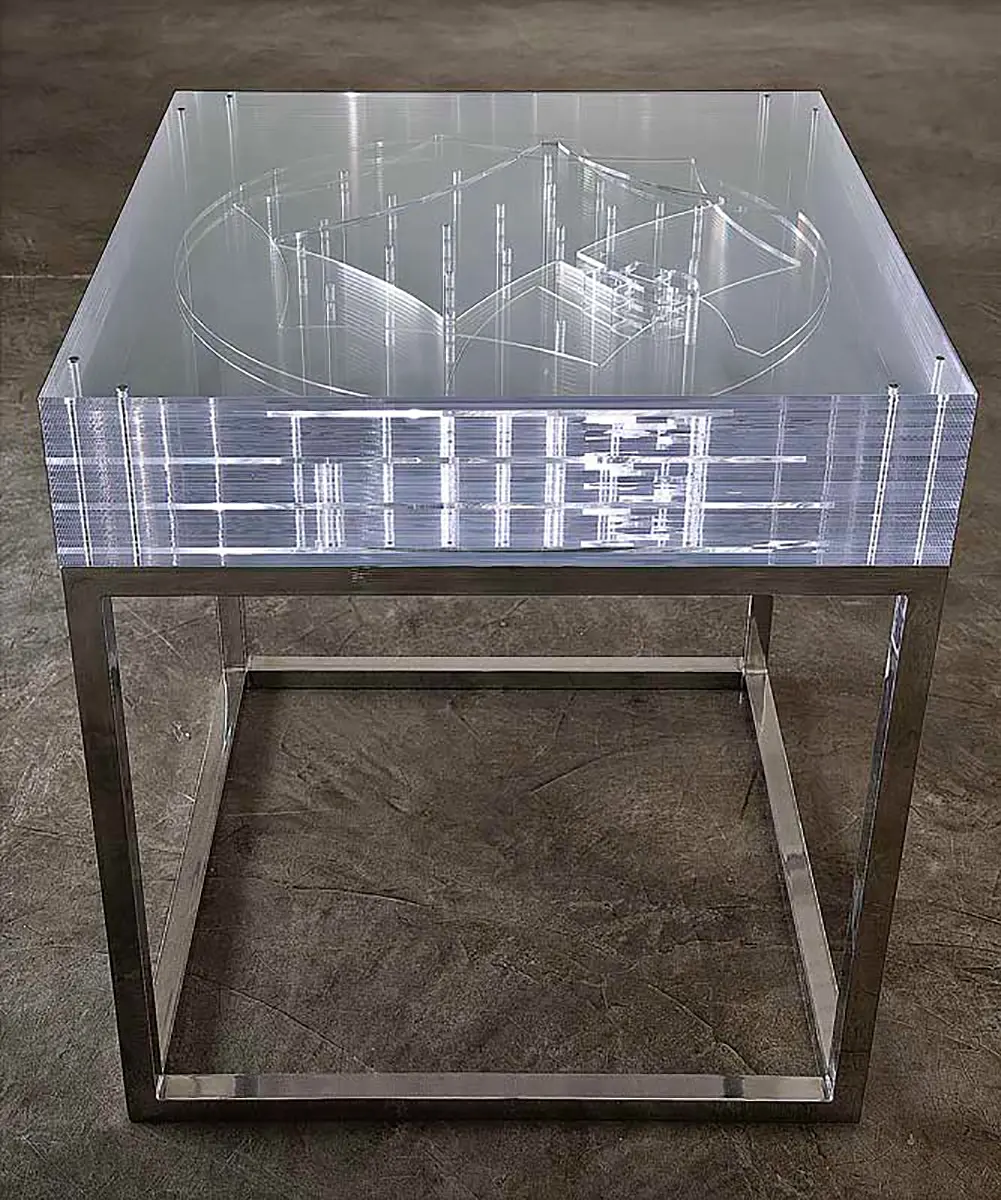
The multifaceted fifth piece in the exhibition continues with the same game. Entitled Mesa Oca (Hollow Table), it was inspired in the Oca1 building designed by Oscar Niemeyer in 1951. The piece consists of a base formed by steel parallels and 26 superimposed glass sheets (methacrylate). Measuring an area of 27.60 × 27.60 inches that is 0.4 inches thick, these sheets are arranged “one after another” just like Donald Judd liked. The problem is when we attempt to tell them apart.
So we have an object that appears to be compact—until we have the chance to ascertain its depth—but also fragmented by these sheets that must be eventually taken away, lifted, no longer with the hands—as it occurred with previous works—but with the imagination; namely the ability to reduce three-dimensional volumes into images.
Once the object has been captured in the mind, the imagination begins to work; it separates and organizes the sheets like a regular mosaic formed by several images. Nonetheless, and just when the real work begins, those parts are not willing to let anybody separate them because the borders between the sheets are not that clear any longer.
The interior of Neimeyer’s building appears before us. Shapes that resemble columns, floors, and stairs float over the glass as if they were levitating. They were built with the remnants of the materials; anything that was recovered after the glass was subjected to laser cutting. So, in the same manner, that sculptor chips away pieces of stone to form an arm, Ana Tavares extracts material to obtain a form but follows the opposite process, as she works from the inside out of the glass. This is possible because she works with sheets that have left behind their function as plans and have turned into a solid; or more precisely, the mirage of a solid.
The dialogue with Neimeyer—who dislikes solids—is intense. Returning to the theme of the Oca building: first conceived as a planetarium, its subtlety centers in that it is a dome that does not need a base. Thus, the structure does not rest on any columns but is kept elevated by a steel framework that is so strong that it is also autonomous. This is the reason why the structure appears to be weightless as if instead of being built over its location, it had landed on the Ibirapuera Park, where it remains until today. The paradox of the work is that it is precisely the steel frame—a symbol of weight—that confers the work the effect of being weightless.
Although the columns were already mentioned, the levels and stairs are contained inside the dome, they are independent for at no point are they part of the structure. This allows for an interaction that is as incredible as it is modern. Without any kind of ornament, the dome never touches the ground. Originally created to be functional, now it lacks any functionality and its sole reason for existing is to levitate over the ground.
Ana Tavares confronts the Oca, she builds it: the circles in the subsoil, one level, then another; and when she finishes the entire interior, she leaves it to viewers to complete it. In other words, viewers are left with the task of raising the dome. In adding everything that is available as they move forward through the structure, viewers begin to generate it by themselves: the borders and columns behave like coordinates; they become the instructions of the game.
This is the way in which viewers interact with the work: they construct it, see it appearing in the interior of the volume, observe it as it is elevated without the need for supports. But then it dissolves into thin air as soon as they managed to complete it because it turns out that everything was in their heads, not in the glass object.
Thus, the imaginary dome follows down to the last letter the quote by Marx that Berman used as a title: “All that is solid vanishes into thin air.” It is just that in this case, the opposite is true, as the air here—the idea—is represented by the dome that does not need support. Here something vanishes into the solid, into the thickness of the object, into the matter of the world. A world that is not created for ideas and where, as a result, solids cannot float—as modern architecture would have us believe: from Luis Barragán to Vilanova Artigas, Villanueva and his association with Calder (remember the auditorium), and even Oscar Niemeyer himself.
NOTE
1. It is important to point out that OCA means “hollow” in Portuguese. Therefore, the building is known for its popular name and not for its official one: Lucas Nogueira-Garcez Pavilion.
JULIA BUENAVENTURA