
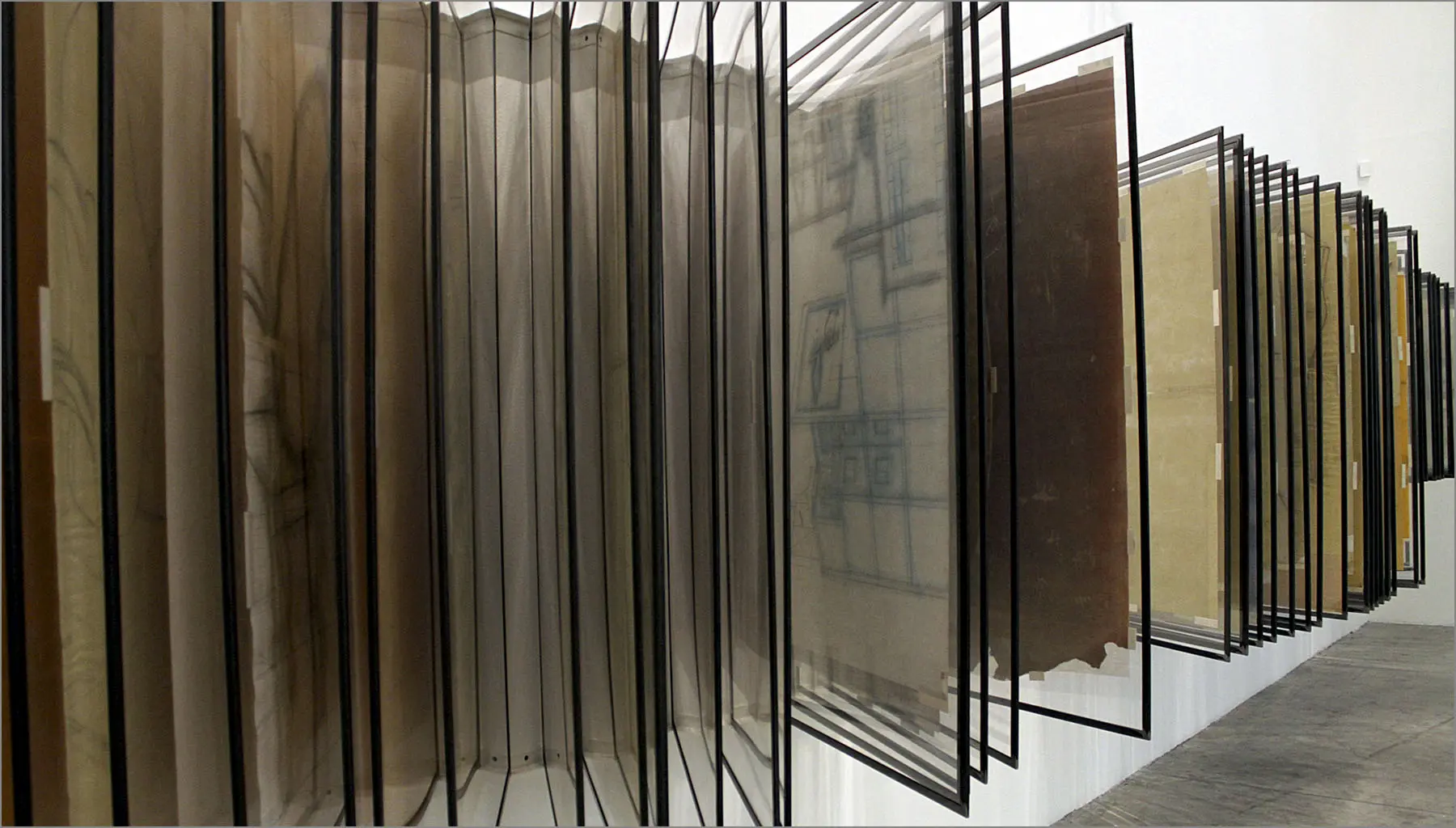
In 1994, two young artists, Daniel Guzmán and Luis Felipe Ortega, collaborated to create something whose strategy for action would become the essential narrative to understand the art of the 1990s in Mexico. Playfully and following open parameters, they produce an interpretation of classic 1970s performance works by artists like Bruce Nauman and Paul McCarthy. Although they titled their work REMAKE, in truth it was closer to a reinterpretation, since neither of them had traveled to New York or to other great art centers, and all their information was collected from the frozen stills found in the few contemporary art books that reached Mexican libraries. In their unfamiliarity with the live performance event, they invented a new course of action, rendering it, through their playfulness, a kind of cannibalization of the artistic object.
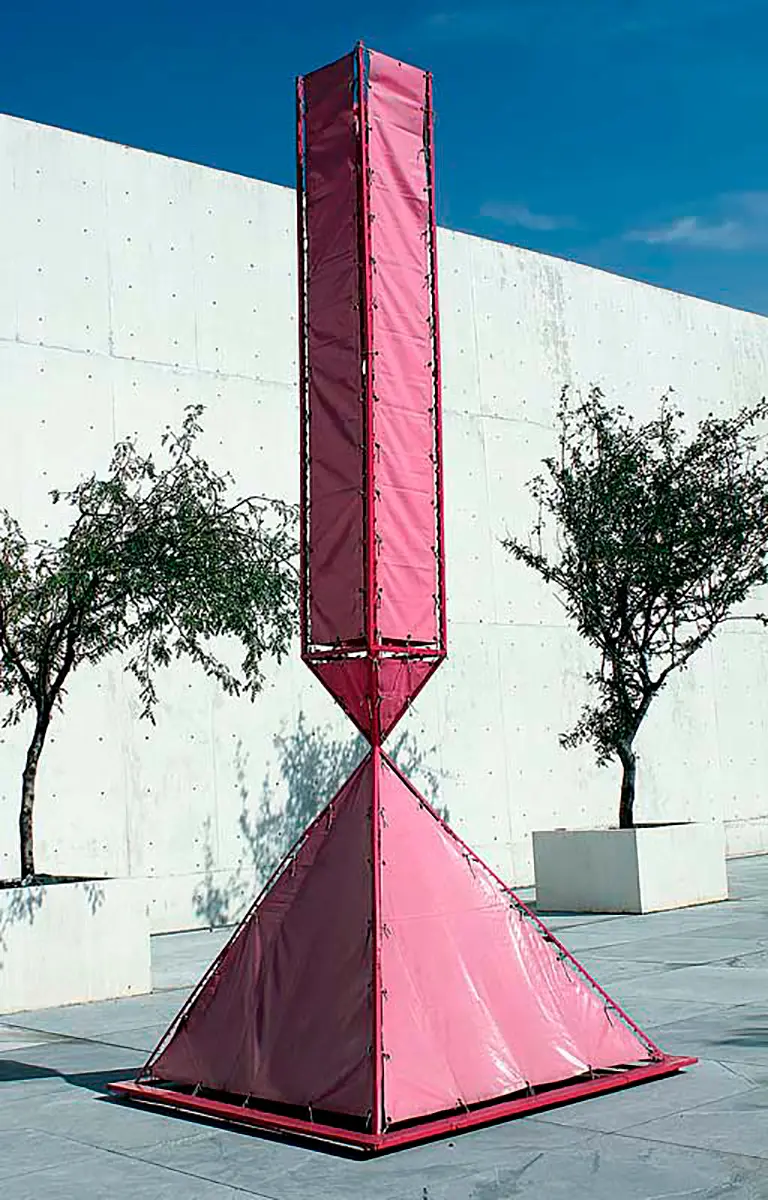
A year before, artist Eduardo Abaroa had also produced a sculpture remake of an important Barnett Newman work (Broken Obelisk, 1967), where, in an impossible action, the tip of an inverted Egyptian obelisk rested at the cusp of a pyramid. Abaroa’s 1993 traveling installation Portable Broken Obelisk (for outdoor markets) reproduced Newman’s sculpture to scale, but with a radical shift in materials: instead of steel, it has a moving metal structure covered in pink plastic. As the title announced, this work was to be mounted alongside a market on wheels. It no longer was the “sublime” monument imagined by Newman, but a semi-camouflaged presence that adopted the nomadic principle of Mexico City’s ambulatory markets. There was, however, a distant yet metaphorical equivalence between the two, saving contexts and historical events. The Menil family had supported in 1969 the installation of a version of Newman’s Broken Obelisk in Houston, as a tribute to Martin Luther King. Although the sculpture had not been created with that purpose, the truncated obelisk appeared as a sad premonition of the future of the American dream. In 1963, King had pronounced his mythical I have a dream… speech in front of the great Lincoln Memorial obelisk, in the US capital. He was murdered in 1968, taking with him the hopes and will to change of an entire generation. Abaroa’s obelisk, at a different scale and without the intention of making exact comparisons, also spoke of dreams and hopes suffocated under modernity that had failed but retained its capacity for reinvention.
Sol Henaro, Collection Curator at the MUAC, gave the title of Antes de la resaca to this attempt to reformulate, through a selection of works from the collection, the preoccupations that shaped the conceptual apparatus of Mexican art in the 1990s. Despite the importance of individual figures and the acclaim received by most artists included in the show, one of its premises was to permeate (with a note of the difficulties presented by the white cube, emblem of such a quintessential institution as the MUAC), the collective environment, the distended and underground action, as well as the points of reference that nurtured one of the most intensely effervescent moments of recent years.
While the appropriation of and reference to Anglo-American conceptual and post-minimalist art of the 1960s and 1970s emerges as a formal reference and leitmotif in many of the works shown, some of the actions carried out at the time expressed, in their ephemeral and clandestine condition, the legacy of the work processes evolved in Mexico by various activist artist’s collectives after 1968, such as No Grupo and Proceso Pentágono. The new cohort absorbed what it found, learned from the past, and established new contextual parameters that gave their production a different political and social meaning. More than coming together as collectives, these artists formed workgroups that established platforms for reflection through shared teaching, as well as a permanent critique of forms of doing. Given the urgency of exhibiting and the impossibility of doing so in institutional spaces, they opened new work sites, appropriated spaces that had no artistic avocation, and interfered with the everyday life of citizens with actions, events, parodies, bringing art into other spheres without regard for possible repercussions. In general, none of these platforms posited a commercial strategy; rather, they existed as “social centers” of a kind.
Three spaces function as an axis for the show: La Quiñonera (1986-1992), Temístocles 44 (1993-95), and La Panadería (1994-2002). Although the exhibition does not attempt to restage or relate what took place in a documentary fashion, it does recreate the synergy that drove their workings through reference materials, publications, and other discursive tools. Three platforms with very different outputs, yet sharing a drive to experiment on the basis of dialog and circumstantial events, undoubtedly the incubators for the majority of artists included in the exhibition. Thus, rather than engaging with a precise and unilateral set of topics, the twenty-five artists represented here point towards the disparity of the positions evolved in a shared environment.
Alongside this experimentalism and what was learned from conceptual art coming from abroad, the alarming political events of the time, such as the economic crash of 1994, helped trigger a series of works that delineate the authentic context of Mexican art. It is clear that these artists were turning away from an official cultural policy that up to that point had flowed towards national edification and symbols of identity, avoiding any critique of the system of government through a variety of methodologies. On the one hand, there was a discovery of Mexico City’s megalopolis and its economic and political idiosyncrasies, represented through everyday occurrences that shunned grandiloquent symbols or critiqued their excessive use. Francis Alÿs’ The liar, the copy of the liar (1991) is part of a series that represents a kind of deriveur, through urban hikes where casualness and repetitiveness illustrated the reality at hand. For this series, Alÿs selected quasi-literary stock characters such as the liar, the seducer, or the navigator, related to discovery and adventure but above all to the possibility of survival. His methods indirectly explored the absurd and the unique characteristics of a given territory and culture, establishing a series of actions that highlighted, in their own coming to pass, the hilarious but fruitful workings of Mexico City’s underground economy.
Melanie Smith also focused directly on Mexico City. Her encounter with it, since her arrival in 1989, had proven far from the idyllic panorama proposed by tradition and folklore; rather, it was the brusque discovery of a city that had become an overwhelmed maquiladora-type sweatshop, synonymous with a process of contrived industrialization. Stripped of national symbols, she transformed herself into an archeologist of the future, described as such by Olivier Debroise in La Era de la Discrepancia: Arte y Cultura Visual en México, 1968-1997 (Editorial Turner, 2007), through found objects that she put to work into semi-abstract assemblages.
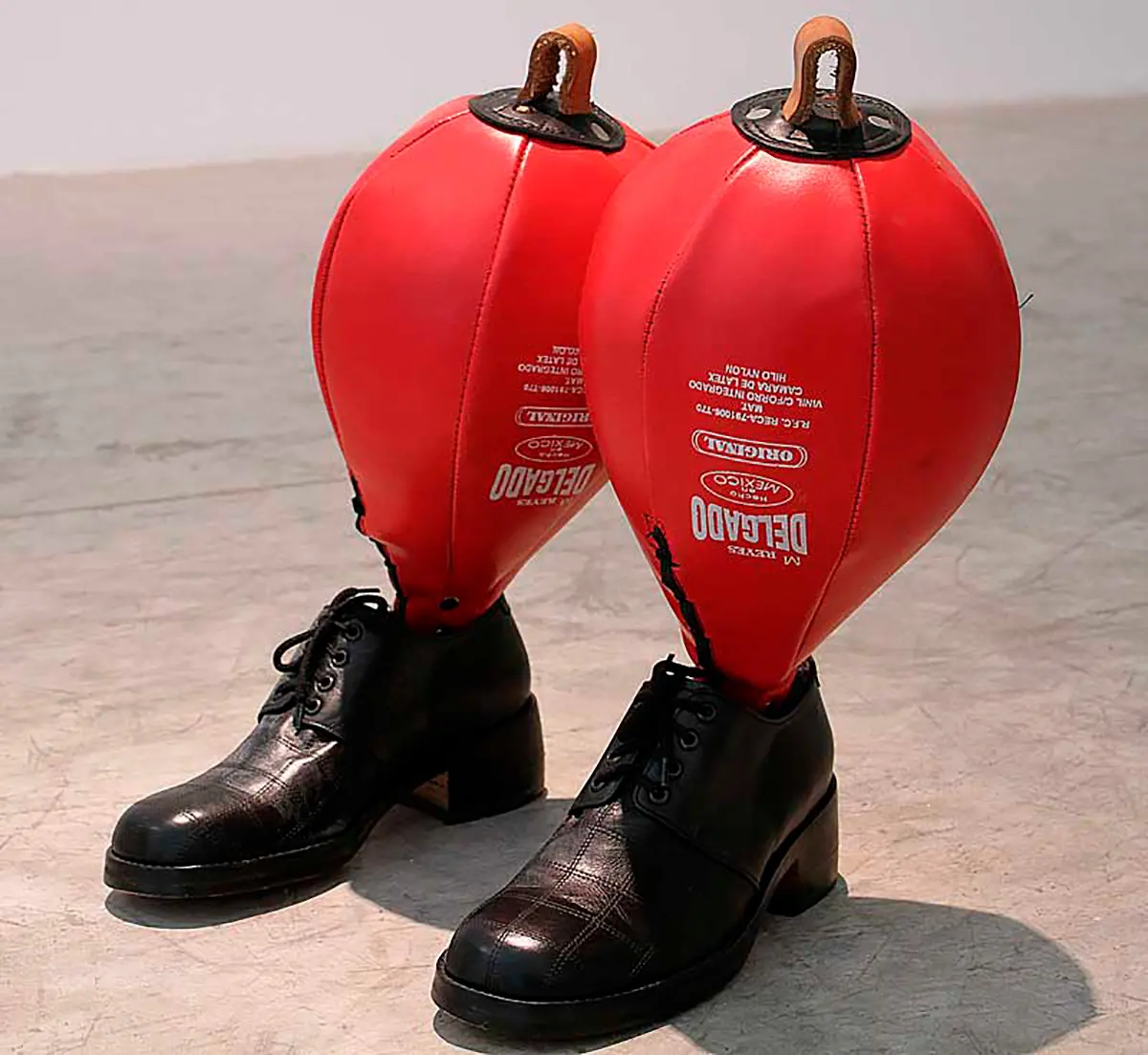
Smith’s found object was a way to problematize, through every day of the city, the boastful glories of a dubious past. In the case of Gabriel Orozco and the disciples that followed in his wake, such found objects had to do more with an abstract frugality that avoided the interference of explicit ideas and statements about the political and social situation, as they were implicit in the very materiality of the object and its disrupted use.
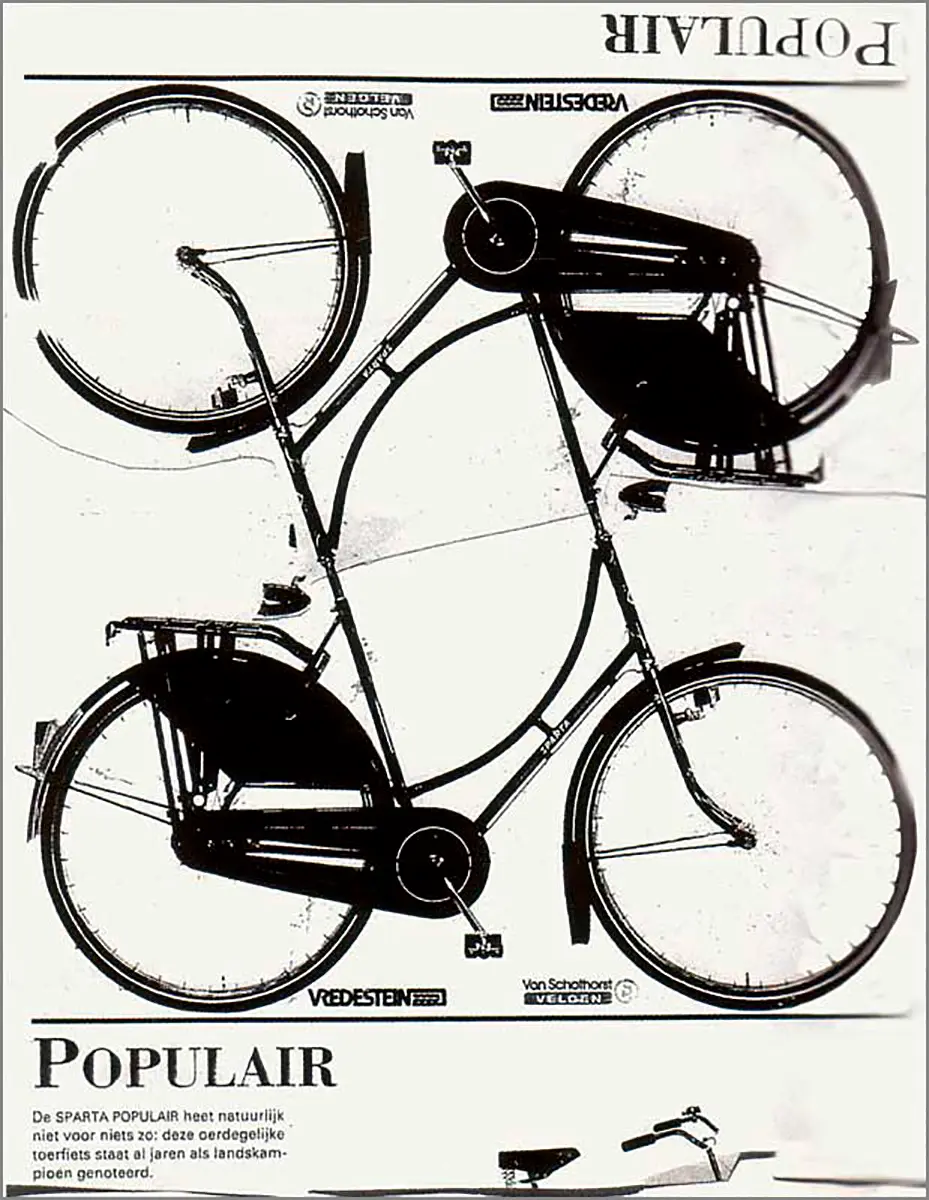
The idea of problematizing national symbols and their Manichean use on the part of the government also animated the work of Rubén Ortiz Torres, one of the first artists to disengage from the search for identity that had so occupied the discussion in Mexico, and in general across Latin America, in the 1990s—a discussion that was centered on diasporic and forced-migration processes—to focus on a new discourse derived from economic neo-liberalism and the loss of a center provoked by globalization. A kind of committed art that militated between aesthetic object and satirical critique, almost always focalized on the distorted image of Mexico that the State apparatus insisted on constructing, particularly facing the United States.
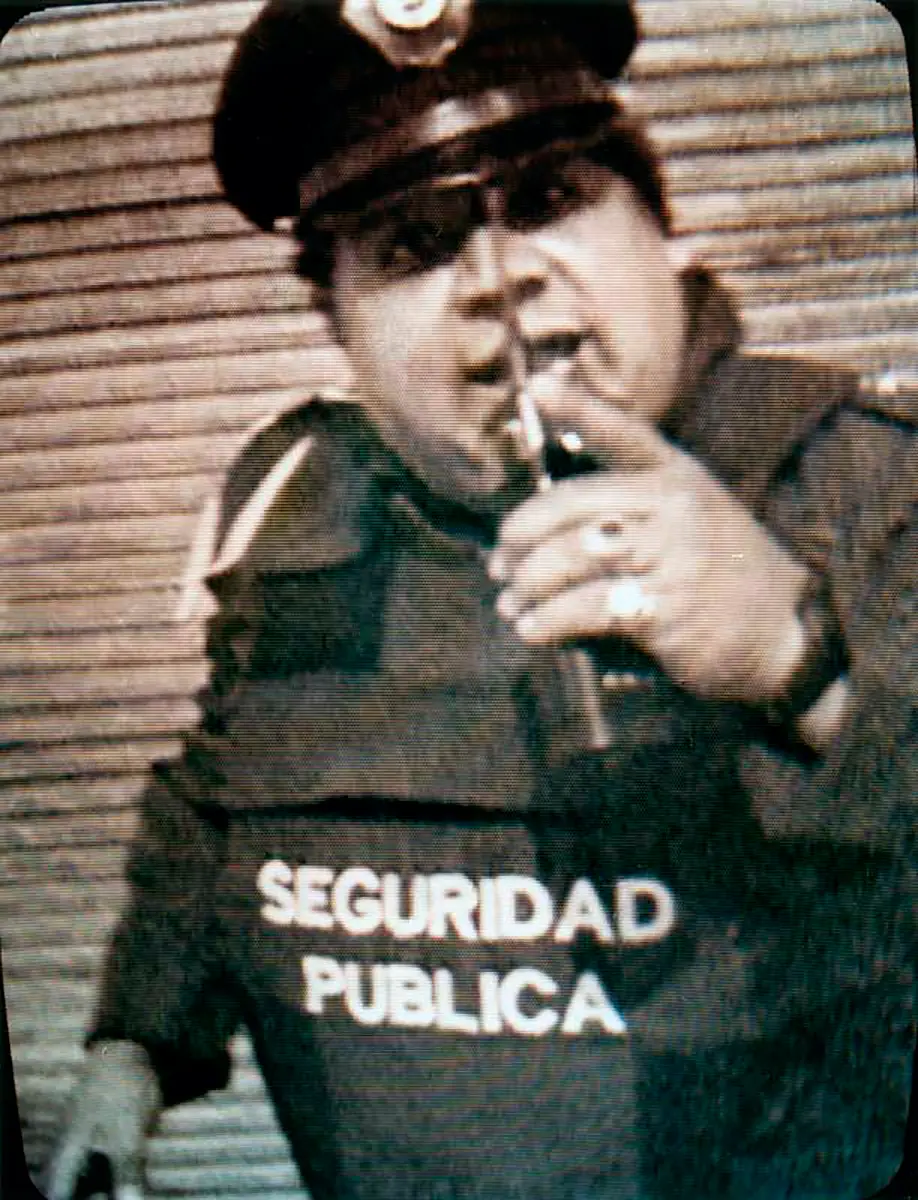
Satire as an argument to problematize Mexico’s degraded social landscape, as well as the extreme fragility and the hilarious situation of power represented in its official media, is also present in one of the show’s most eloquent works, Yoshua Okón’s Oríllese a la orilla (1999-2000): A series of videos, manipulated to various degrees by the artist, showing police playing the nefarious role of guns-for-hire and establishing themselves as society’s anti-heroes.
In turn, SEMEFO attempted in his performances to understand Mexico’s social degradation beyond a comical or satirical function, carrying it into a historical plane and highlighting the status of violence in contemporary Mexican society in the political, social, ethical, and even cultural realms. In their Larvarium (1992), a wooden coffin appears upside down, closed by several chains, like just another object that was part of our lives’ collective imagination. Undoubtedly inspired by the aesthetic of Viennese action-art, of Joseph Beuys or Gina Pane, SEMEFO sought to subvert the canon of representation in Western art through a variety of means, and especially in radically different contexts.
Titling this show Antes de la resaca seems particularly accurate if one understands the context of the 1990s as the golden age of what many consider the “boom” era of Mexican art. It is clear that later cohorts were not compelled by the need to create workspaces, having learned the methods and exhibition circuits implied in contemporary art in detriment of experimentation and dialog.
In recent years, a large number of art galleries have emerged as the main spaces of the exhibition for young artists. The fact that the show ends in 2005, the year of Mexico at ARCO (Spain’s contemporary art fair), is not a coincidence. While in previous years artistic practice had been deeply influenced by political and social debacles, now commercial events became fodder for production and scaffold for visibility. Yet, and despite risk having been substituted by comfort, Mexico’s inefficient cultural policies soon enough overtook all the new discourses generated in the 1990s. Above all, because many of these artists began to be widely recognized and collected at the international level. I believe that this has spurred many young artists to work on the basis of new references, once again questioning the past and the construction of history on the one hand, and the mechanisms of the city (no longer interested in its idiosyncrasies as the result of a failed modernity, however, but in the way in which Mexico has adapted to the global process). This is a type of art that reformulates the idea of the historical archive and the explanation of history from alternative perspectives, deploying strategies of micro-history in order to juxtapose and thread “personal theories” capable of achieving an echo in the Mexican public sphere. Perhaps this is a moment for reflection, after the whole resaca (hangover).
RUTH ESTÉVEZ