
Asco, the Chicanoconceptual artists’ collective (its primary members Harry Gamboa Jr., Gronk, Willie Herrón III, and Patssi Valdez), first exhibited at the Los Angeles County Museum of Artunofficially in 1972, when the artists tagged their names on the museum’s façade. This was their response to Gamboa’s questioning a curator about the omission of Chicano art at the museum and being told that Chicanos “don’t make fine art, they only make folk art or are in gangs. Spray Paint LACMA (or Project Pie in De/Face), 1972, the documentary photograph of Valdez posing near the short-lived graffiti, is one of more than 150 works on view at LACMA as part of“Asco: Elite of the Obscure, A Retrospective, 1972-1987.” The works on view are mostly hung at eye level on white walls or are mounted in pristine display cases. The exhibition is carefully organized, extremely thorough, and quite academic, thus inverting the logic of the guerrilla tactics often used by Asco.
The exhibition opens with the collective’s formation and early collaborations. A vitrine contains documentation from Caca-Roaches Have No Friends, 1969, the outrageous performance piece composed by Gronk and enacted by Valdez, as well as Cyclona (Robert Legoretta) and (Ed)Mundo Meza. It was through this piece that Gamboa, Gronk, Herrón, and Valdez all garnered one another’s attention, although they knew each other casually as students at East L.A.’s Garfield High School. By 1972the four began to collaborate, first producing artwork side-by-side for the Chicano publication Regeneración, at the request of the editor Gamboa. The artists were associated with the Chicano Jetter (pachuco meets punk) counterculture and their irreverent attitude translated to their work, which was ultimately responsible for earning the collective their name, Asco, which translates to disgust.
Gronk’sdiptych of disfigured bodies, The Truth about the Terror in Chile, 1973, hangs on the wall alongside photographs of Asco’s performance First Supper (After a Major Riot), 1974, which featured one of the paintings. The terror in Chile under Augusto Pinochet was compared to the violence imposed on the Chicano community. During their performance, Asco (with Humberto Sandoval), flamboyantly costumed and adorned with heavy make-up, occupied the median of Whittier Boulevard and enacted a meal. Through their “first supper” the artists symbolically reclaimed the very site where the riot police had struck during the 1970 Chicano Moratorium. The photographs further reveal the artists’ homespun aesthetic with costumes and props made from inexpensive and found material invoking the religious and Day of the Dead iconography. Costuming, as seen here, allowed the artists to assume different identities and confront Chicago stereotypes.
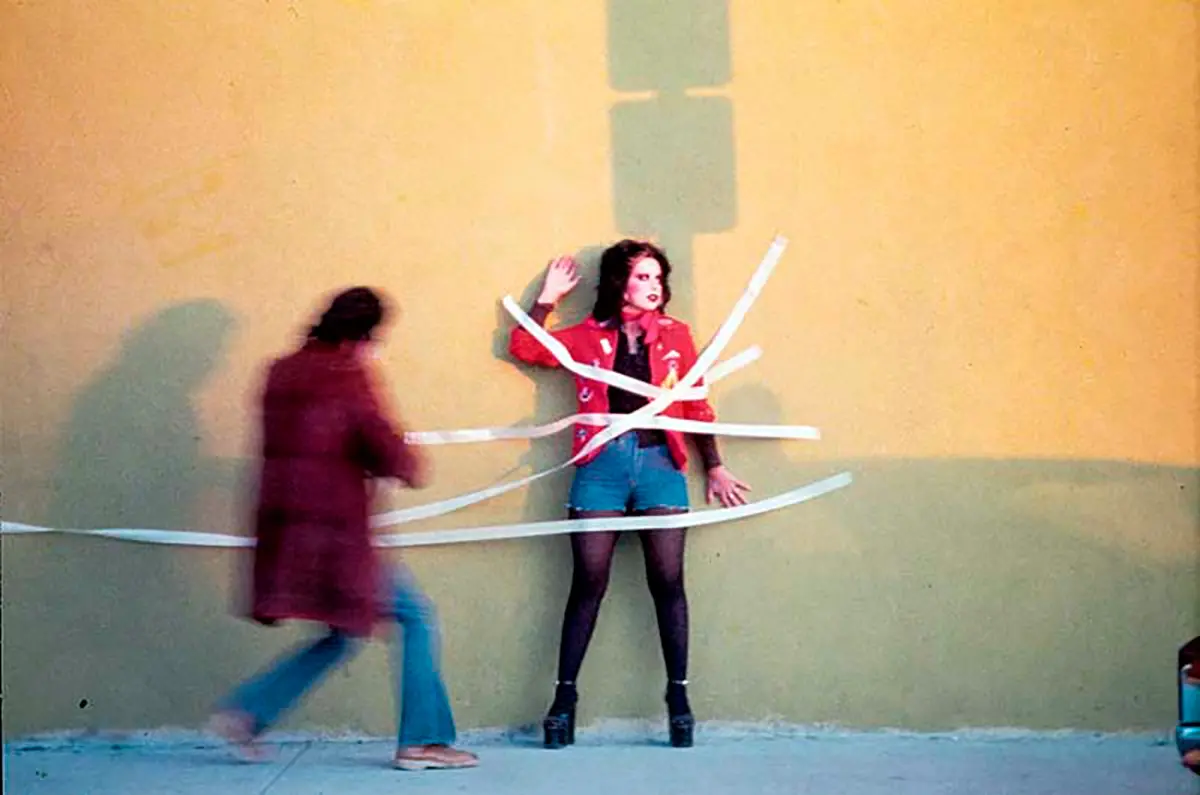
Asco’s urban interventions are then emphasized. As evidenced in First Supper, the artists took their practice to the streets, which at the time were under constant police surveillance. For their interventions the artists merged activist, conceptual, and performative actions, adapting and transforming the practices of graffiti and muralism. Documentary photographs line the gallery walls including Instant Mural,1974, when Gronk taped Valdez and Sandovalto the exterior façade of a liquor store on a busy street to critique the expected painting format and its affiliated iconography. In Decoy Gang War Victim, 1974, Gronklay in the middle of the street surrounded by flares, simulating the aftermath of a gang shooting. Asco staged the photograph when they learned of a planned gang altercation. They then circulated it to the local media as evidence of the event with the hope of dissuading the violent act from occurring.
Next featured are No Movies, Asco’sinvented medium of non-celluloid “film stills,” ironically distributed as proof of a thriving Chicano cinema. The No Movies stemmed from Asco’s simultaneous fascination and repulsion with Hollywood. Chicano Cinema, 1976, shows the victim of a gunshot wound, holding a gun, in a bloodied white tank top, slumped in the corner of a room. The words "Chicano Cinema" are painted on the wall dripping to emulate the blood. The victim seen in the No Movie is compared to Chicano Cinema, as each struggle for survival. The No Movies are exhibited along with related ephemera, including a No MovieAward, a plaster cobra painted gold, the cobra referencing the East L.A. gang.
The exhibition continues by exploring Asco’s“expanded collections and networks,” highlighting Gronk’s collaborations with Jerry DrevaandTeddy Sandoval. In the adjoining gallery, a film clip is projected on the wall of Death of Fashion,1981, the four artists’ final performance together. HereAscopainted a mural on the façade of Self-Help Graphics and burnt life-size paper figures as a metaphor for Chicano history starting anew. For the exhibition, Gronk reproduced the paper figures. The exhibition ends with examples of work from the eighties when Asco became fragmented as a collective and more professionalized as individual artists. Asco officially disbanded in 1987.
BETH ROSENBLUM