
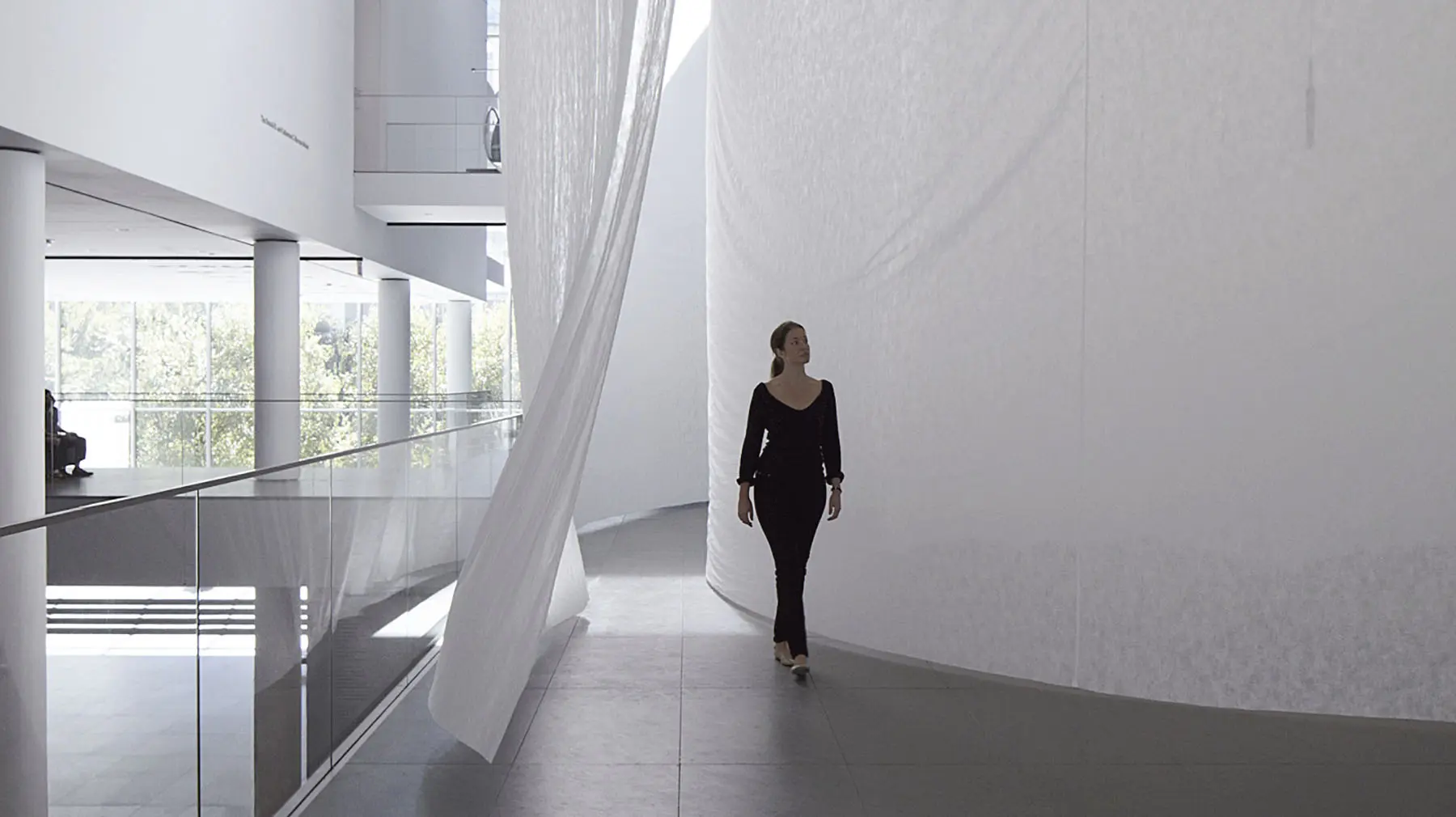
There are many contexts to evaluate Carlito Carvalhosa’s Sum of Days, and they are important because this is not only his first appearance in the USA but also one of the first Latin American artists to occupy the honorific, if problematic, center space of New York’s Museum of Modern Art. And while one may object to raising the issue of “Latin” as a special category separate from a worldwide integration, critical conversations must speak of both similarities and differences. Indeed, one of the most important conversations has been nationalism, or the lack of it, in the critical commentary surrounding his installation.
The six-story atrium of MoMA has presented almost insurmountable problems for curators and installations since its opening in 2004. Most works are dwarfed, some say “crushed,” by a scale that many have called more appropriate to cathedrals of late corporate capitalism than to art. But Sum of Days is one of the few successes on several levels. It matches the scale as the translucent white draperies rise the full 20 meters up before cascading down to form the elliptical labyrinth passages for people on the floor. Symbolically their organicism counters the rectilinear minimalist aesthetic that stands as a symbol of MoMA’s dedication to the rectilinearity of the modernist machine aesthetic. The diaphanous curvilinear forms of the light, translucent folds move gently in the wind as an apparent foil to the stiff minimalist grid and serve as a reminder of Carvalhosa’s ongoing concern with nature and his own strong sense of “spirituality”—a favorite word of his—to construct a temporary and temporal counter-cathedral. Indeed, counter-narratives seem to be at the heart of his aesthetic.
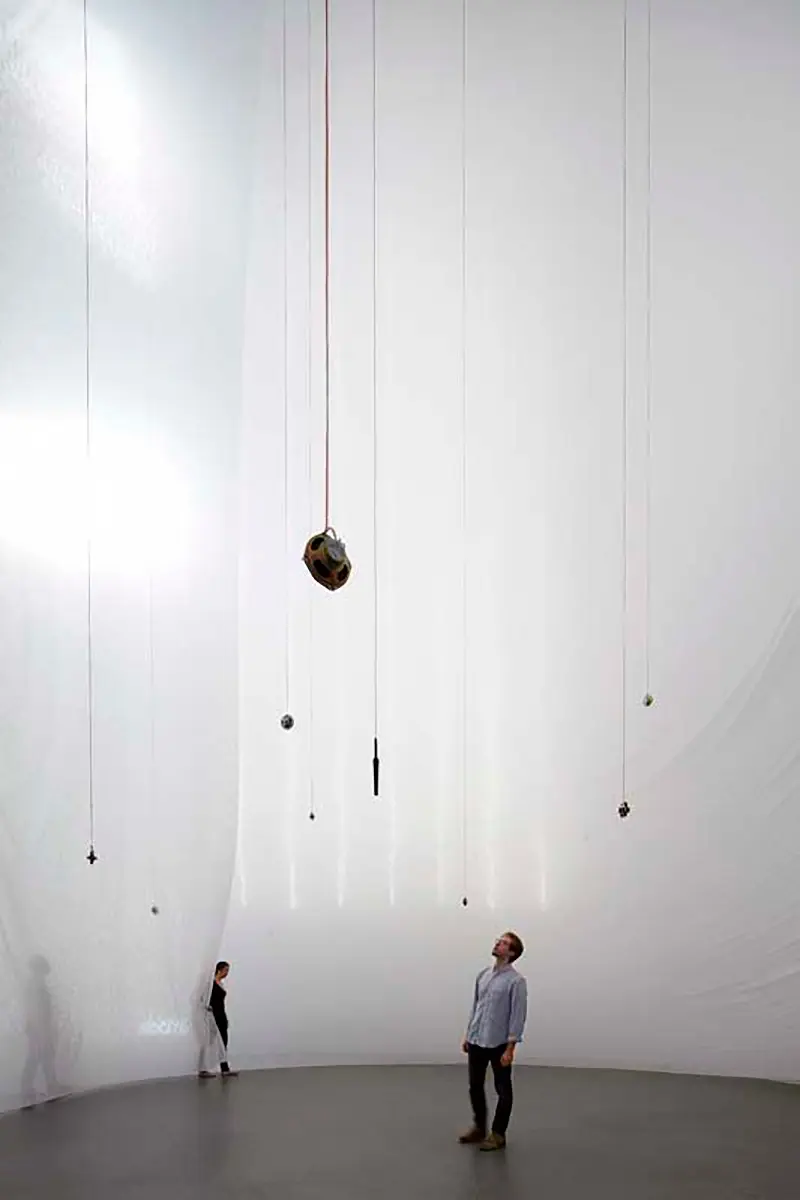
The use of large-scale diaphanous scrim cloths and the use of diffused natural light and the fluorescent tubes present here, mounted on the vertical walls outside the ellipse, are elements in his earlier work. Their combination has led to the most common interpretation of his central concern as displacement, of both architecture and people. To some extent, such a reading is reinforced here via his continued concern of architectonic forms, no matter how pliable and immaterial, and the ways in which the bodies of the spectators working through the passages in and out of the labyrinth are both close to you yet rendered indistinct by seeing their traces through the cloth. Then, too, when you arrive at the supposed heart of the spiral you find a vacant space, one only occasionally occupied by musicians from Philip Glass’s entourage. But at those times the spectator is kept outside the enclosure so the “performer” disappears, somewhat to the acquiescent chagrin of the famous minimalist composer Mr. Glass, obviously a friend of the artist. Rather you are left with unembodied performance and music and the beginning of a counter-spiral that exits you back into the real world. These factors certainly reinforce the concept of absence. So why does the artist insist the issue is not displacement but “meaning?”
The clue is in the other displacement that lends itself more directly than the draperies to the title. Sum of Days refers most apparently to the accumulated audio recordings made from the spectator’s voices and ambient noises as they wend their way through the murky maze which allows partial, localized glimpses but no sense of totality. As each day’s interactions and events record on top the previous days, the past is overwritten and fades, merging into the newly present, with the summation functioning as a major metaphor for Carvalhosa’s esthetic: not only the passage of time, with all its concomitant associations such as memory and vanitas, but also its very presence, time frozen to realize its duration as well as its momentary passage within the cacophonous hustle and bustle of New York City and the Museum of Modern Art. As the alchemist told Santiago on his journey in Paulo Coelho’s famous novel of the same name, the treasure is the experience itself; there is double nature to it. Presence does not overcome absence but rather in the coincidental coexistence of opposites the components of meaning are brought to a momentary reflection. Your choice!
Such an understanding is useful in relation to the development of both Carvalhosa’s own early work and contemporary Brazilian art, especially in the context of the international “Brazilian Diaspora” of the early 21st Century. And while such a larger overview is outside the confines of this review, I have found most local critical responses attempt to evaluate this work in terms of the development of modern art in the USA rather than as a reciprocal dialogue or as the development of an individual difference. As the curator Paulo Herkenhoff remarked several years ago, the context is not art attempting to update European ideas but an attempt by Brazilian (and one can extrapolate to other) artists to find its place in issues not yet solved by Eurocentric aesthetics.
*My thanks to Carlito Carvalhosa for his informal interview.
RICHARD LESLIE
Corresponding Editor, ArtNexus.