
The coherence in Carola Bravo’s work can be approached from several points of view: the integration of drawing and space (“installation” drawing), the consolidation and correlation between the artist’s expressive resources and materials (marble and the line), the outlining of territories (imaginary cartographies) and, most recently in the exhibition presented at the Galería Fernando Zubillaga in Caracas, the rendering of other corporeal and rhythmic elements, as well as an approach that draws from the modern tradition of art seen through the Colorhythms of Alejandro Otero.
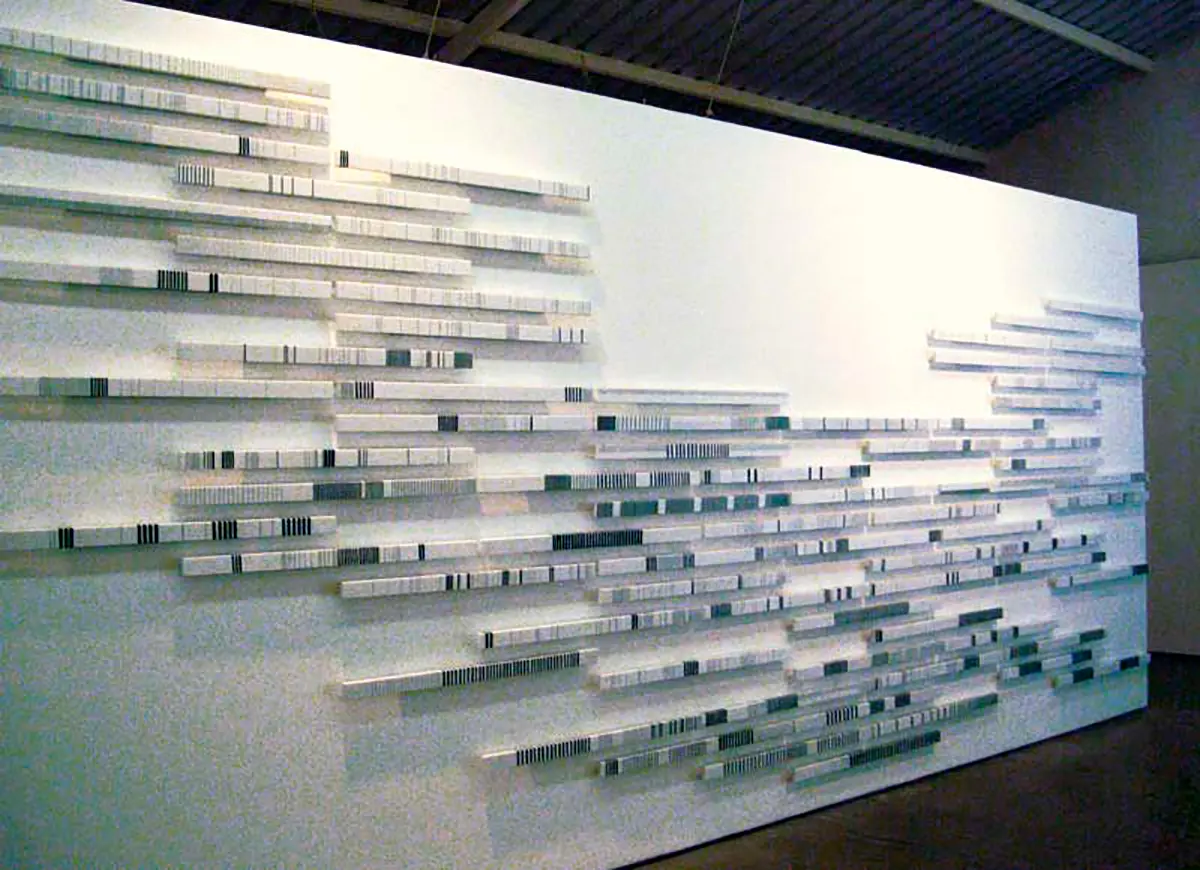
At first glance, Bravo’s work appears to deviate from the cartographic element found in earlier pieces. This impression stems from the fact that her current works display—in the formal sense—a more structural tendency than the one found in the irregular topographies that the artist has created on other occasions. In those earlier works—from the series known as Imprecise Cartographies—the “invasive” process of the lines over the marble was palpable as it extended over the wall and ceiling when Bravo decided to integrate the work into the architecture. But in this current exhibition—which consists of her series Stretchmarks, from 2005, and Slabs—such lines are not rendered in the same seemingly “adrift” manner. On the contrary, there continues to be a territorial demarcation given that, while space and the lines continue to have a central role, there is now a much more restrained spatial expansion. The juxtaposed marble slabs or ribbons intervened with drawings and serially or systematically arranged one next to the other, do definitely occupy a place in the space and, when observed as a group, acquire their meaning. The result, different from the one obtained with the earlier maps or topographic drawings, is a series of fictitious pentagrams or illegible discourse whole lines—some more intense than others—that produce gradations of value that generate a highly intense rhythmic visual reading. Added to this are the size and thickness of the sheets, whose equally diverse protrusions accentuate that “rhythmic counterpointing” effect. This alternation between high, medium and low intensities of light in each of the slabs, and their placements on the wall as reliefs, is that which establishes the syntax of the work. They are works sustained through a grammatical structure of tones, semitones, and a variety of graphic intensities, purely based on the size of the slabs and the value—namely, the greater or lesser degree of light—of the lines.
The absence of color accentuates these effects. The resonances of the stone are achieved solely through lines. This quality exists as a visual code in earlier works by Bravo, particularly in her series of maps. Nevertheless, there is something new in this 'Intuitive Records'. It occurs because the artist approaches the work with other motivations: the corporeal markings of the skin—the stretchmarks—and the Colorhythms of Alejandro Otero. In the first instance, a personal circumstance—the transformation of the pregnant body—results in the “marks” left on the skin, in the same manner in which the artist has followed in other occasions the “marks” of the territories of her cartographies. In both processes—in the stretchmarks as well as in the maps—the vein of the marble induces the directionality of the lines, a path that is nothing more than a metaphor of the future. In the Stretchmarks, the stones that were used had vertical veins. When intervened with the lines, it became evident the structural relationship with the Colorhythms of Otero.
This connection is possible because of the directionality of the drawn lines as an extension of the marble veins. It is only that Bravo’s are similar structures, but without color. Bravo concentrates on these structures strictly speaking. An installed piece presents a rhythm in itself. When juxtaposed, the pieces accentuate the rhythmic signification of the group. The series is perceived as a ciphered language with a powerful rhythmic impact.
To create a work based on rhythm implies, in itself, to consider not solely space but also time. Each of the series extended on the wall has a rhythmic and temporal reading. They are pieces that are read as leaps in time because they present variation in the middle of rigorously ordered elements. These variations are the linear interventions of greater or lesser intensity. Such tonal “irregularity” is responsible for producing that visual rhythm.
On the other hand, the stones condense an important energetic charge that comes from both the environment and time. Marble is an ideal stone for these works, as its natural graphism favors new and unlimited significations. Bravo has used this natural rhythm to create a particular kind of grammar that suggests sonorities that steam from the silent stone, thus becoming an undecipherable discourse—pentagram or visual text. The stone, then, becomes an immobile witness that also contains sounds, stories, and circumstances.
SUSANA BENKO