
After an absence of several years from the Buenos Aires exhibition circuit, since she decamped for Europe and ended up settling in Brighton, England, Claudia Fortes presented El sonido del árbol caído at Ignacio Liprandi Contemporary Art. And the content of her proposal has to do, precisely, with grazing from these lands—Latin America—towards those—Europe—and vice versa, in a poetic interplay that also includes the pain of migration from one continent to another and the pain caused by the present state of the world.
Yet it should not be assumed that the show, for which Fortes installed four different situations in each space in the gallery, has a purely autobiographical content. If there is some of that, it is because it touched upon a more broadly encompassing fiber, a more collective fiber that lies in the depth of the subconscious.
In the first space, the embroidered image of a deer with a large, disproportionate set of antlers evokes, according to the text by Gabriela Salgado, the hunting trophies (often merely ornamental) often seen in homes in the region. A somewhat contrived way of invoking a European background (both of the cervid species, which originated in the Northern Hemisphere, and the local immigrant population) in these sub-tropical lands. Through the trasnmutating effects of art, Fontes reverts this pseudo-bourgeois action into something that is almost mythical. But the central figure in this initial entrance to the exhibition is, paradoxically, the small, black, soft sculpture of a newborn fawn, with a number of equally black threads—umbilical cords, says Salgado—spilling to the floor and a portion of the wall. It is after seeing this initial composition that the viewer, possessed of such minimal signals, begins to feel submerged in a daydream. The artist has taken us to symbolic terrains.
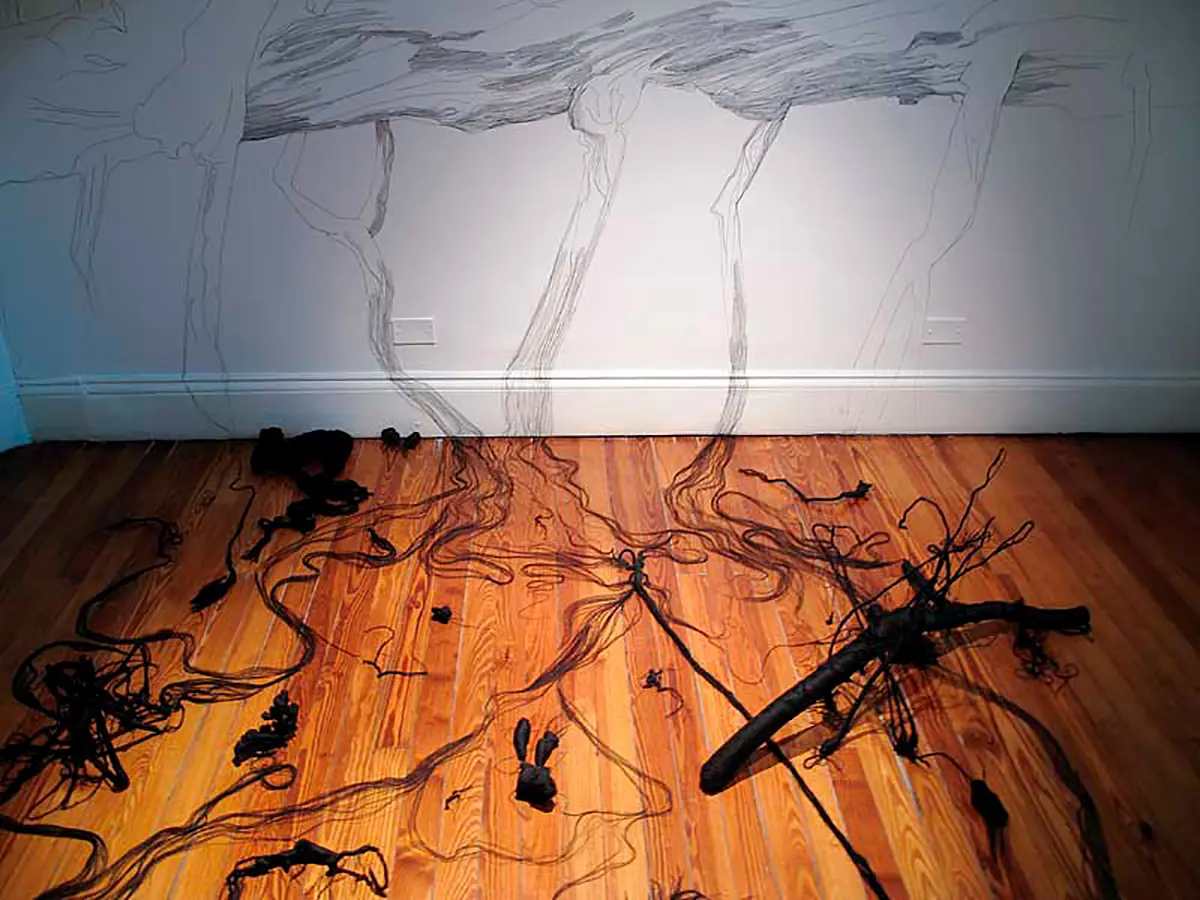
In the next area, a drawing is outlined on the wall, traced, graffiti-like, by threads that then descend. The threads intertwine into an installation where once again the figure of the small fawn is central, along with broken branches that cover the floor in its entirety. Through this iconography, the artist took us directly to the connection between the deer and the tree of life, present in several cultural traditions. “It symbolizes fertility, growth rhythms, rebirth,” said Jean Chevalier and Alain Gheerbrant in their Dictionary of Symbols. They add, also, that “the deer is the herald of light who guides us towards the clarity of the day. Interestingly (and paradoxically), the figures here are black. In this gallery we find, then, the interchange and assimilation between the animal and plant realms, with its roots deep in the mythical world that underlies the human world we inhabit.
From a private, interior world, we move to a large hall, where Montaña rises: it is a single sculpture built from 1,400, very thin pinewood rods, crowned by the following sentence: “The moment of collapse reveals key points of the construction.” Lighted by two circular light beams, the structure projects its shadow onto a white screen. Almost synchronically, this section of the exhibition appears to bring the narrative into the present, this 2011 of economic and social convulsion in Europe and in traditionally “strong” countries.
In the last space, however, we return to the realm of daydreams with Training, a video made by Fontes in a park in Brighton, near her house. The woods and its healthy trees, drizzle, a dog playing and jumping around. The dog was put in charge of investigating the location, and the artist made it her videographer. Again, a symbiosis, nature, humans, and animal species, are set in parallel to each other. And, lastly, a small white porcelain sculpture in a corner, a child and a dog, in an attitude of playfulness and sympathy, close the circle.
The topics of migration, an eminently colonialist country like Great Britain and an immigrant nation such as Argentina, the feeling of uprootedness, promote allusions to a world in crisis and the consequent shakeup of collective and individual consciousness. Art in a time devoid of gods, as in the title of a book by Jorge López Anaya, is hit, like a skin that is both sensible and freed from any fixed rules, by the state of contemporary consciousness. If it is true that artworks with the same materials as a myth does, by its transitive function it can indicate the need to return to certain myths in particular or create new ones apt for our times, capable of rearticulating us as individuals and reconnect with our vital core. Thus the presence of the little fawn, a symbol, as we said, of rebirth among other things.
MERCEDES CASANEGRA