
Angel, Is It You? welcomes passers-by on the street to this intense exhibition by David Zink Yi, the Peruvian author who is the epitome of the contemporary artist. The biblical number 7 is the sum of the parts in this show dictated by the fragments and the whole. It is a sequential installation that occupies the entire gallery using several disciplines, formats, dimensions, and self-contained links. The aforementioned question to the angel establishes the tone of the installation: it is possible to perceive the respiration between each of its parts. These conversations between life and death are intertwined by the Pneuma that gives this exhibition its title. According to the ancient Greeks, theology, and philosophy, Judaism, Catholicism, and even according to medical references, the word pneuma can mean breathing, respiration, a breath of life, spirit, or soul.
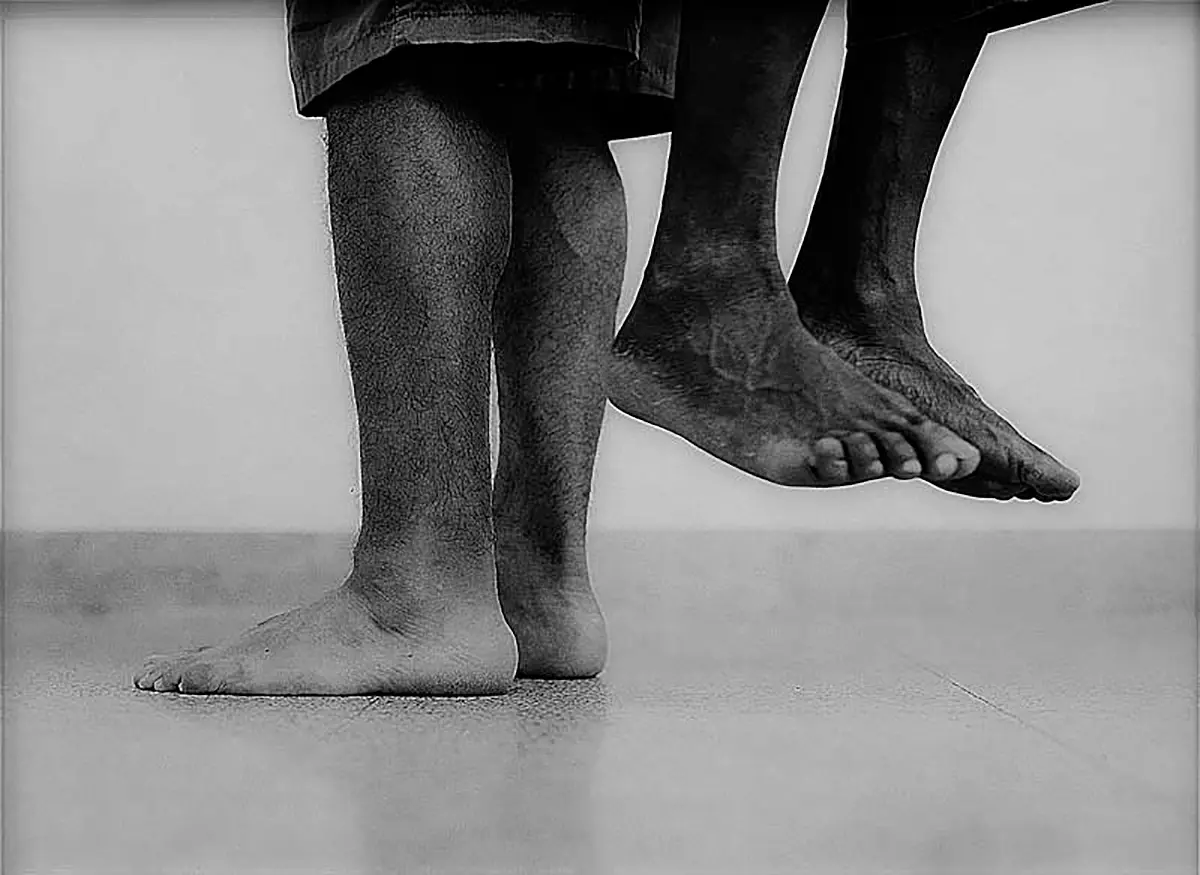
The first breath crashes on the glass, as one becomes aware of the presence of a vertical levitation, a person who committed suicide, or a non-seer who perceives a pair of feet about to touch the floor? This black and white photograph is associated with another tangled, lush, and darker C-print; the place where breath finds a place, third respiration exhaled in the work Cuatro Caminos (Four Roads), a color photograph on aluminum board. The author confronts us with one ritual after another. In this particular one, the strangled and bloodstained cloth that attends a crucifixion, while a pink hallo of light appears in the background to announce its birth. Also a black and white photograph on aluminum board, Untitled is the next link. It is a scene inhabited by several pots. Do they contain sights and ashes, dematerialized spirits, or perhaps an enclave of souls in reservoirs?
The Hauser & Wirth gallery in New York happens to have the right spaces for this installation. Its several exhibition areas work perfectly to meet the needs of Pneuma: time and scope. Alrededor del Dosel (Around the Canopy) is one of the transitional zones—between photography, film, and video—rendered through sound and texts. Pneuma is presented in the breaths of the performance by Cuban trumpet player Yuliesky González-Guerra, who appears from afar and eventually moves towards the foreground until he occupies the entire screen. Playing one of the most ancient musical instruments, González-Guerra—a member in the band of David Zink Yi—puts his lung capacity to the test as he takes the deepest breaths to play his trumpet in a 16mm short with the projector insight. Returning to the use of video, lush and vivid green vegetation in the Peruvian rain forest, represents the background for a cascade overflowing with water. The videos are projected onto the floor, the wall, and the suspended screen. There is no need to conform to the restrictions imposed by a traditional frame in the representation of nothing. Something watched on a wall can very well be projected on the ceiling… that which was placed 160mm from the floor now is flush with the floor—in the gallery and the street. That which was once indispensable—presented the work hanging on the walls—today is not necessarily appropriate. Breathing requires a place in the soul of every scene.Both the green vegetation with its condensed humidity, and the human figures that also require moisture to survive, exude physical and spiritual breaths. In the piece Untitled (Architeutis), the immense ceramic cetacean figure that rests exhausted across the transparent bloodstained floor represents the most eye-catching element of the entire installation. Because of the technical ability required to render such image and because of the expressive reach of a being whose lungs have been emptied of all its breath—as it no longer breathes—this treatment of expressionist figuration also addressed inversed situations. With each step, “the living breath” is increasingly more exposed to disappearing.
The videos acquire several dimensions, intensities, locations, as these also underscore the meanings contained in the title. This Berlin-based Peruvian artist develops his works on several simultaneous territories: experimentation, reflections on identity, and the thesis of pneuma—according to which respiration is the breath of life, music, and dance. Internal and external elements constantly share the space as everything turns into inhabitable theatricals. To some extent, archeologically speaking, this part of the installation rescues an ancient squid. Created in ceramic, the monumental size sea animal brings the museum of natural history into the gallery. But instead of sitting quietly in its embalmed state, the animal almost appears to be waiting for the admiration that will awaken it from its stupor and that will hopefully breathe enough life into it so it can exist. In the face of such impossibility, David Zink Yi sets his monumental technical mastery against reproduction, as he demonstrates that originality is more important than mimesis.
GRACIELA KARTOFEL