
One of the most undervalued episodes in the history of Chilean art is the meeting of a couple who in the early 1980s left its surreptitious mark on the local neo-expressionist school. Graduated from the Universidad de Chile’s Art School, painter Omar Gatica and sculptor Francisca Núñez moved together into a shack built of the same pressboard planks he used to paint his Eros-and death-oozing bodies, and she to assemble—with fabric, colors, sticks, and knots—characters ripped from her own biography. The moment they share is essential to a Universidad de Chile pictorial tradition that harks back to post-impressionism—a tradition given to blotches, to gestures, but from a territory that puts the psyche into play. Núñez is the single sculptor in the group, which assumes the blotch as a possible gesture on any surface, an almost existentialist attitude towards the urgency of creating in such difficult times.
This episode seems unrelated to the work developed, almost thirty years later, by another painter and another sculptor, Ignacio Gumucio and Francisca Sánchez. Much less to what the present review wants to accomplish: a reading of Núñez’s show Idea fija, presented during the month of September at the AFA gallery. In a way, the exhibition brought to the fore certain connections that make it possible to describe the artist as one of the most genuine local sculptors in recent times; it revealed unsuspected filial ties with Núñez, with Gumucio, with that entire school and its “blotch” tradition, but above all with the art of painting.
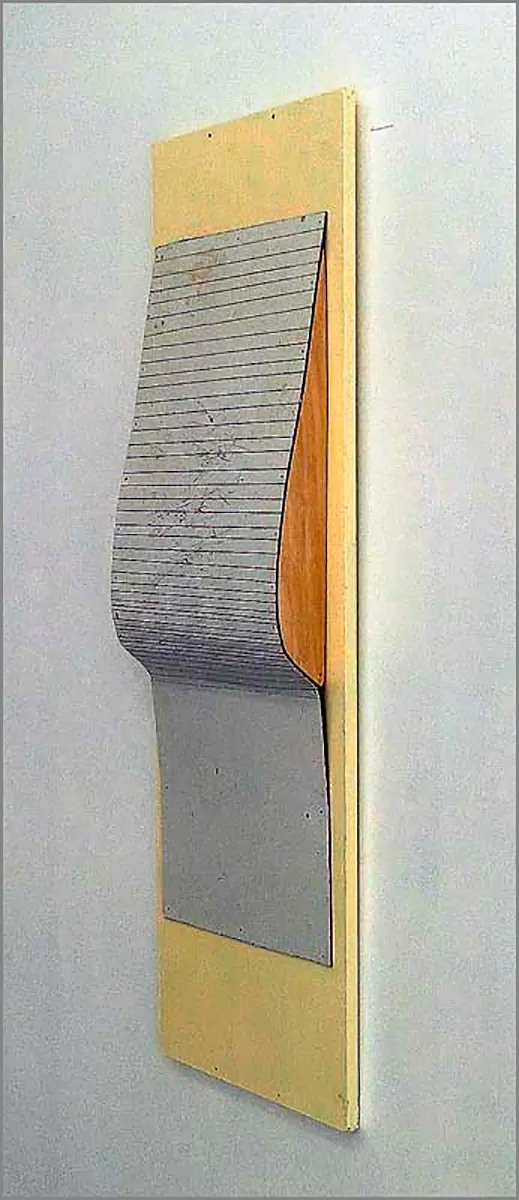
The young couple was educated at the same art school and situates itself at a new point of departure from that tradition, in a context where international post-minimalist and neo-conceptualist tendencies have provided a new asceticism for expressive freedom. While he is a painter who plays with illusionism on materials such as fabric, wood, photocopies, and cardboard, restraining the sensuality of his painting through increasingly more geometric representations of the city, she also deploys simple, precarious, accessible elements like cardboard, paper, cutouts, magazine photographs, and/or photocopies, in order to rearticulate volume in an interplay of shells and voids that—in her earliest work-simulated bodies deposited in the exhibition space, turning the ostentation of the sculptural work of art into a supposedly casual gesture.
As has been the case with Gumucio’s most recent paintings, the body disappears in Idea fija to give way to an obsessive landscape. This series of “sculptures,” wall works and site-specific creations can be seen as a single large scene, as an organic whole where volumes repeat, in echoes and different intensities, the sinuous shape of a rolling hill, the back and forth of waves, or the taciturn presence of the Sun. We have, for instance, an accumulation of broken sticks placed between a platform and the floor, snaking around playfully; photographs of seascapes on the wall, cut into parallel lines that peel off with and order that resembles the cadence of spilling water; a piece of sponge delineated with mathematical precision on wood, which can be a wave or a mountain, in truth an abstract-minimalist painting; there are geometric modules that repeat, combine, or undulate; cardboard painted with the colors of the Sun or piled to outline the frothy, ragged edges of Hokusai’s The Great Wave. Finally, towards the back, there is a large sculpture supported on wooden easels, launching itself forward like an ocean swell or a toy-sized tsunami, made with black rubber tires that fall in bands and end in white moldings that are like the froth of the sea. The referents break down into lines, curves, and pure forms; our perception of the simple, everyday materials shifts under minimal operation like trimming, scratching, assemblage, folding, and gluing. The montage also produces kinetic and optical effects, painting proper, graphics that are left behind as if by chance on some surface or another, and chromatics dominated by blue, white, grey, and ochre hues.
Each work is a clue, and all reconstruct the scenographic presence of a single painting, an ever-shifting landscape in each of its parts. This is a meditation on the local nature, which reopens the path followed by Francisca Núñez in the 1980s: a kind of gestural sculpture, with the matter, drive now contained under an extreme distillation of the form. In the recent history of Chilean art, both sculptors embody something unique: the spilling of pictorial gesture into volume, where the gesture is not just a “kinetic impulse” provoking a pictorial blotch or sign, but a seemingly haphazard action that is nevertheless freighted with meaning. In Francisca Sánchez, this translates into the selection of everyday materials, the disposition of volumes, and the very trace that is left through a strategy—half minimalist, half low-tech—that plays with the precarious and the misshapen end, in the process, ennobles it.
CAROLINA LARA