
In The Cave, one of his most dramatic novels (2000), José Saramago tells the story of a potter who is confronted, from one day to the next, with the obsolescence of his craft and the disappearance of his space in society, after the arrival of a mega-mall to the city where he lives. This fact, inconceivable for the protagonist of Saramago’s masterful narration, reveals the way in which a way of life and its characteristic rhythms vanish as a new structure of social relations, governed by the values of globalization, is installed. Such a situation is not alien to us; it has been the source of many a reflection about what is lost in our mad race towards an ideal of progress.
Artist Giovanni Vargas has been thinking about this phenomenon for some time, focusing on his immediate surroundings: the Chapinero neighborhood in Bogotá. On the basis of his walking exploration of the area, Vargas develops both his themes and his visual approaches around the micro-histories of the city, observing the changes in its architecture.
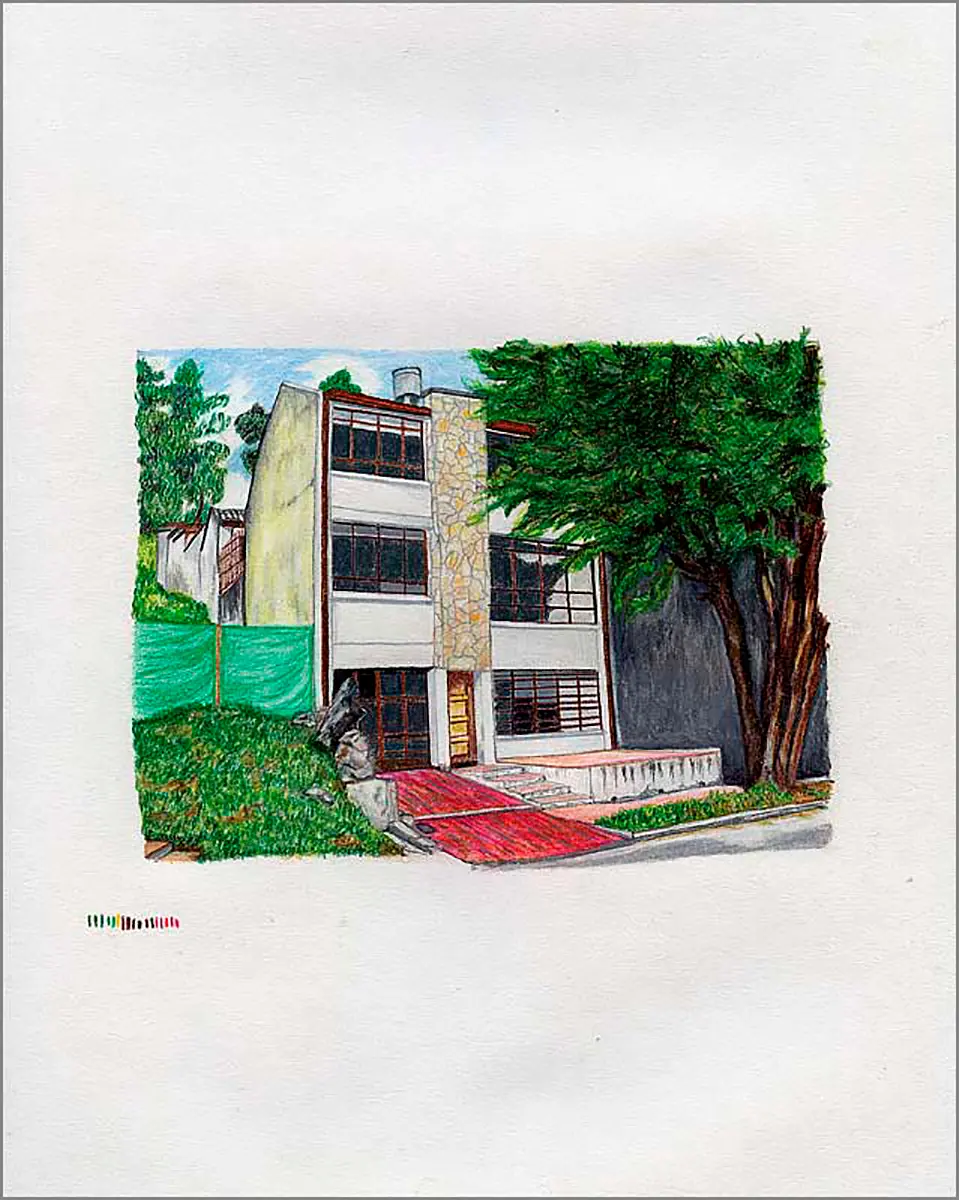
In Estudios de caso, Vargas builds inside the gallery a space that establishes relationships between façade and interior, both at the formal and symbolic levels. The installation includes a series of shelves on which painstaking drawings of the façades of traditional Chapinero houses are displayed like porcelain figures inside a home; thus, the façades are positioned in the space of remembrance, relic, and fragility. On the floor are pots with interior plants illuminated by a lamp, which function ambiguously since space works both as a front garden and a window sill.
Vargas’ works point out how neighborhood stories and their particular way of constructing a sense of community tend to vanish as our concept of the city shifts. In Bogotá there is a simultaneous transformation of housing sites and ways of being in the city. As in Saramago’s tale, Vargas bears melancholy witness to the way in which the neighborhood store is replaced by the supermarket and the mega-mall, while the life of the families that traditionally inhabited the houses he draws is displaced by different dynamics.
Although this phenomenon is generalized in Bogotá, the title of the series, Estudios de caso (Case Studies) suggest that we look at each disappearing home with attention and study its façade as the key to a particular history; with this, Vargas presents his own kind of resistance to the voracious forces of demolition.
Armed with a unique sensibility, Vargas confronts Bogotá’s idea of progress and its aspiration to the status of megalopolis with the history of one of its most emblematic neighborhoods. After the 1948 Bogotazo, the social center of the city moved from Teusaquillo to Chapinero, and this shift brought about several further transformations that it seems inconceivable we might now forget, for example, a change in the city’s drive to reproduce the British style and it's becoming a modern city in the mold of Paris or some of its North American counterparts.
The modernity represented by those houses, particularly in the straight lines of the façades, the functionality of their shapes, and the generosity of their spaces, is now seen as obsolete, and their demolition makes room for a different idea of modernity. The city that expanded throughout the Twentieth century from its center to the north has seen in the Twenty-First Century a move from the horizontal to the vertical: this is to say, to the optimization of space by means of taller buildings housing hundreds of families.
Estudios de Caso is part of the larger project Apuntes para una historia de Chapinero, which has taken in the past a variety of shapes. It is worth mentioning El poder necesita de la piedra IV, presented at the 12th Regional Artist’s Salon, Central Zone. This work consisted of an urban intervention where a series of placards manufactured in a traditional printing shop in central Bogotá were glued overnight to the fences protecting the lots where houses have been cleared for the erection of tall buildings. On that occasion, as in this show, Vargas salvages an almost artisanal process—the manufacture of signs and billboards using moveable-type presses (in the former instance) and color-pencil drawing (now at Casas Reigner)—in order to underscore, with anguish and nostalgia, the vanishing of these houses.
Vargas protests the new wave of construction that, willfully ignoring the stories and relationships that evolve in a neighborhood and the life of the families whose homes these houses are, has gripped Bogotá for more than a decade. His purpose is not to stop the disappearance of the houses, but to raise his voice against the oblivion that the process implies.
Thus, in Estudios de Caso Vargas slows down the accelerated process of demolition, if you will, by carefully identifying exemplars to photograph and then painstakingly drawing them as if paying tribute to literally fallen heroes.
MARÍA CLARA BERNAL