
Ten years ago, while I was living in Spain, a dear and respected friend of mine told me the following: “I was born in the border, son of different cultural territories and I am the result of a compilation of nationalities.” This same quality is shared in the solo exhibition by Juan Carlos Delgado entitled North Room, presented at the Galería NCE in Bogota.
It is a daring and defiant proposal that is also intimate but never exhibitionistic; a mise-en-scène that includes a minimal number of elements, sufficiently compelling to convey its communicative potency. The exhibition faithfully reflects Delgado’s professional temperament: serious, committed, and reflexive; an artist who does not admit improvisation or the over-handling of art. It is a unique artistic experience that stems from an aesthetic proposal that shakes the viewer’s sensibility because of its grandeur and serenity.
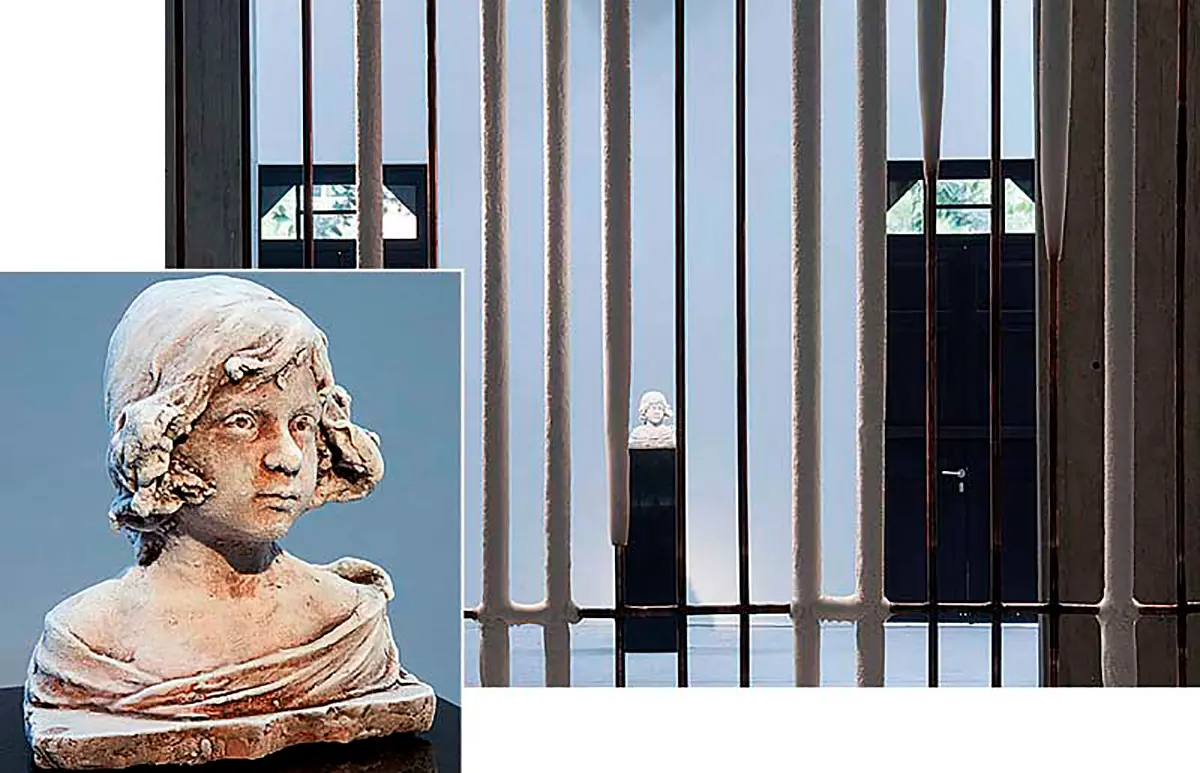
The exhibition becomes unsettling from the very first visual impact: a large frozen copper railing that decisively divides the space. Its bars condense the humidity released by the public who visits the exhibition. It is an intimate memory by Delgado that alludes to the title of the show. North Room is an uncomfortable space that inscribes us in the collective experience surrounding captivity. A confined, chromatically-invested space that silently records even the smallest of contacts. As the ice thickens, the cylindrical nature of the bars is deformed, allowing us to visualize a state of hibernation that is part of the visual referents of Juan Carlos Delgado.
Facing the scene and displayed so as to simulate a provocative posture, we encounter a delicate and anachronistic bust supported by a black marble pedestal. It is the sculpture—anonymous and found in a flea market and, nonetheless, irritatingly familiar—of a young girl that looks like it has come from a Renaissance portrait book. A copper sculpture covered in frost that comments on the processes to frieze the image—like a photograph—that is transversally present throughout Juan Carlos Delgado’s work.
The construction of this work as an object relies on semi-industrial processes in which pipes, motors, and cooling mechanisms are adapted to generate optimal conditions that enable the spontaneous transformation of the image. Thus, the image is understood as the accumulation of layers of frost on the girl’s sculpture, until the referent is completely lost and a block of ice replaces it at the top of the black marble pedestal. The thawing process—which if analyzed rationally would signify the deconstruction of the image—is also part of this construction process. Therefore, the image is inscribed in the concept of non-permanence, once again used transversally in the work of Juan Carlos Delgado. It is a mutating image intervened by the time that does not last long enough to be fixed in the memory.
Committed to inquire about the fragility of the human condition that permeates all aspects of life—its interactions with matter, human relationships, the understanding of existential questions—Delgado confronts moments of personal subjugation in which he risks his sanity on behalf of attaining an understanding of the way to access other worlds. It is not an esoteric challenge or alternative practice, but an everyday resource that is part of his actions and practices surrounding art; it occurs when he constructs a mechanism to create a sculpture when he has someone produce it when he selects the provider and even at the moment the finished work is bought.
This is the way his work navigates a territory without borders, led by a highly-gifted sensibility rooted in a solid conceptual commitment. It is a body of work that is interwoven and that considers its support according to the technical possibilities, as its aesthetic proposal already has a well-defined path. It follows the changes generated by natural processes that address the inexorable question of existence; the fragility of our bodies and the way these relate to the environment; the instability of the supports that supposedly make us safer.
Juan Carlos Delgado is a talented and reflexive artist who shares the same contemporary inquiry that inspires these letters. His proposals are the quicksand that brings down the power; they terrorize the domain of aesthetic instability with its reflections and a dignified way of facing life. North Room is, conceptually, an impeccable proposal that consists of three pieces displayed at an important and imposing exhibition space. These three works communicate a reflexive moment in the life of Juan Carlos Delgado. Above, where nobody thinks to find anything, a sole piece created with fire, speaks of hope, possibilities, and a path; it is a very thin thread available to this artist.
ESTEFANÍA SOKOLOFF