
Leandro Erlich’s exhibition in New York on view at Sean Kelly Gallery in Chelsea was an exercise in illusion and the illusionary accuracy of vision that is a trademark of his work.
This exhibition is dedicated to the world of that most modern of artificial inter-spaces: the elevator. The ubiquitous presence of these cages of transport in modern buildings has allowed for certain mythology to evolve through the years in popular culture whereby the space of transport becomes a special terrain, the rarified atmosphere of persistent movement within the same space and switching from one world into another as it stops and goes in its consecutive travels in the same building, opening and closing doors to different realities that are accessible by pressing a button.
Elevators also convey a certain banality that derives from the repetition of function, and elevator music itself has become associated with this trivial aspect of the object, yet there is also a presence of anxiety that we associate with these temporary spaces of transport that comes from a combination of both fear of heights and a natural human suspicion for the malfunctioning of anything that is made with human technology. Very latent anxiety of modern society that has been countlessly proven correct by stuck elevators the world over, but that in New York has a particularly sinister relevance in connection with the disaster of the World Center Towers in 2001.
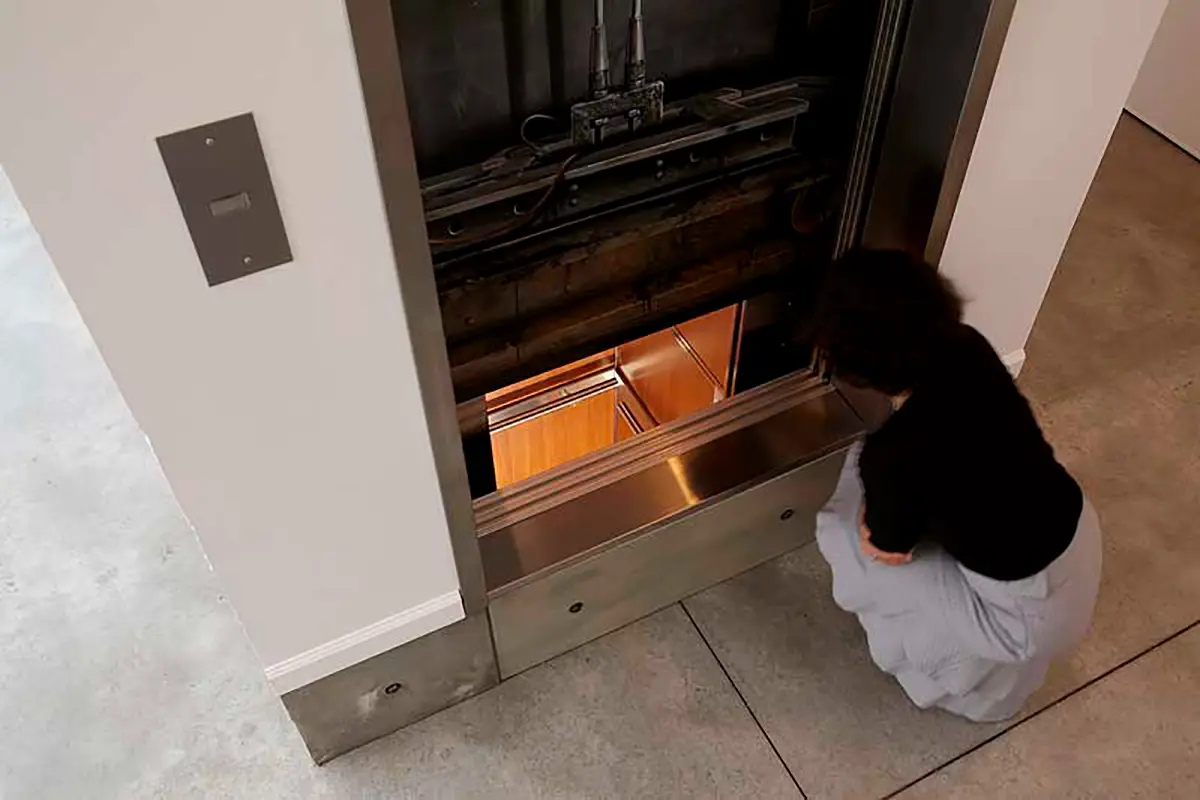
The first room in the gallery to the right of the entrance is precisely a study in the situation of a stuck elevator that is obviously opening between floors. But here the idea of depth in the space itself is provided by the use of mirrors, which create an illusion in the same way that Erlich’s swimming pool at MoMA PS1made us believe that there was a crowd of people at the bottom of a pool. In effect the artist is making us see an unreal depth of space that does not exist, thus putting into question our own perceptions of reality, which we tend to automatically trust by viewing habit rather than real observation.
Another gallery had a series of elevators next to each other, the use of mirrors in this case even makes us see mirrors where none are present, and where we should be surprised not to see our reflection we discover that it is not because we have turned into a creature without reflection, but because instead of looking at a mirror we are actually facing a perfect reproduction of the elevator space where we are standing. But we were expecting to see the mirror there. Thus the artist is so apt at making not only the real seem questionable, but the expectations of viewing as an experience itself are challenged.
Perhaps best of all in its total impact on the viewer was the one installation in a small corridor in the gallery, which reproduced to perfection the interior of an elevator shaft. As the viewer goes further into space, the realization that we are approaching an elevator cabin from the top gives a sudden twist to the experience and one cannot but feel the anxiety and fear of those places we never hope to see, for it would only be in case of rescue that a passenger would see these cables and part of the workings of the machinery while exiting a stuck cabin through the roof.
Erlich’s work in this instance has perfectly captured the essence of illusionary reality, as well as giving a refreshing thought to the observation of art. He is challenging us to see further and not to trust our first impressions, even if we are seeing and witnessing it ourselves, and he is conveying as well the uncertainty and anxiety that comes with the discovery of self-deception.
ALBERTO BARRAL