
During the month of September, the Galería Thomas Cohn in São Paulo, Brazil, presented an important retrospective of the powerful work created in the last ten years by Lia Menna-Barreto. The close relationship between this artist and the gallery began to develop in 1990 when Thomas Cohn showcased her work for the first time in the exhibition titled Peludos (Furry Things). Back then, the gallery was located in Río de Janeiro. Up to that point, Menna-Barreto had only shown her work in Río Grande del Sur and in some isolated presentation in San Francisco, when she was studying in the US. According to Thomas Cohn, back in 1990, he had already identified her as one of the most innovative, daring, and revolutionary artists of her generation, and one who was totally unconcerned with “contemporary art recipes.” Other exhibitions by Menna-Barreto at the Galería Thomas Cohn during that decade include: Cavalos (Horses, 1992), and Ordem Noturna (Nocturnal Order, 1995).
With these exhibitions, the career of Menna-Barreto exploded into the Brazilian and international art scenes. From Porto Alegre, her works began to resonate in places like Río de Janeiro, São Paulo, Belo Horizonte, Brasilia, Salvador, Puerto Rico, Lisbon, Havana, Los Angeles, Wichita, San Diego (California), Mexico City, Berlin, Graz (Austria) and Fribourg (Switzerland). So much international exposure has also led to her work being acclaimed in several editions of the Mercosul Biennial.
Thomas Cohn does not hide his elation about once again bringing—this time to the São Paulo address—Lia Menna-Barreto to his gallery; 16 years after he discovered her, and this time with a retrospective that underlines her maturity as an artist. With the same excitement Menna-Barreto emphasizes the emotion of this new encounter with the art dealer: “In 1990 he introduced me to Río de Janeiro and my work became visible for the first time.”
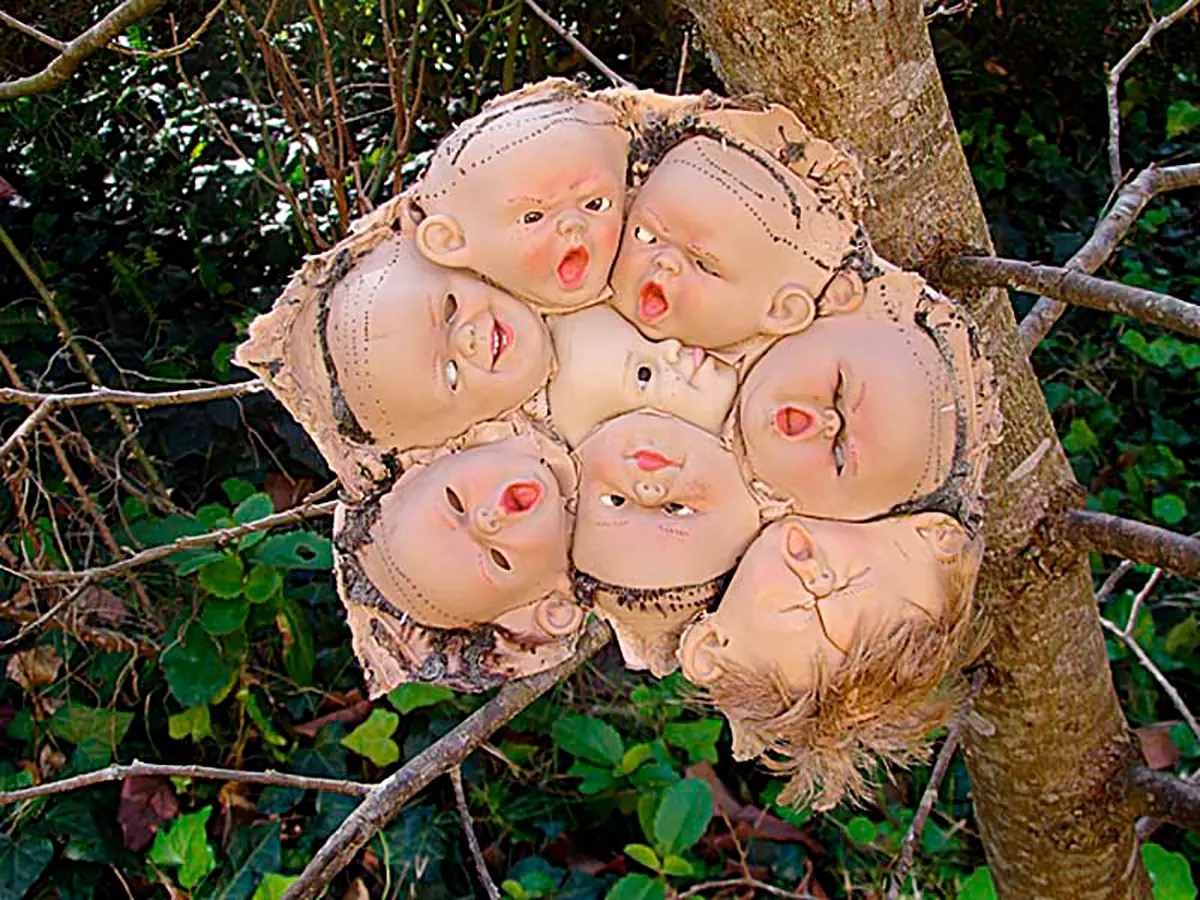
The most important thing about this current exhibition is the organic concept with which the artist symbolically recodifies the characters in her sculptural narratives that she chooses to invent with absolute freedom. Menna-Barreto constructs installations out of dolls or plastic toy animals that she strips from their original materiality to frame them in the aesthetic realm. According to the artist, “the idea is to work with simulations to deconstruct their meaning through formal actions, in order to decontextualize, manipulate, reorganize, sculpt, and group them.”
Through this operation, Menna-Barreto simultaneously manages to charm and horrify, as she relies on an aesthetically sharp constructive gentleness that, at first glance, produces a dreamlike dimension. This effect finds opposition—one that also causes surprise—in the deformations, transfigurations, perforations, cuts, seams, unimaginable joints, and permutations of the new compositions. With these gestures, the artist reconstructs an organic architecture that brings back the senses, sensations, and emotions—that pertain to human development over time, ruptures, and nocturnal systems—of the invisible.
In 2008, I became acquainted with and fascinated by, Lia Menna-Barreto’s work in the exhibition entitled Mano Doble (Double Hand), at the SESC Pinheiros in São Paulo. On that occasion, the work Flores de Ratón (Flowers of Mice), created with hundreds of white plastic mice, immediately conveyed the tension between reality and simulation. There, the artist also endeavored with a profound reflection to search for a way to harmonize diachronies with a careful aesthetic.
The lexical composition of her work is marked by a symbolic trap that is permeated by the effects of the mandalas, flowers, butterflies, and toys. Even abject elements such as mice, small lizards, frogs, severed doll heads—domesticated by the artist’s hands—are conferred a charming poetic.
The exhibition at the Galería Thomas Cohn showcased a comprehensive look at Menna-Barreto’s artistic endeavor. Her work completely occupied the interior as well as the exterior of the gallery, in search of an extensive dialogue between works produced across several periods.
By the gallery entrance, one could admire a texture created on silk, flowers, dolls, and butterflies melted into the fabric through the application of heat. The translucency became more delicate with the light and created a magical, dreamlike, and gentle atmosphere, like the one in a child’s world. Four silks were placed in a sort of fake embroidery arranged on pure silk with plastic animals added through a melting process.
The work titled Chatas (Bored) depicts several identical dolls that have been flattened by heat and united with a ribbon. In the installation, Wá Wá Menna-Barreto uses the name of a toy in Mandarin to present a collection of small dolls flattened with high-pressure heat and enclosed inside a horizontal glass display case.
Installed at the end of the gallery, the piece Piel de Muñeca (Doll Skin), is constructed with threads taken from the heads of dolls, like orange peels, and organized as a curtain. The installation also contained doll heads turned inside out and arranged on the floors and walls of the exhibition space.
Lia Menna-Barreto was born in Río de Janeiro but adopted the town of Río Grande as the place where she produced her work after moving there during the 1970s. She graduated from the Universidad Federal de Río Grande del Sur in 1985. During the 1990s, she studied in the US at Stanford University in California. Menna-Barreto participated in the Sixth Biennial of Havana and in the 1st and 4th editions of the Mercosul Biennial. From Porto Alegre, she moved to Eldorado del Sur, where she has her studio and home. Today, the artist is working on an overview of her trajectory and research begun in 1978, reinvesting her accumulated experiences gained through research, creativity, and the mastery of the conceptualization of her exhibitions. Menna-Barreto is continually in search of new dialogues.
HÉLCIO MAGALHÃES