
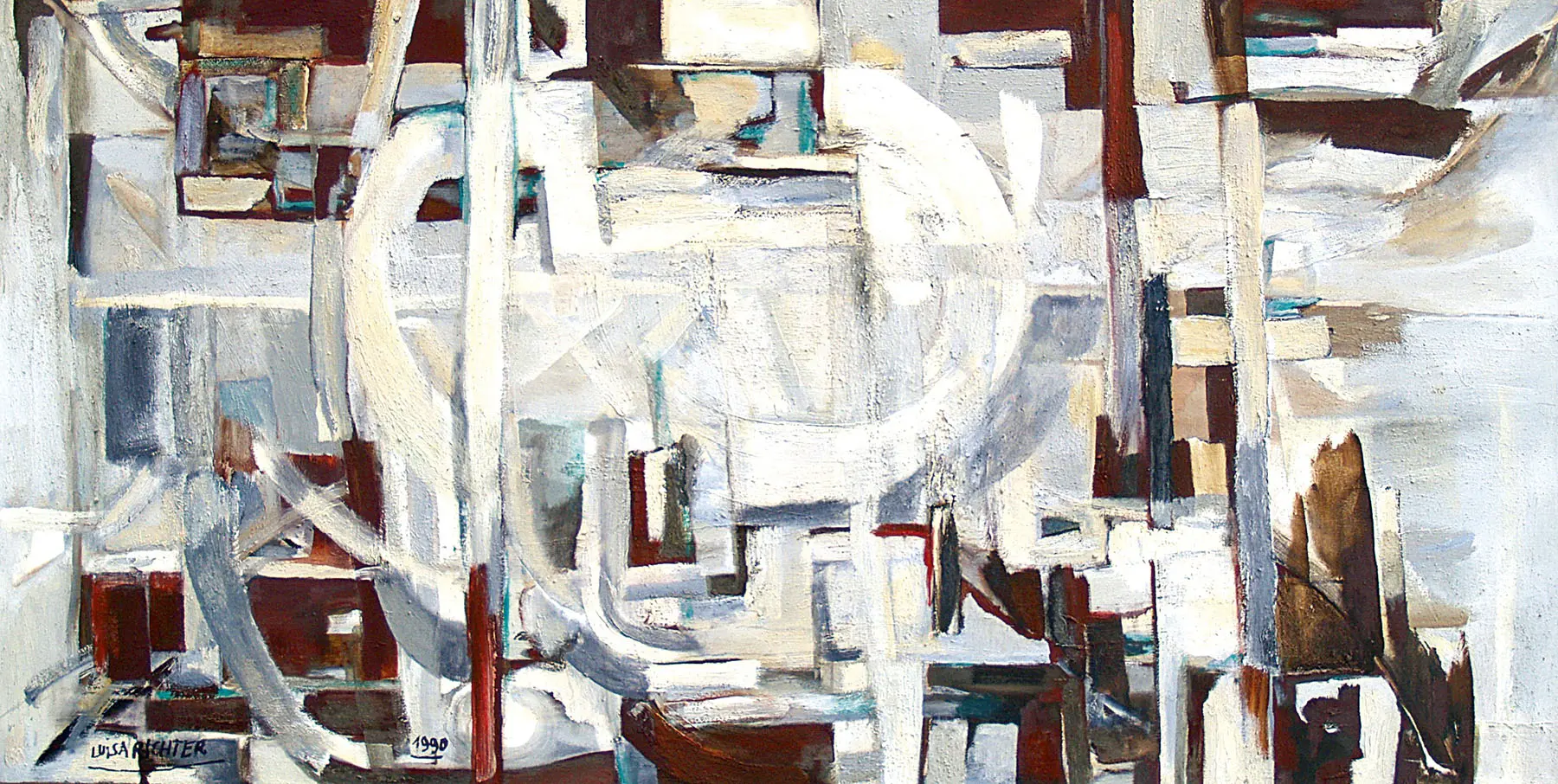
Luisa Richter (Germany, 1928) makes intellectually rigorous paintings of inner silence and of thought. Venezuela welcomed her in 1955 with the light of two seasons that are renewed each year through the magic of a natural cycle of rain and drought, the accompaniment for dreams and creative mysteries. Driven by an imperious need to paint, she devoted her time to recreating the line in the autobiographical drawing of experiences and meditations. “The clouds copy my paintings,” Richter says as, from the vantage of her work desk, she sees them slide by a large window through which mountains and landscapes appear to the gaze; on the canvas, she gives all things their proper order, like the order of a recovered eternity. Richter’s works are conceptual landscapes where two universes coalesce: memories of her childhood and adolescence in Germany, and the sun and tropical nature of Venezuela. Her paintings are the result of impulses that come from the environment that surrounds her, and thus she does not hesitate to write that “everyday life / offers up the union of image/matter and craft, / which are the components of a work of art.” 1 Richter emphasizes academic rigor, the need to master the proper instruments for the effective practice of art, and knowledge of philosophy and the history of art. Life and spirit are important to her.
In the life of Luisa Richter, née Kaelbe, the year 1955 was a watershed: her dear teacher Willi Baumeister passed away, and she married civil engineer Hans Joachim Richter, with whom she resettled to Caracas to fully join the artistic milieu of a city just waking up to modernity. Restless and bohemian by temperament, Richter had developed her first experiments in drawing already in 1932; to her solid formal education, she now added the effervescence of a scene gripped by a passionate interest in geometric abstraction, seen as a universal escape from the language of the naturalistic landscape school that had dominated Venezuelan painting since the early Twentieth Century. While retaining her independence from the aesthetic postulates of the geometric abstractionists, the structure of Richter’s work, in all of its expressions, always moved in the direction of informalism; key examples of this are her paintings Fragmentos (1996), La fuerza de la visibilidad (1990), and El jardín de los Senderos (2001).
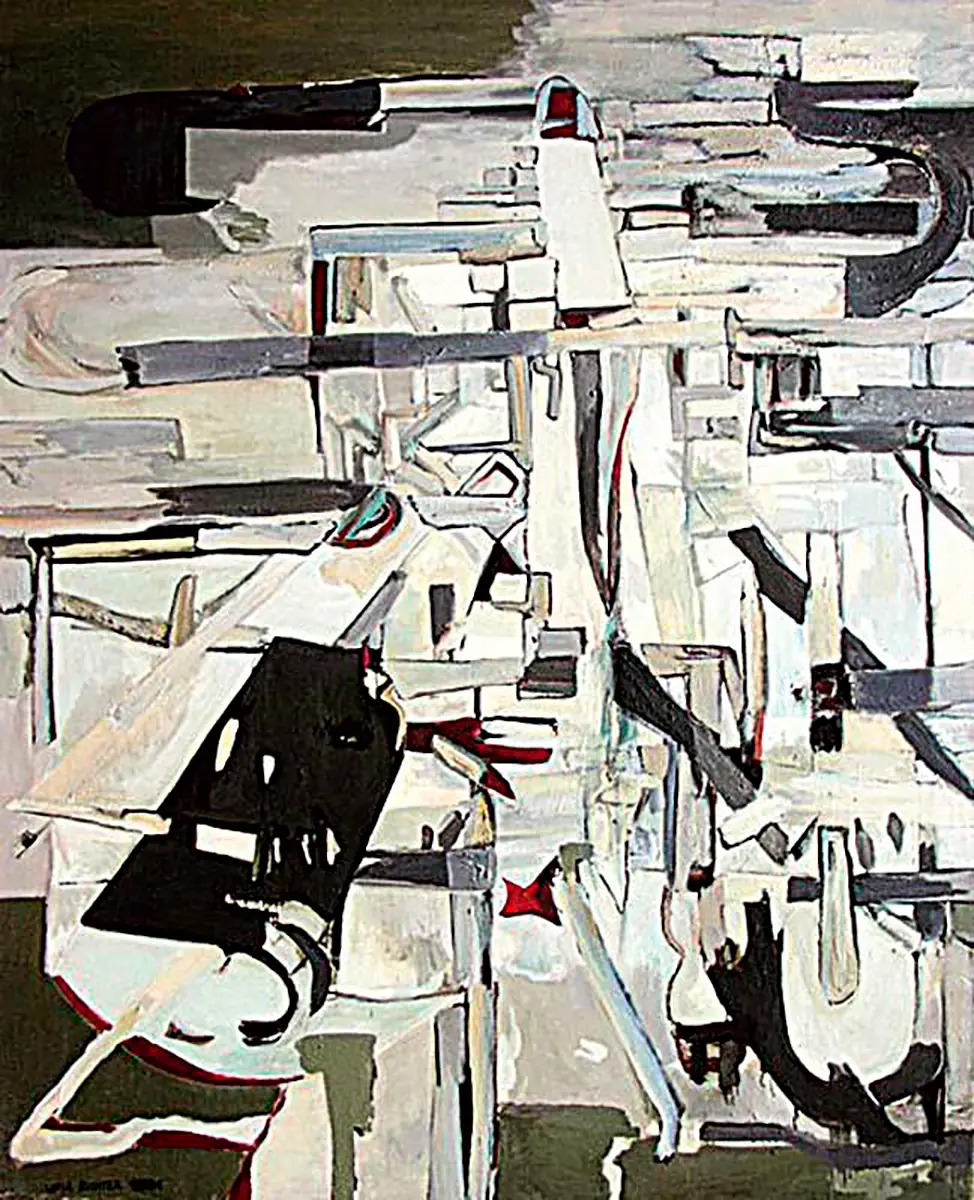
A good part of Richter’s formative period was spent in Stuttgart, Germany, where she regularly attended art school. Having imbibed the liberal ideas and the rejection of naturalism of the Ludwigsburg Lyceum (1941), she began her formal studies at the März Free Academy (1946) and continued them at the Independent Art School (1949). A student of philosophy, a lover of poetry and of travel, alongside her academic pursuits she produced illustrations for the journals Stuttgarter Leben and Die Weld der Frau, and for the Egon Schuler and Bechtle Verlag publishing houses. Thanks to these activities, she was able to spend long periods in Paris and Rome, until “in 1955 a cargo ship took me to South American shores… arriving in Venezuela, I was impressed by the luminosity of the environment. I started then to use the color white as well as warm and cold shades of gray. Between 1958 and 1963 I painted Venezuela’s land in a bare state: geological strata, reddish, gray, brown, impacted by a radiance that sharpens the air.” 2 In her works from this period, one is left with the impression of a plowed-up, arid terrain pregnant with incandescent light: Figuras en el paisaje (1960).
Richter’s most complete education took place under Willi Baumeister, a proponent of abstraction in Europe and also an inspirational teacher at the Academia Nacional de Artes Plásticas, with whom she studied between 1948 and 1955 at the State Art School; while remaining at a distance from Baumeister’s abstractionism, Richter learned from her demanding teacher an approach to the practice of art that was based on creative freedom, and awareness of the need to acquire a well-rounded education, and unflagging loyalty to irrevocable ethical and aesthetic principles on the basis of full-fledged creative demands and life attitudes. In 1958, Richter was invited to participate in the 19th Official Annual Venezuelan Art Salon, at the Museo de Bellas Artes, “and since then I was fully a member of the Caracas and the Venezuelan scene, regardless of my being a woman, and a foreigner.” 3 The following year, 1959, she presented her first solo show at the same museum, with informalist works. From those years, she remembers that “my first oil paintings in Venezuela were closely connected to the city of Caracas. Living here, I was part of contemporary artistic processes and at the same time lived through the confluence of international trends.” 4
Between 1956 and 1962, Richter worked on her series Cortes de tierra, inspired on “the land of Venezuela,” paintings of textured surfaces in a variety of hues, sometimes monochrome, with impulsive strokes and demanding formal rigor: “these oils on jute, canvas, and wood… can be defined as informal painting or informalism, blotching, or action painting… my work has incorporated traces and gestures into the composition since the beginning, at the time of my arrival from Europe, and this has been with me to this day,” 5 as she notes in her Anotaciones durante las clases de Baumeister; it was “in Caracas where I started on the path of discovering, inventing, building a language.” 6 With emotional inflections that propitiate creative storms, discoveries, instantaneous annotations, and the sensitive pulsations of fervor for painting, Luisa Richter developed a dynamic of knowledge of the history of world art and an artistic and spiritual approach to other creators. In those years she began a trajectory marked by elements of the unconscious, visual investigation, a will to analyze, and a reflection about the creative act and its consequences.
Space, Plane, Line
Prepared in practice and attached to experimentation at the two-dimensional level, in the 1960s Richter created works whose diverse visual space and chromatic proposal were unique within the context of Venezuelan art. From several starting points at once, Luisa Richter approaches creative action as an ontological and phenomenological event of sensibility, locating Being at the center of an investigation on the “visibility” of the concept of painting. What delineates the pictorial theme and space in this body of work, still influenced by the post-expressionist school, is the gesturality of the brushstroke. Richter creates drawings, collages, prints, and lithographs with the visual elements that were characteristic of her first period, as exemplified in her lightly post-expressionistic portraits. At the forefront, the figure stands out against a background whose structure is a symbiosis of abstraction and gesture, for instance, Retrato de la Señora Blanca de Gerlach, 1972, at the collection of the Fundación Museos Nacionales in Caracas.
By 1968, she had started Paisajes, a series of paintings defined by German artist Kurt Leohard, a close friend, as Flat Spaces, the title of the series of twelve large-format oil works that, along with sixty collages and texts about art, Richter presented in the Venezuela Pavilion at the 38th Venice Biennale in 1978. The aesthetics of the abstract-organic defines Richter, objectively, as a painter of the gestural space and the relationship between plane and line, all of it in relation to the light that is generated by the clarity of her whites, which delineate certain angular and dynamic points of the pictorial structure. Such luminescence produces motion by animating the gestural vertigo of sinuous or straight brushstrokes that balance the rhythm of the drawing. Richter proposes an informal direction resolved as a unitary logarithmic problem concerning the work’s visible reality.
Space as Topic
Luisa Richter’s conceptual and existential concerns about philosophical and artistic matters, both at the level of the creative experience and the practice of art, are well known. Analyzing her work, it is possible to infer a formalist and philosophical interpretation of the pictorial space as the modelic representation of abstract themes, supported by the natural phenomenology of the landscape. Her concept, according to Eduardo Planchart Licea, is “an aesthetics that turn the landscape into a spiritual geometry.” 7 From the moment of her arrival in Venezuela, nature has been the vibrant object of Richter’s creative interest, pointing towards rules of the absolute, or the transcendent; she is attracted to all that expresses the seduction of the unique universe that is hers, the universe to which she belongs. This is expressed through an original visual structure that, in a process of inner motion, projects itself towards the viewer in an existential dynamic.
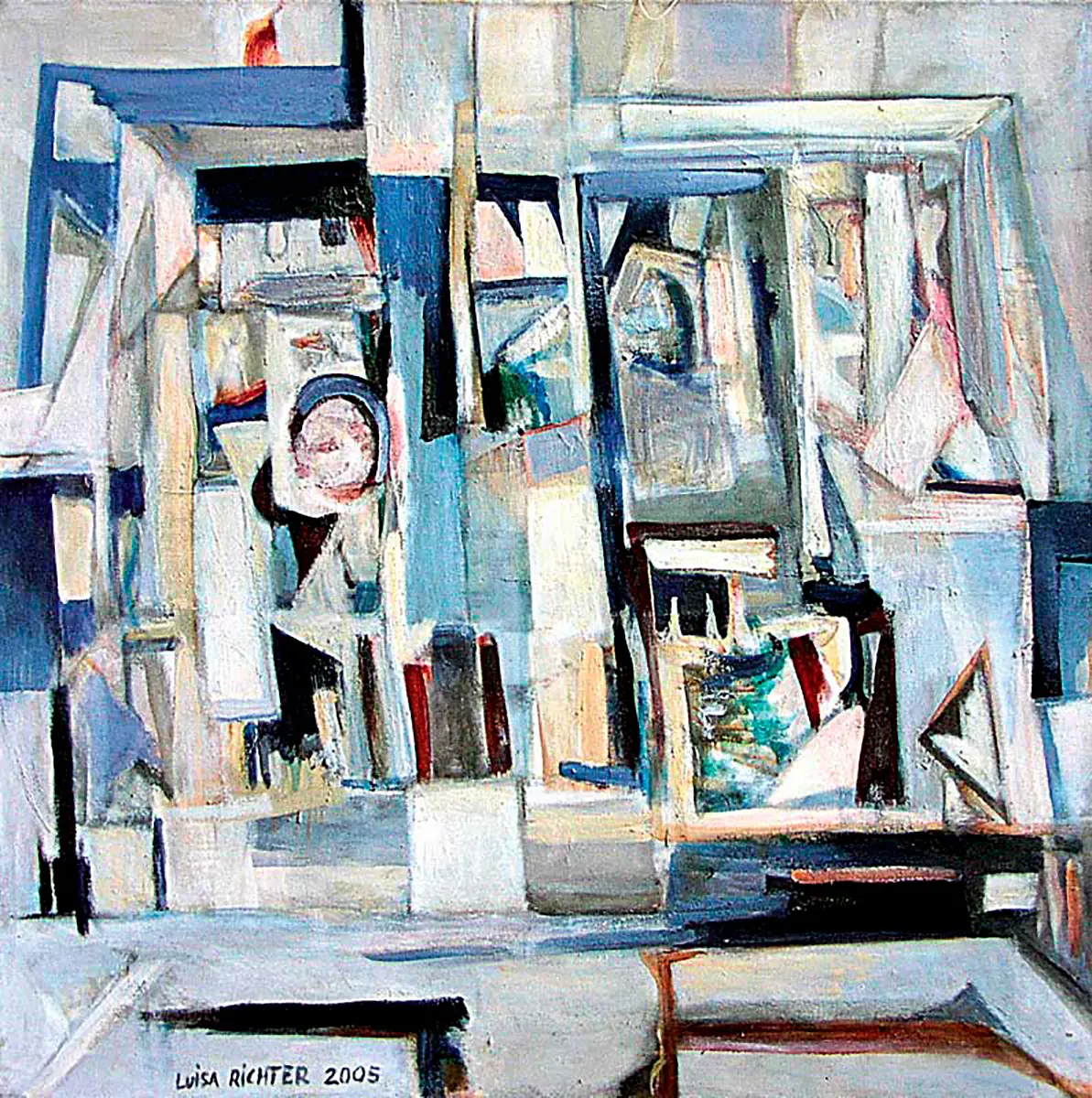
The issue of space in Luisa Richter’s painting is rather complex, given her references to several implications of life and art. In that sense, Hans Joachim Albrecht’s analysis helps us understand the complexities of the work of this German-Venezuelan artist by speaking of “the ‘cosmically familiar’ space of experience, the infinite transcendental space, paradoxical in itself and yet philosophically ‘evident,’ which breaks down into metric (measurable) or peiric (experiential) space, on the one hand, and apeiric (incommensurable, inscrutable) space on the other…,” 8 thus situating space as a fundamental topic, applicable to oil works such as Lancelot (1987), Trueno Sordo (1988), El jardín de los senderos (2001) and Recuerdos del mañana (2004,) to name just a few. Retaining the same visual elements since her earliest works, Richter’s established formal relationships flow into “measurable” geometric propositions that transcend the realm of experience and, in a complex compositional structure, reflect the “real (inscrutable) metaphysical cosmos” of meanings that encompasses the diverse dimensions of the visible.
Collages and Drawings
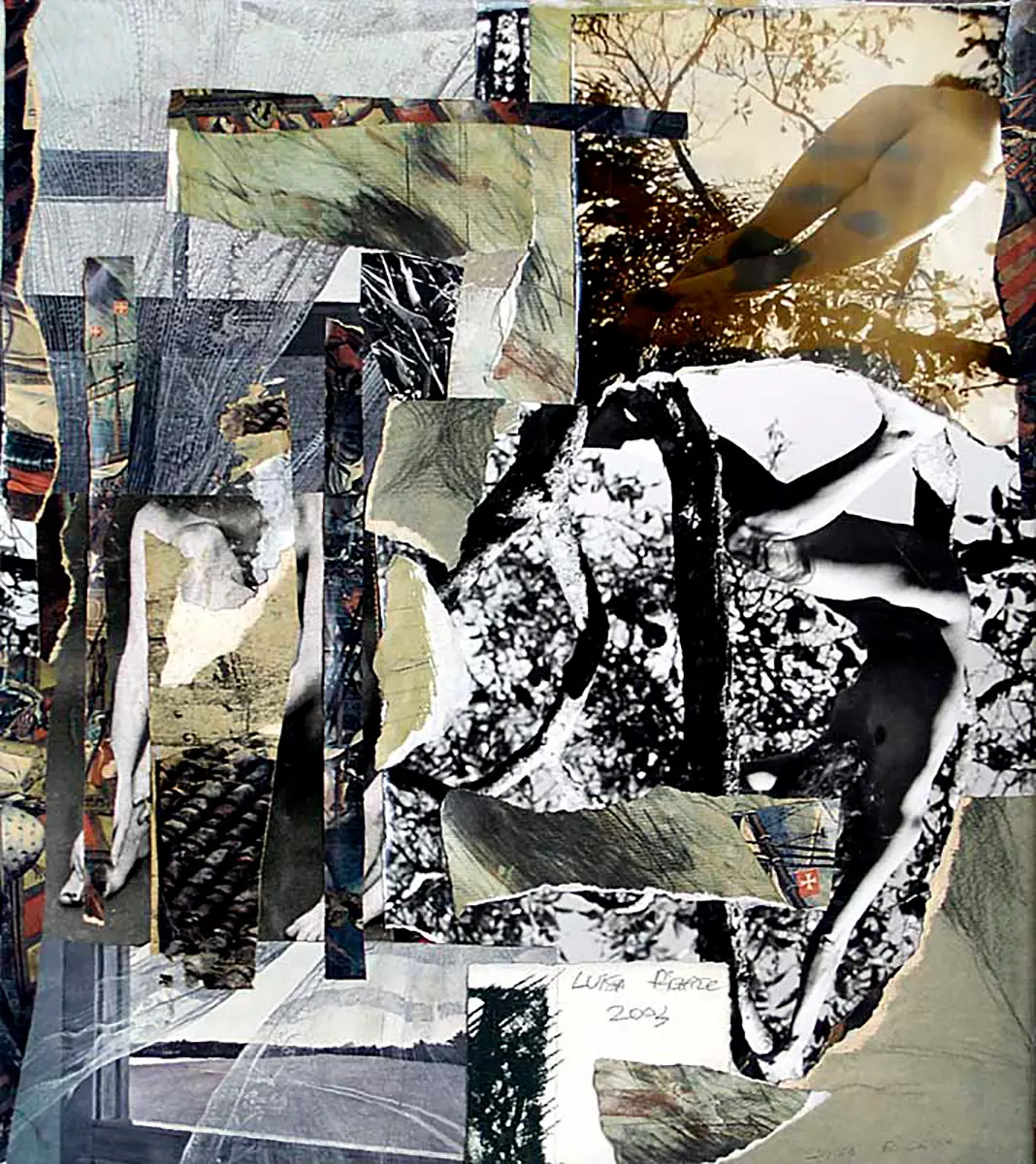
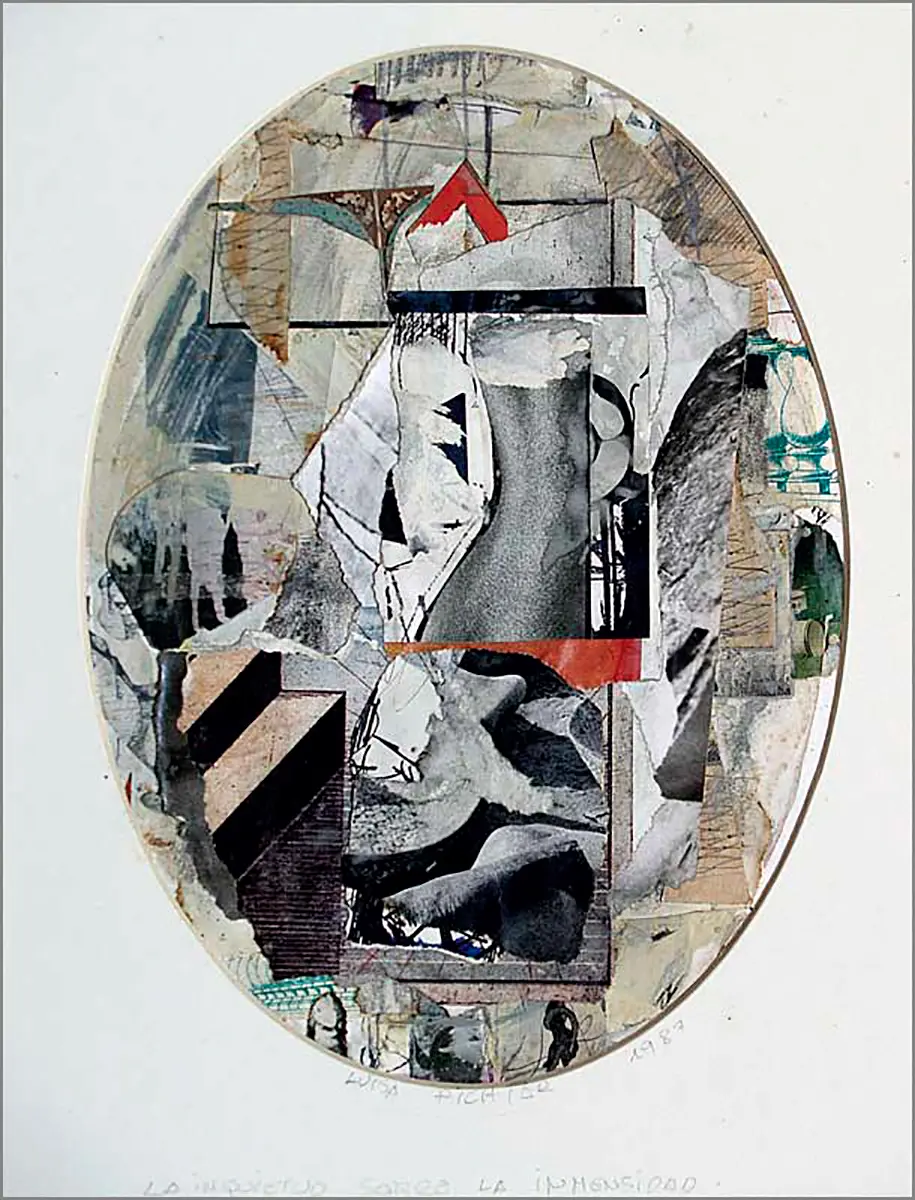
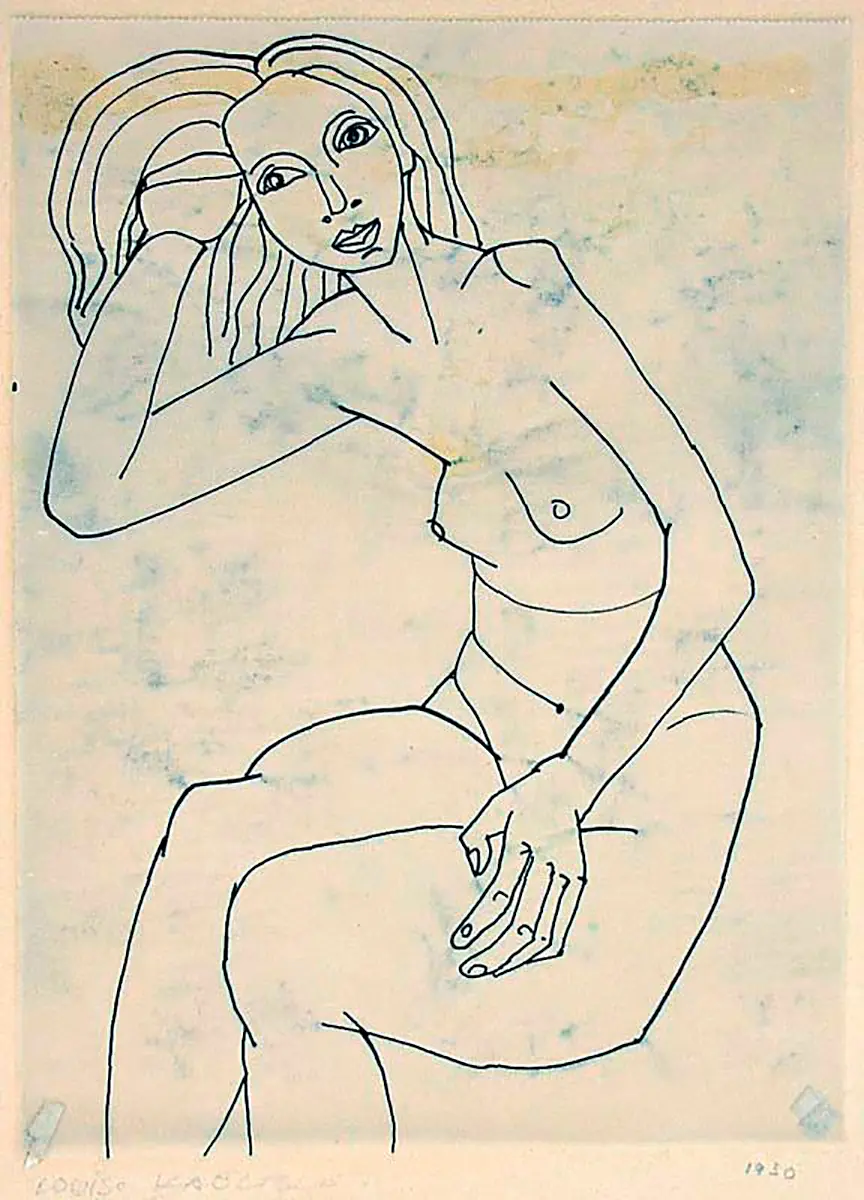
Collages and drawings are self-sufficient items in the context of Richter’s oeuvre: visual and aesthetic proposals of inescapable content and force. On the other hand, they have also been important resources for her pictorial language, conditioning the conception and execution of her paintings. For Richter, collage is “and ordering of debris / a whole made of fragments. / The concepts and parts extracted from their matrix by the loss of a univocal meaning acquire an unsettling life of their own. / No longer defining / objects or meanings / they are their own matter, / their specific weight, / with sharp / and decisive outlines,” 9, and, as Marta Traba wrote, “through a system as clearly associative as it is anti-structural, Luisa Richter develops successive luxuries, creating magnetic fields that, in turn, are irradiating.” 10 Richter’s collages transfigure her own life, counterpoising successive images from her lived experience and observed reality; in Un bolso lleno de recuerdos (1977), the visual presence of dissimilar objects fluctuates between the apprehended and the learned, between the seen and the imagined, and the simultaneity of images, in quick film-like succession, produces open and closed expressive rhythms. We deduce, then, that what the artist explores through this complex technique is the superlative refinement of the element she has selected—fragments of life, of remembrance, absences, and presences, pieces of photographs—to put together her mysterious photo-collages, for instance La inquietud sobre la inmensidad (1987) and Transparencias naturales (2003).
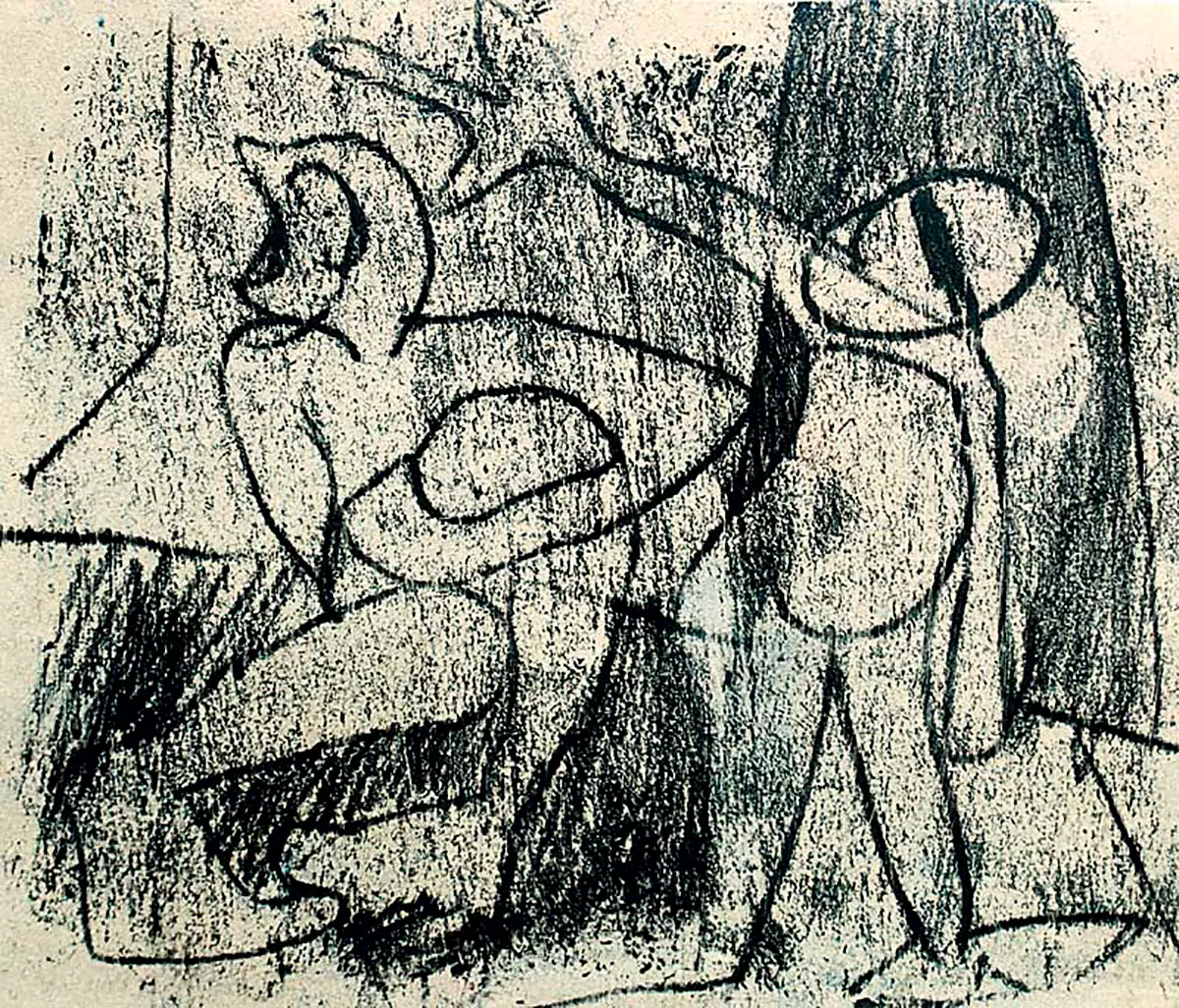
With regards to her drawings and collages, one could speak of visual proposals of almost baroque perspective and space; the compositional visuality takes us to structures that are analytically harmonious thanks to strokes that “cross” the support in a seemingly arbitrary fashion: El Aleph (1993-1994) or Anhelos y nostalgias (2005). What predominates here are linear drawings organized into strong gestures that energize the pictorial surface. In consequence, and in a kaleidoscopic reaction, the structure-whole, i.e. the theme, organizes the variability of the different planes. We are dealing, then, with the exact relationship between the gathered tangent-axis that, encased one within the other, motivate formal actions defining the thematic meaning. Through the correspondence of a single force, the superposition of planes turns the perspective, already multiple on its own, into a plurality of space and time.
Manifestoes of Past and Present Time
Often, the titles of Luisa Richter’s solo exhibitions are key contributors to deciphering the implicit meaning of the works included in them. The titles became more significant in the late 1990s, when she presented Larga travesía at Medicci Gallery (1999) and Hojas de mi diario at the Museo del Diseño y de la Estampa Carlos Cruz-Diez in Caracas (2001). Both exhibitions expressed Richter’s deep interest in art theory and philosophy, as well as her life experiences and her experiences as an artist. Similarly, Los recuerdos se hacen presente, at Medicci Gallery (2002), also expressed the fluidity of time and space in her painting, through Manifiesto del tiempo, at Galería de Arte Ascaso (2007), a magnificent remembrance of what exists and doesn’t in life and in memory. In Luisa Richter – Memorias, Medicci Gallery (2009), an anthology show fully exemplifying the lucidity of an artist who always knew her destiny, with works from the late 1940s such as her charcoal-on-paper drawing Sartre and the China-ink-on-paper drawing Desnudo (both dated 1950), to some from the first decade of the Twenty-First Century. The titles of the exhibitions and of the works themselves, with an intentional logic, offer clues for uncovering the deeper meaning of master artist Luisa Richter’s creative universe.
NOTES
1. Luisa Richter. Ecos y reflejos. Fundación para la Cultura Urbana. Cuaderno 16/Testimonios. Caracas, May 2009. p. 23.
2. Luisa Richter. Armitano Editores, C.A. Caracas, March 1992. p. 33
3. Catalog Memorias Luisa Richter, text by Eduardo Planchart Licea, Medicci Gallery, Caracas, September 2009-February 2010, p. 7.
4. Catalog Vértigo del tiempo. Text by Ricardo Pau-Llosa. Medicci Gallery, Caracas. February 2004.
5. Quoted in the catalog Luisa Richter Manifiesto del Tiempo, text by Ricardo Pau-Llosa. Galería de Arte Ascaso, Caracas, 2007. p. 7
6. Catalog Vértigo del tiempo. Text by Ricardo Pau-Llosa. Medicci Gallery, Caracas. February 2004
7. Luisa Richter. Armitano Editores, C.A. Caracas, March 1992. Pg. 15. Albrecht, Hans Joachim. Escultura en el siglo XX. Editorial Blume, Barcelona, Spain, 1981. p. 60)
8. Catalog Memorias Luisa Richter, p. 11.
9. Escultura en el siglo XX. Editorial Blume, Barcelona, Spain, 1981, p. 60.
10. Luisa Richter. Armitano Editores. p. 115.
BÉLGICA RODRÍGUEZ
Art researcher and critic. Teacher. Honorary International President, IAAC.