
The border as the site where two territories are divided, be it due to cultural, natural, social, or economic factors, is both an imaginary and legal notion and it implies innumerable complexities in terms of multiculturalism and concepts of identity that derive from migratory flows, the idea of sovereignty, extreme security and control, the legal and illegal traffic of merchandise, as well as a variety of political and historical realities.
All of this comes to a head in the US/Mexico border, specifically, the crossing between Tijuana and San Diego, deemed the world’s most heavily trafficked border point. For over twenty years, this has been the central theme and field of study for Marcos Ramírez Erre (1961), a Tijuana-born artist who has explored throughout his career ideals of conviviality and human development in the area is a critical, symbolic oeuvre that confronts the viewer with the realities of the border environment.
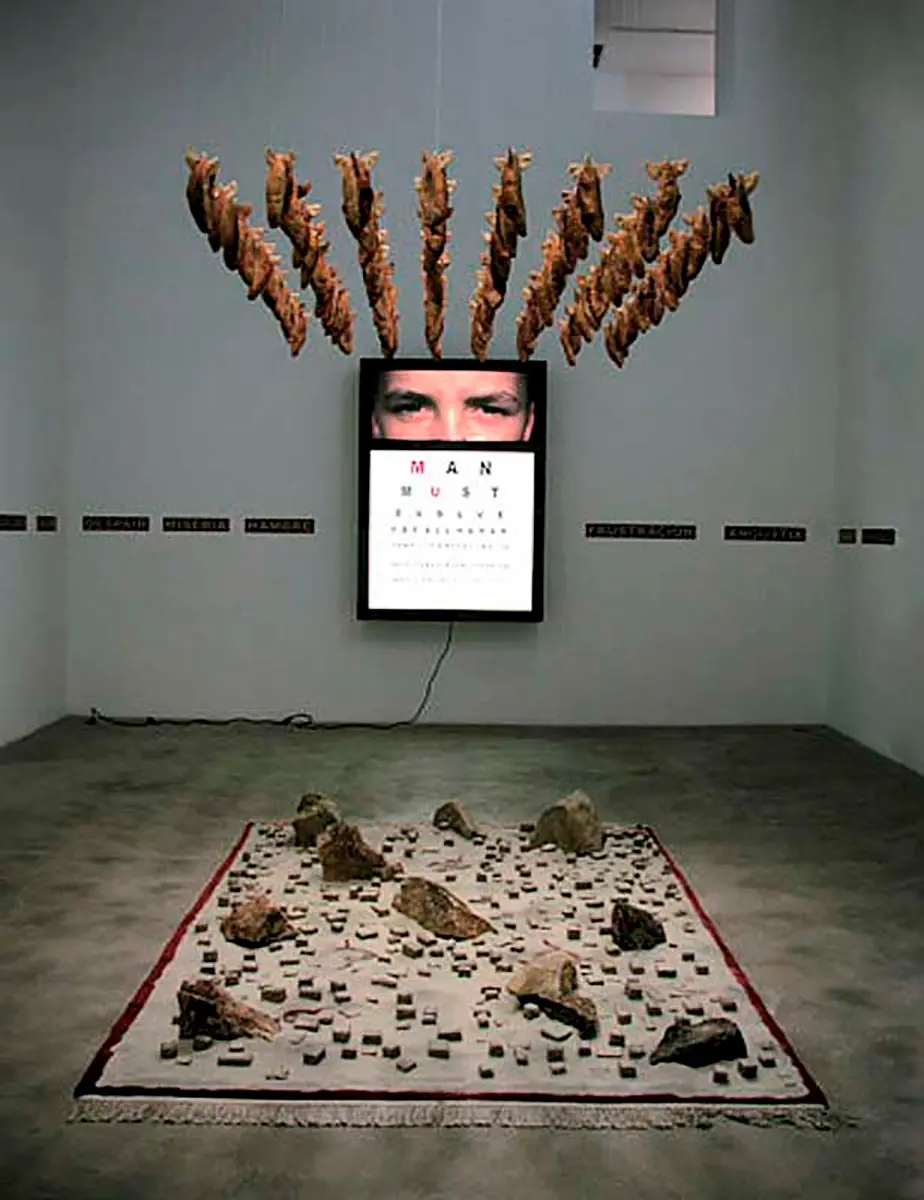
La reconstrucción de los hechos, a mid-career retrospective presented at the Museo de Arte Contemporáneo Carrillo Gil, includes some of the artist’s iconic works, more recent works, and works that had never been exhibited in Mexico before. A new corpus representing Ramírez Erre’s current conceptual and aesthetic explorations will simultaneously be on exhibit at the LA<>ART festival in Los Angeles, California.
Curators Kevin Power and César García wanted to present a critical perspective on Ramírez Erre’s work and show the connections between political, social, and cultural issues and the contradictions of the human condition in geography with such specific characteristics.
Marcos Ramírez Erre’s work is intent on collectively creating an environment of poetic questions, a series of relationships of dialog with the viewer that render the latter an involved subject rather than a passive entity—a subject charged with the responsibility of taking an active role in producing the tensions expressed by the works.
The show is arranged in three different levels, each independent of the others: exhibition, dialog, and discourse. The exhibition part is built like a timeless dialog between the artworks, which are displayed in a non-linear fashion. The dialog part is comprised of a series of interventions with the participation of the artists and a number of specialists. The discourse part is based on a selection of archival material related to works that were not included in the show and a series of programs sponsored by Estación Tijuana, which is not only the artist’s studio but has become a center for contemporary art, architecture, urbanism, and popular culture.
One of Ramírez Erre’s most representative works is Toy-an Horse, a monumental wood sculpture 10 meters tall, 9 meters long, and 4 meters wide at its base, created on the occasion of the border region’s most important bi-national art festival, InSite, in 1997. The sculpture was installed precisely at the dividing line between Mexico and the US, in an allusion to the mythical Trojan Horse through which that city was overtaken by warriors hidden inside a wooden horse. In Erre’s sculpture, the horse has two heads, symbolizing the mutual exchange or invasion; the very presence of this object in that precise geopolitical site directly interrogates the relationship between the two countries.
His work revolves not only around the idea of the border in the San Diego/Tijuana region but also around the concepts of power and domination, as well as the implications of war. To represent his concepts, Ramírez Erre moves from painting to sculpture, from drawing to installation, from photography to video.
Another one of Ramírez Erre’s important and celebrated works is Oro por espejos, which unfolds through five sculpture installations. Originally installed in Los Angeles, before the 2000 presidential election in Mexico, this work interrogates in a direct way the syncretism at the base of Mexican culture and identity, the relationship between the pre-Columbian and Hispanic legacies, as well as concepts of domination and colonialism. Oro por espejos alludes, automatically, to the exchanges between Spaniards and Central American indigenous peoples.
Thus, the constant theme in Ramírez Erre’s work has been the salvaging of history, of memory, the notions of the local and the global, peering into the border between the personal and the collective. His work is founded on the conviction that art is an instrument for social change and an effective medium to communicate the way in which identities are perceived and nationalisms are blurred or reinforced, and the way in which this generates, among other things, cultural clashes and relationships of power. To a great degree, this promotes a reflection not only about certain sociological or cultural phenomena but a personal consideration of the idea of the Other.
ISAURA RUIZ