
For Nelson Leirner creation reveals an ample, varied, and uncertain landscape of images that life establishes and develops as a resource for our survival.
To provoke, to subvert expectations, to assort the levels of comprehension, and, especially, to invest in everyday humor, is the tonic that pushes the visual poetry of this master of associations forward.
The exhibition titled Nelson Leirner 2011-1961= 50 Years, is presented at the Galería de Arte do SESI, in São Paulo. Amid a kaleidoscopic environment, the exhibit includes an endless number of the associations Leirner has proposed during five decades of artistic endeavor.
Framed by other periods that are part of the gallery’s curatorial proposal, the interaction with his most recent works is elicited by each of the places of an invention created to meditate on accounts of the mundane.
In walking through the space that showcases Leirner’s paintings, objects, and installations—in each environment of the exhibition space—viewers encounter the strategies of an acid creator who is essential to contemporaneity and the agent of many narratives.
The invasive surgical operation that moves Leirner toward the collection of mass culture, is the mark and itinerary of many aesthetic interests that are legible in the curatorship by Agnaldo Farias.
According to the art critic’s proposal, the exhibition that celebrates the vitality of this tireless creator consists of three moments of a visual poetic in endless activity: “work (…) that is regarded as one of the most provocative in the history of Brazilian art, with iconoclastic pieces based on the persistent deactivation of the notion of art.”
During the mid-1970s, Leirner stopped painting and began to listen carefully to the potential of industrialized objects. His fluctuating auditory sensibility followed the echoes of Dadaist poetics.
Acting as an active agent on each chance encounter, the artist endeavors to find various objects and persevere to entangle the usual understanding of everyday life.
Noteworthy among the many works exhibited, is the particular milestone reflected on the works created between 1965 and 1994 that represent a compelling record of his opposition to the violence institutionalized in Brazil after the 1964 military coup.
Constructed with chrome steel, mirror glass and cut out wood with 16 locks and 15 keys, the piece titled Você Faz Parte II (You are a part in here II) reveals the exception to the rule: an open cut out, a lock without a key, and a calculated opening, as the background reflects the faces of the spectators who recognize themselves as protagonists in the criticism toward the political environment of the time.
It was not the first time Leirner questioned the status quo of the artistic world, or that he challenged the comfortable readings, or pushed forward his political struggle as he established his fighting fronts.
A case in point was the exhibition titled Exhibition-No-Exhibition, the staging of the closing down of an art gallery in São Paulo (in 1967). It was a proposal that could be interpreted as a strategy envisioned by the artist to subvert expectations.
The closing event at the Rex Galería, a space Leirner opened together with a group of friends—Carlos Fajardo, José Resende, Wesley Duje-Lee, among others—to question the artistic establishment, concluded with the opening of an exhibition by Leirner foreseen as an act of political and conceptual resistance.
As a result of the attention, the exhibition was able to attract amid the artistic environment of the time, the event gained importance among the members of a generation that did not believe in the established artistic system and that proposed the incorporation of poetics of process.
There Leirner testified—amid the realities constructed by a conscious or unconscious desire to coexist with the image—about some aspects of the precarious state of the contemporary.
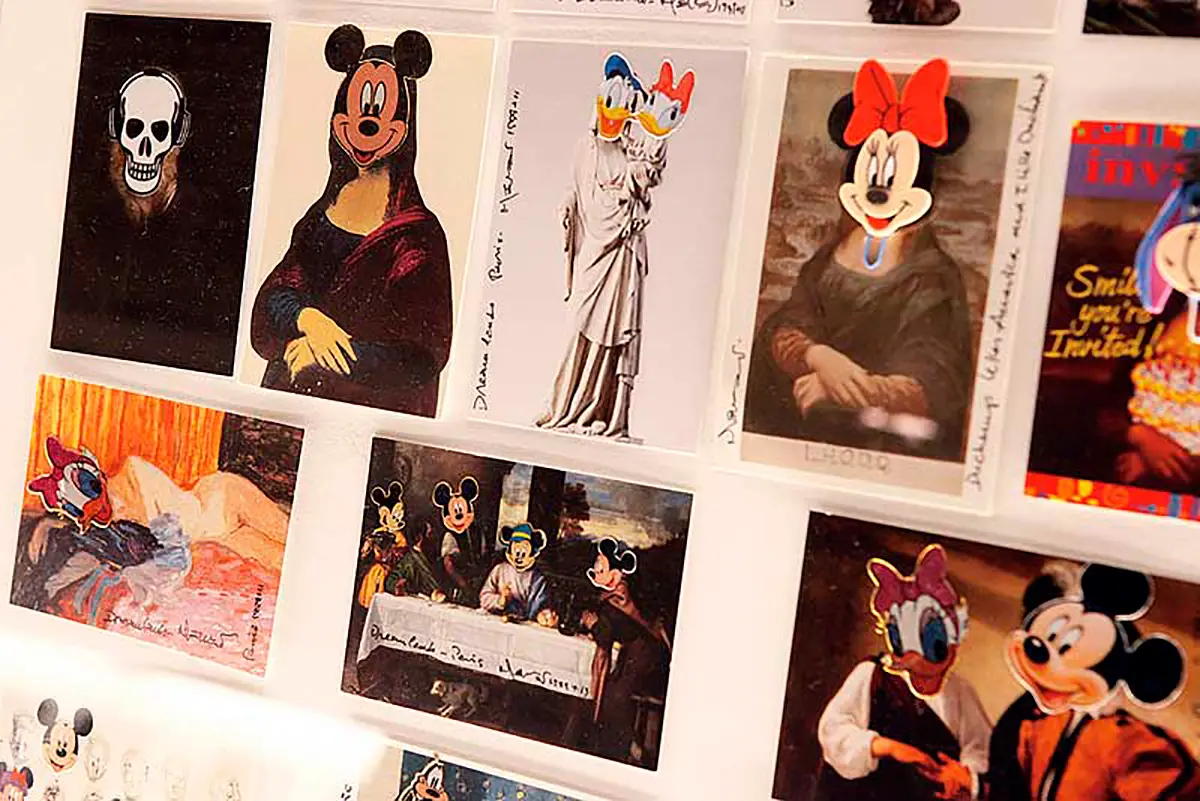
The constant use of stickers in his works—self-adhesive stamps that are particularly damaging to the childlike-young imaginary—incorporate fertile associations into his visual poetic.
In this emblematic exhibition of visceral compilations, the never-before-exhibited installation titled Hobby (1 Ninguno 1000.00) (Hobby [1 None 1000.00], 2011), created during the last fifteen years, Leirner gathered supports of every kind—invitations, postcards, bills, magazines, books, stamps, and photographs—with the marks and scars of a reinvented appropriation through the collage of the so-called stickers.
Every piece, every support—whether an invitation for the opening of an art exhibition, or a postcard—receives a calculated intervention, and one or more stickers, as a signal that frees the image and allows the invited viewers to tell their own stories.
Like in the novel by Luigi Pirandello, Vitangelo Moscarda, the main character in Uno, ninguno y cien mil (One, None, and a Hundred Thousand), can be the result of the “coexistence of opposites,” of that unavoidable fact, of that fate full of maneuvers that are certainly not known to us.
In his most recent installation, Nelson Leirner once again addresses life: that enormous display window in which he places all the pieces he collects to show us a few rules about the game of human nature recreated.
CLAUDIA FAZZOLARI