
It has been a long time since I met an artist who blushed during an interview. And this was something that really caught my attention about Óscar Santillán (Guayaquil, Ecuador, 1980). He turned red when I told him that I sensed the struggles of a tormented spirit in his recent exhibition entitled Azor at the DPM Gallery, Guayaquil. His discourse successfully manages to navigate the conceptual mess of today. This success has earned Santillán various scholarships abroad, a teaching position at the University of the Arts (Uarts) in Philadelphia, as well as the right to participate in the 11th International Biennial of Cuenca that will begin in the month of November.
Is it really relevant whether or not Oscar lies to us when he tells us that he achieved his halos and water drops without the help of Photoshop? Or if the ashes that he shows us are actually from a jackal or a northern rabbit? Azor addresses the way to attract attention through a visual grammar centered on “the essences” that—in the face of reality so prone to epidermal gazes—could likely take by surprise the average viewer. There is in this creator a spirituality that is skin-deep. Some years back, and until approximately 2007, Santillán demonstrated through art—and through a Latin American political conceptualism that, in his particular case, longed for a way of life inclined toward the militant support of the Grupo Ruptura de los 25—his adhesion to the New Left in Ecuador. His piece entitled Memorial consists of a copy of the New York Times without any actual, physical, text. On one of the edges of the page, there is the drawing of a tiny deer—rendered with all the ink extracted from the periodical through a chemical process performed by a chemist—that marks a period of transition toward his most recent line of work.
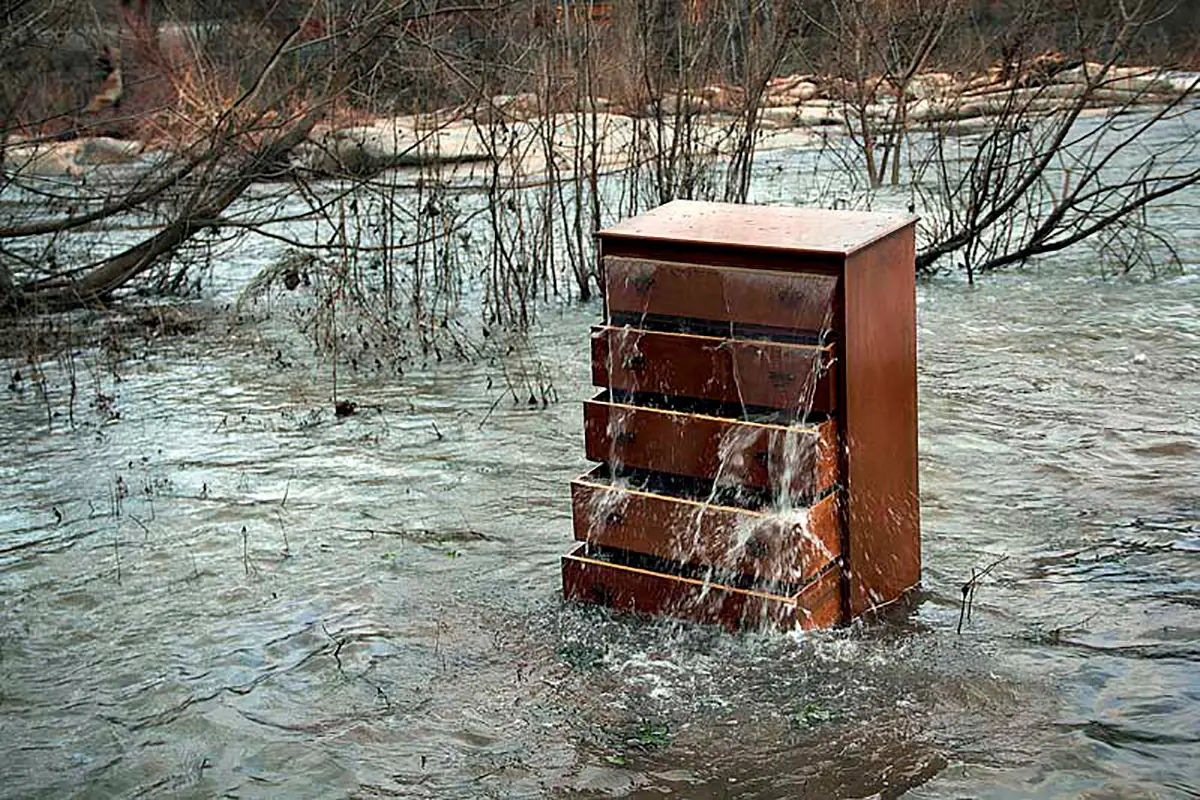
Distanced from political endeavors, the current maneuverings by Santillán stem from an interest in the phenomenology of events without regard for their nature. The artist himself explains that at one time in his life he realized the fallacy of feeling committed to the political events that surrounded him, as he began to question the sinuosity of certain tendencies in such context. Now closer to the thinking and methodology of Edmund Husserl, he aspires to the strict understanding of phenomena while orchestrating a “return to the things themselves.” Santillán’s proposal leaves us with the feeling of mystery that many avoid; a complexity essential to the processes of comprehension. He ponders—in a scientific-like manner—on the established relationship between facts and the environment of the psychic or conscience in which this reality settles. According to the definition found in the Enciclopedia Libre Universal en Español, Azor is a medium size bird whose body shape is similar to that of a sparrowhawk—although the species is more closely related to eagles. The hunting characteristics of its body enable it to hunt in the forest as the bird lies in wait for its prey by staying on a vantage point from which it can observe its territory and locate any potential prey without being seen.
The exhibition reveals the endeavors of an artist “with gumption.” Save for the graphite on canvas works that do not capture the compelling nature of his “wandering gaze,” the rest of the pieces present a production that expands across disciplines: photography, video, sculpture. We are left with many questions after observing the piece The Wealth of Nations; a title that borrowed the magnum opus of the same title by Adam Smith, the so-called “father of political economy.” He made a mold from the original book and then recreated the object with transparent resin, in order to address the Scottish economist’s controversial thinking, as Smith proposed the existence of a “natural order” that controls the market and dominates people. In spite of being a text written in the 18th Century, Santillán feels compelled to point to its relevance today.
After completing a scholarship in Contemporary Sculpture and Expanded Media at the Virginia Commonwealth University (VCU) in 2011, Santillán became a professor at a university in Philadelphia. He is aware that nobody is a prophet in his own land and, at the same time, he worries about the repercussions of this 180° turn on his work. In Broken Land, Santillán gives us two portions of land: one flushed to the floor graced by a small display of weak vegetation; and another that is elevated—and full of vegetation—and suspended on the air by a magnet hidden from sight and attached to a long chain that links both works. Santillán puts on his teacher’s hat to comment on the inconvenience of “thinking oneself” as Ecuadorian.
This artist’s post-conceptualism is enjoyable to the extent that he chooses not to take a dense or inscrutable approach. He is also conscious of the need to search for complexities, and he is precise in the prioritized localization of that which we can continue to call the mystery. I sometimes think of him as a combination between that likely to be a deceitful coyote or demiurge gnostic, and the various anthropological approaches of analysis in the Lévi-Strauss style that also includes a little bit of Beuys’s stamp. It is as if he crossed out the meanings to try certain challenges during the intellective process. This is the way I perceive Santillán in A Knife To Defeat The Night’s Breeze, where he references the great German artist and shows us a ludic approach in order to leave us a wide-open road ahead: Is it more important to adore Beuys or to analyze him, to deconstruct him or to enrich his legacy (to call it something)? Here, the artist reminds me of Hegel, to whom the pleasure generated by the archeology of knowledge was based on the search for truth and not on the end result. A knife whose entire shape we must mentally complete is constructed from the ashes of the cremated coyote, contained in acrylic plates as the equivalent of layers of meaning that we must unearth during the oblique road to knowledge.
Also noteworthy of mentioning, because of their symbolic significance, are the videos entitled The Cannibals and Telepathy Manifesto. The term used in the former may respond to different approximations having to do with the density of the sign. But every approach underscores the existence of the dominant and the dominated, which Santillán attempts to subvert when he chooses that which is perhaps the most extensive of significations: the one that points to the act of obtaining the strength and courage of your enemies through the consumption of their flesh. This piece was created with the collaboration of UK artist Signe Schmidt. It consists of a loop with the moving image of a horse dominated by a rider—not in sight—who is constantly blurring the lens with his breath as he exhales. The movement ends when the animal is forced to stop by the presence of an obstacle that blocks its way. The environment becomes thicker in the apparent stillness of the action. The author invites us to a revision of history and its subsequent restoration by the actors.
On the other hand, the Telepathy Manifesto establishes a dialogue centered on human feelings—including the sense of variety that pertains to the range of effects—achieved through a substantial lyricism. The absurdity of the plot throws light on the much-needed and, on occasions, distant human affection.
Azor left the artistic art scene from Guayaquil energized. Santillán must be followed closely. At any moment he can surprise us with his discrete exercise of invention, as he undermines our conventional way of confronting “the real.”
AMALINA BOMNIN