
Argentine sculptor Pájaro Gómez is currently showing a group of 15 recently created sculptures, along with another two pieces from 1989—presented in a separate space—at the Galería Laura Haber.
It is interesting to confirm that the qualitative factors that defined his importance as a sculpture, not only have survived with the passing of time but have also reached a higher level of maturity.
Few sculptors organize the exhibition environment the way he does, by approaching it as a whole and by developing ideas—in implicit and explicit lines—that progress from one work to another.
Energy takes on a resounding leading role in the works by this artist, who relies on a minimal number of elements to achieve a maximum degree of tension.
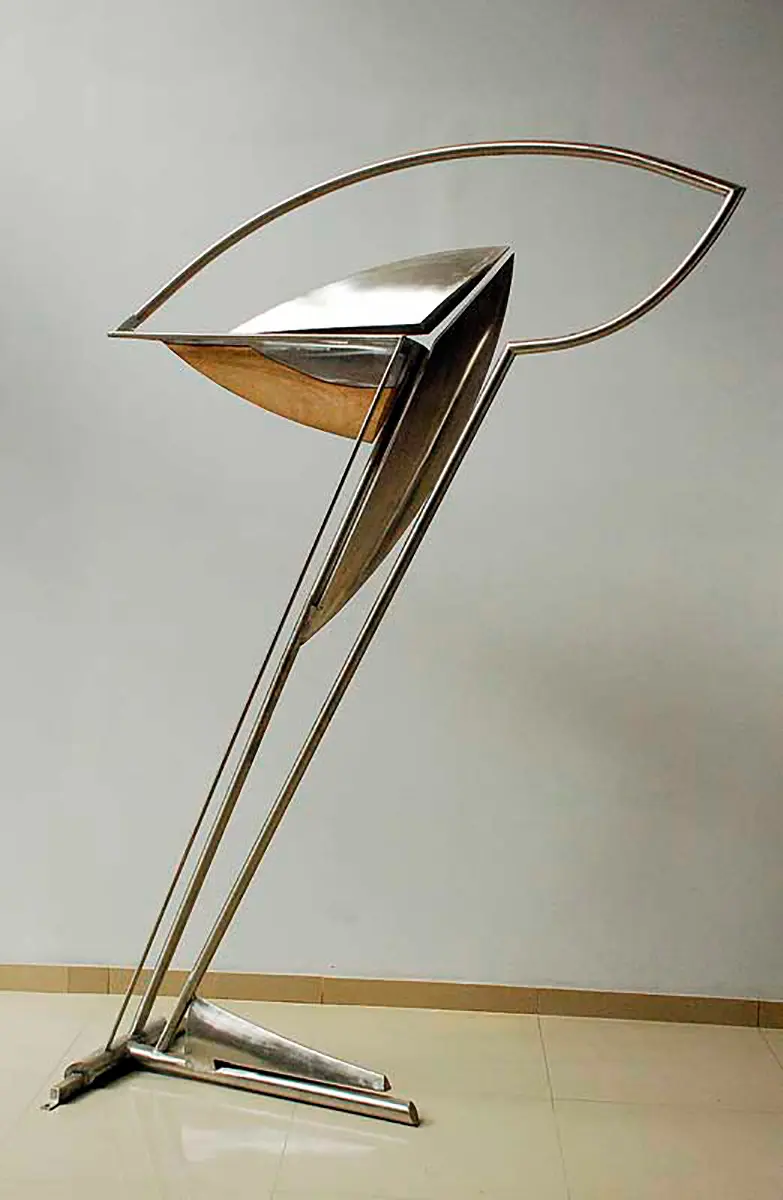
Nothing is visually static about the works; nor the volumes, the coordinates, or the possible turns of the articulations that do not solely move in one direction but also perform several types of movements within the space.
In a chapter of his personal life, when he used to practice archery, Gómez would spend hours feeling the tension of the bow. He was obsessed with that contained force he endeavored to unleash in order to reach a target.
He brought that experience into his work in the form of a constant need to infuse energy into matter, as he would also reference the shape of the bow in some of his works.
Gómez’s triangular shapes and acute angles—recurrent in his work—also contain an extraordinary infusion of energy. The heads of the arrows are triangular, the planes come together to form acute angles, the tensors draw triangles on the vitreous surfaces. As Kandinsky once said, “the acute angle is the tensest, warmest, and also sharp and highly active.”
This way, space is created in which latent energy can be perceived flowing through it, generated by the forms and the reference of ancient arms and tools.
Acting as the central catalyst of that preoccupation is the unstable nature of works whose structures are always based on diagonals, degrees of inclination, and circumstantial equilibrium.
The manner in which Gómez uses metal in sculpture is very interesting. He forsakes the traditional parameters of constructivism and reconciles the weight of the metal with the apparent lightness of the glass.
His works always appear to have an ethereal quality to them. They are nevertheless powerful and elegant because of the structuration of their moving articulations, and for their planes that do not present any opposition but rather—through their transparent condition—communicate and establish connections, while multiplying the ways in which they can be observed. The tensors in charge of dematerializing their presence to the maximum, contribute to the levity of the image.
The radiant energy of these sculptures ensures that, when observed as a group, they acquire a musical quality because of their rhythmic glide.
This exhibition showcases the work of one of the most relevant sculptors working today in Argentina.
NELLY PERAZZO