
The most recent work by Pedro Fortunato-Velázquez is a remarkable interpretation of the hydraulic mosaic, known in Puerto Rico as losa criolla. This type of floor tiling was introduced in Puerto Rico in 1900 and originally came from Catalonia. It was used to decorate residences from that time as if it were a colorful rug framed by borders that harmonized with the main design.
Nonetheless, the paintings by Fortunato are very different from those tiles. The designs of the traditional tiles consist of modules that are repeated, with brilliant—and sometimes even loud—colors, and floral motifs combined with geometric patterns. But Fortunato subjects that traditional design to an analysis that rejects the formal characteristics and aesthetic values of the traditional designs series titled Cardo and Decumenus1 is remarkable for the purity, sobriety, and elegance of forms subjected to rational analysis. The examination begins at the drawing table, as a fragment of the hydraulic mosaic’s design is reduced in scale and a grid is added to it. The design is analyzed or defragmented on a computer. Then values are assigned to the colors of the defragmented design and are quantified. Through a three-dimensional grid prepared by the artist, the design of the mosaic is translated in the canvas into hundreds of small frames of many colors set in relief. The small frames of color that are glued and ordered according to the results obtained from the analysis of the hydraulic mosaic reveal an almost mechanical process of creation. Each small frame of color is the result of the submersion of a plastic screen or a large grid into a bath of pigment. The areas of square colors on the canvas are reminiscent of populated areas in ancient Roman castra, while the roads that divided them are, in the paintings, the wide strips that divide the pictorial plane asymmetrically. The calibrated chromatic range and the placement of the small squares in the composition through a depurated analysis, result in an image that is the opposite of excess, lack of moderation, and ornamentation; distinctive traits of the abstraction of recent years in Puerto Rico. The asceticism in the composition, form, and color, represents an imposition freely assumed by the artist and translates into the rejection of ornamentation, understood as the denotative sign of kitsch and luxury from a cultured obsessed with consumerism, stridency, and excess.
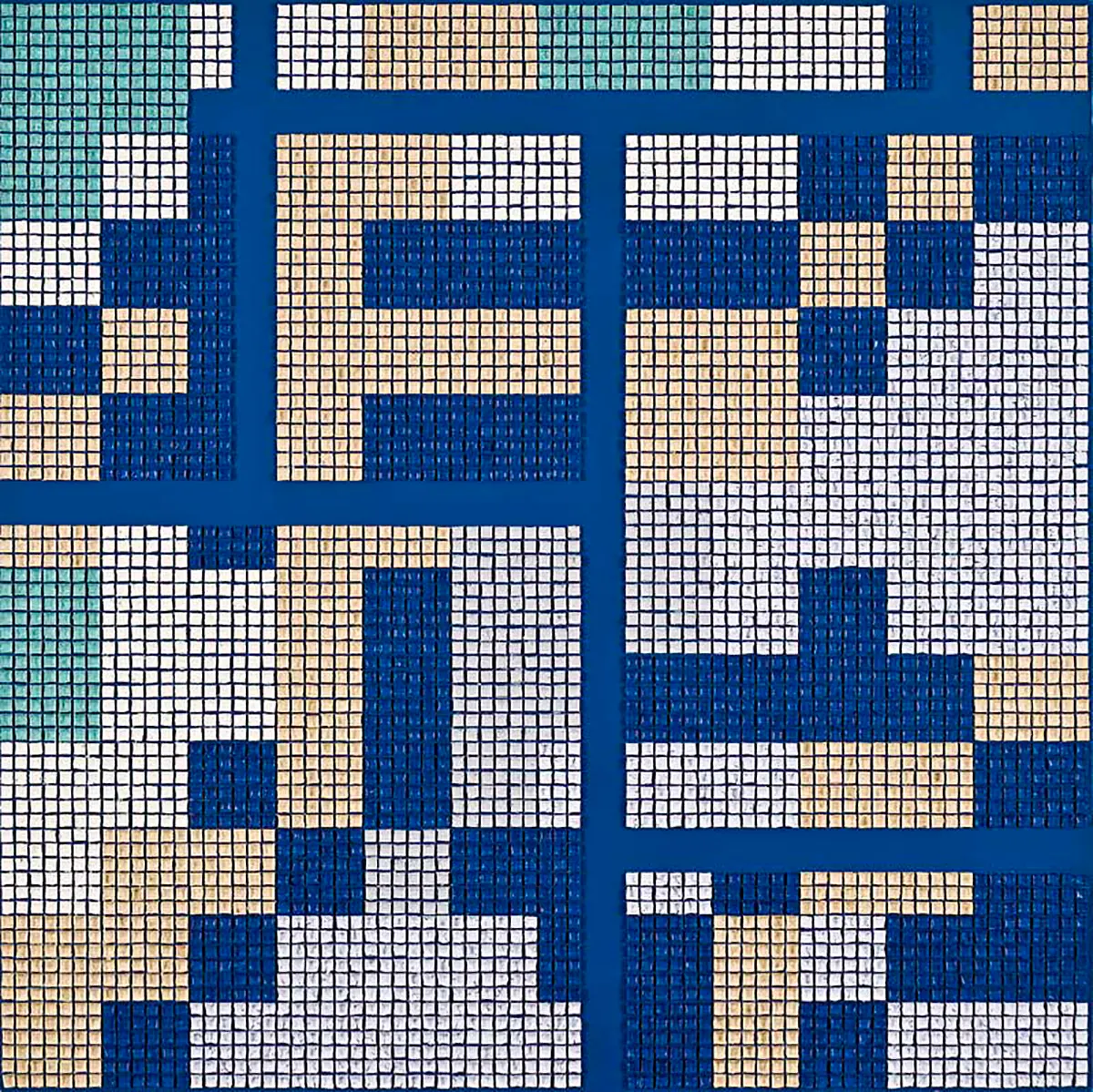
Fortunato-Velázquez combines and contrasts manual work and computer work. Hand and machine share a leading role in the creative process that binds his proposals to a Puerto Rican architectural element that vindicates the work of builders and bricklayers. His work also associates the history of architecture and Roman urbanism with that of ancient and contemporary Spain. The floor is replaced in this exhibition by a canvas wall that honors the place we are used to stepping on; a metaphor for urban spaces in contemporary cities that have surpassed the idea of the metropolis. The canvases stand out in the organization of ancient Roman castra for solely bringing out on the pictorial plane an eccentric and enlarged fragment of what can be described as the plane of orthogonal defined by cardo and decumenus.
The grid of the castrum has been replaced in postmodernity by models like those generated by fractal or by the rhizome. This results in images that instead of being examples of absolute symmetry, precision, and uniformity, are rather reiterative, fragmented, and irregular symmetries. According to Benoît Mandelbrot, the one distinctive characteristic of a fractal is to be self-similar when its parts have the same form or structure than the whole, and when it is presented on a different scale and appears slightly deformed. The process followed by Fortunato is similar to Sierpinski’s in the construction of a fractal known as a geometric carpet. While the mathematician relies on a square to build reiterative series, Fortunato relies on a module of the tiles to end with its amplified fragment. The repetition of the geometric figures that occur in Sierpinski’s work cannot be found in the individual works by Fortunato-Velázquez. But it is nevertheless present in the totality of the series of 12 similar, but not equal, canvases.
The work of Fortunato-Velázquez reveals a confrontation between the artist and the exterior world. His geometry, opposed to the relentless change of the urban space, is a rational model that pursues a timeless and absolute beauty. Nonetheless, by rendering irregular squares and by creating canvases-walls with mobile spaces that lack logical continuations, the artist reveals the impossibility of completely canceling the arbitrary nature of reality.
Wilhelm Worringer once explained that the desire to abstract finds its roots in the artistic will to extrapolate objects of the external world from the infinite mutations that all beings are subjected to; in an attempt to detach it from any arbitrariness and to make it unchallengeable. Such pursuit is present in Pedro Fortunato’s work as a drive that calibrates opposing poles: namely, to affirm and negate or to show and to hide. These are dualities that express the psychic needs of human beings as they confront the natural world. Understanding that he is part of the temporal, imperfect, and variable nature of the world, Fortunato offers a brand of geometric abstraction that is influenced by a vision of time intersected by philosophical systems, scientific paradigms, and artistic practices aimed at revealing its complexities.
NOTE
1. The grid of ancient Roman cities was organized around the intersections between two main streets that ran north-south (Cardo) and east-west (Decumenus) respectively. Where these two streets intersect, either a Roman forum or a market was erected in this intersection.
INGRID MARÍA JIMÉNEZ