
In his first solo show in New York since 2005, Pepón Osorio (Puerto Rico 1955) is back con to’ los hierros at Ronald Feldman Fine Arts Gallery. This good-humored exhibition is a tour de force of four recent works in which Osorio uses performance and social sculpture to maintain an active dialogue with the community.
In the storefront of the gallery, and welcoming the exhibition, is El Arresto (The Arrest) (2011), a live performance collaboration with a fully tattooed Latino artist, Jason Gómez. The performer, using a pose that imitates the well-known Sacred Heart of Jesus tableaux, sits still behind a 3D sheet of holographic plastic glass that creates a surreal distortion of his image. His eyes fill with tears (in fact, a bloody one seems to escape silently out of the end of one eye) in a way that enhances the realism of the “holy vision.” His outfit – jeans, a white wife-beater-shirt, and a Yankee cap – defines him as an urbanite. Still, he seems to be naked, dressed entirely by the green chain-of-thorns tattoo drawn as an endless snake across his exposed torso.
El Arresto creates a space of philosophical reflection between the sacred and the mundane. The urban-sanctified character is a contradictory image, a representation of beauty and anger. His look is commonly associated with law offenders but he is the incarnation of the One who paid with his body for our collective sins. The holographic vision of a live Jesus is a mischievous reference to the deep religiosity of a significant segment of the Puertorican and Latino communities and rooted in popular culture. Traditions and customs that define a culture are used as mechanisms to carry out an identity apart from the global one imposed by multicultural and media interaction, like the coming-to-age celebration for girls who reach fifteen.
Quinceañera (2011) is a plastic hand decorated with a synthetic orchid holding a paper plate covered with aluminum foil, suggesting the leftovers after a party. The idea is reinforced by the vinyl text next to the piece that describes a friend’s enjoyment at the end of the party when partygoers argue about who is going to take home the table centerpiece and extra cake.
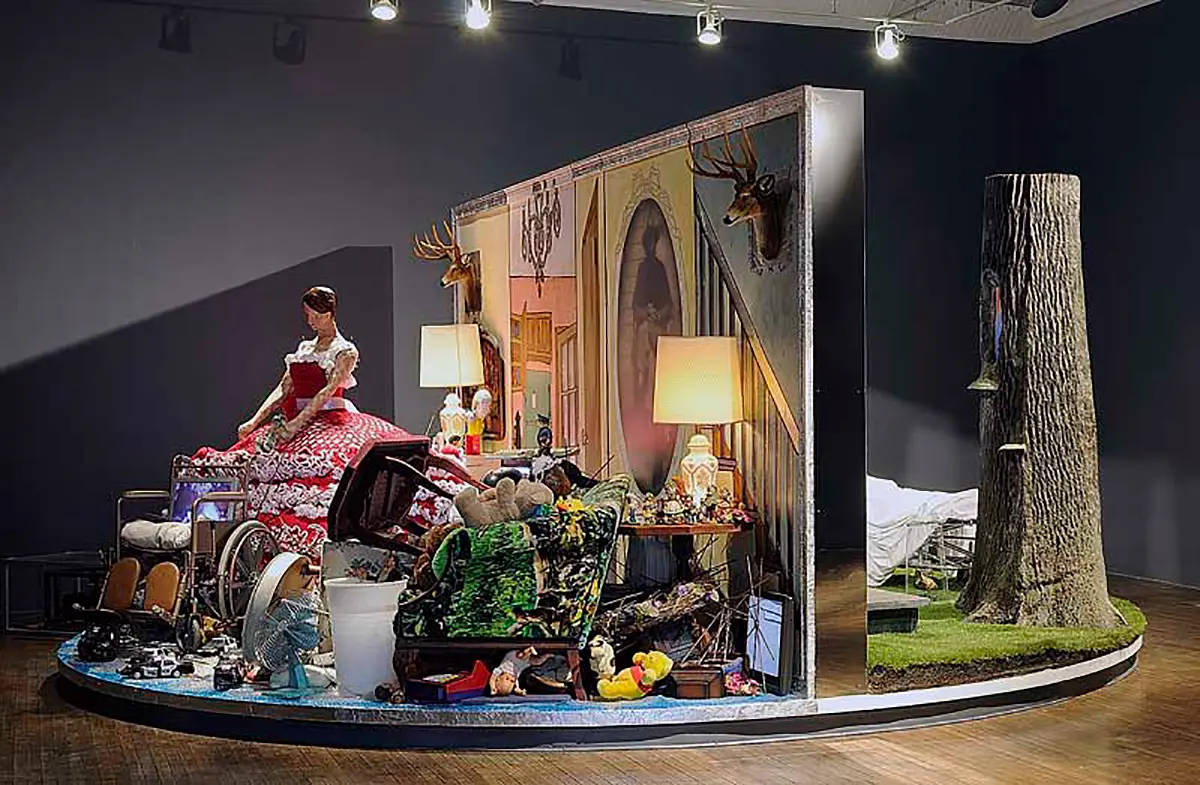
The pride and joy of the show, Drowned in a Glass of Water (2010), is an 18-foot rotating platform that reconstructs the home environments of two families of contrasting wealth, divided by a wall of mirror. On one side there is an overcrowded living room of a lower-middle-class family in which a female figure takes center stage, a mother perhaps. Her open arms are directed to a wheelchair where a monitor rests and in which a character seems to live. A child is sinking his face and attention to a television set that does not show programming. Space contains a disproportional amount of domestic objects that refer to family life. On the other side of the platform, a hospital stretcher on which a monitor rests stands beside a swimming pool on a quiet manicured lawn. On the wall behind, a kitschy moving picture of a waterfall hangs. The quietness of the space is forcibly staged.
Drowned… is a community-based work created under the sponsorship of Williams College in Massachusetts, after a year of sharing personal experiences with local families. Before being shown at the college’s art museum, the piece was exhibited to the community at an abandoned car dealership. It is a vital step into the artist’s creative process that allows those involved to negotiate and interact with the piece in a non-traditional art setting. The installation translates personal memories into a collective narrative while exploring the possible dynamics involved in nourishing an individual, a family, or a community. It employs family-based stories to build up a community history, inviting the viewers to analyze who they are and where they stand, personally and socially.
Overpowering the gallery space is All or Nothing (2011), a large installation of plastic shingles covering all walls, along with metal security doors placed at the gates. It recreates a window from which a video loop of the face of an urban teenager is seen. From time to time a hand appears to apply make-up to the face to make it look beat up, while a mother’s voiceover recounts her son’s beating. On the other side of the wall is the back of the teenager and a double set of bulls-eye targets built out of a table from which a kitschy lamp sticks out, and a human skeleton attached with darts hangs.
All or Nothing is a reference to the invasion of reality television, a good-natured piece that debates the back-and-forth contradiction between reality and life. Perhaps it is also a contemplation of how the human body as a societal unit can convey polyvalent and multi-semantic contradictions, depending on how it is treated. It questions how much the media is an accurate reflection of the realm.
Mr. Osorio through the years has kept a dynamic commitment between his cultural persona and evolving society. In this show, his kitschy over-embellished language is toned down in favor of a more explicit conceptual discourse.
RAFAEL DÍAZ CASAS