
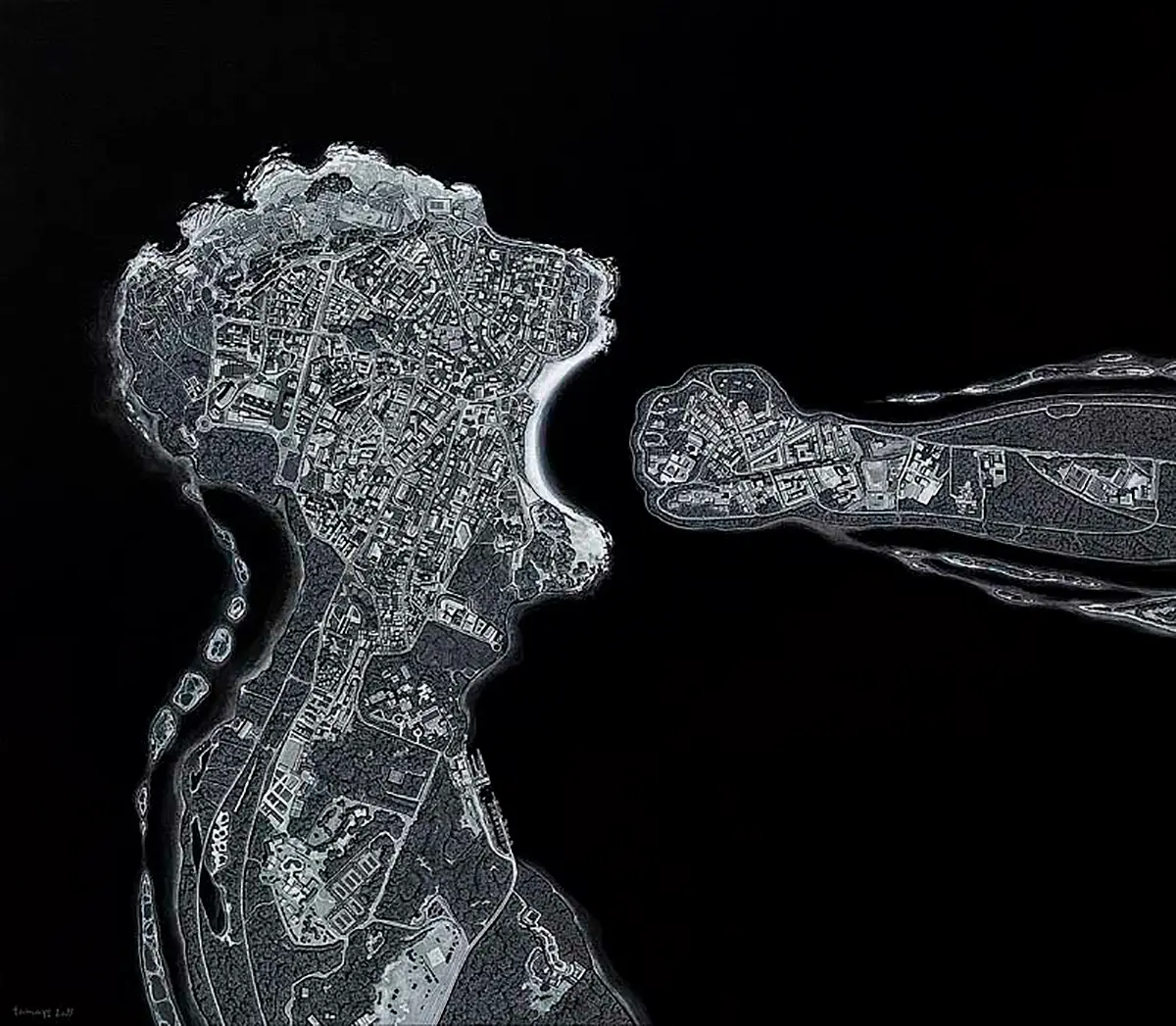
Reminiscent of large-scale monochromatic black and white photographs, the recent work by Reynerio Tamayo plays with the landscape. This artist offers viewers unsettling visions where he parodies geomatics through his rendering of the earth’s surface. Tamayo’s aerial approaches constitute a narrative text that is not concerned with the scientific interpretation of the geography, but with one that favors a humanist point of view outlined by the bodies of metaphors—inspired by art, history, and current issues—that lead the segments from his series entitled Ojo Satelital (Satellite Eye).
Twelve visually strong paintings were included in the exhibition entitled La Tierra Comprometida (The Compromised Land) at the Galería Habana. Interpreted as enigmatic decrees, the works warn us about the stagnation the contemporary world is confronted with. Through a formal rewriting of Pop Art and, most importantly, through the satirical appropriation of the language of Google Earth, Tamayo replicated through the narratives in his work the global visual culture in which we presently participate.
Tamayo conveys a deep respect for creation in this exhibition. It is evidenced in his take on La Gioconda; first in his work entitled Laguna Interior (Interior Lagoon), where he integrated the enigmatic portrait into the urban landscape of Venice; and then, in the painting Península, the artist represented the emblematic icon created by Leonardo da Vinci as a photographic negative set amid the urban structures of Florence, the place of origin of the Renaissance and a prominent historic, artistic, and economic center. With El Último Día de Jackson Pollock (The Last Day of Jackson Pollock), Tamayo pays tribute to abstraction. The information taken from Google about the location of the house where Pollock used to live was combined with an interpretation of the automobile accident in which he lost his life. Tamayo succeeded in synthesizing all over that surface Pollock’s personality, gestural performance, and sensibility. Conversely, the painting entitled Harakiri embodied the artist’s admiration for Japanese culture. The kimono was the financial center of Tokyo and the blood of the suicidal. The Japanese archipelago, on a background reminiscent of the paintings on folding screens, is rendered in a scene that is reminiscent of ancient xylographies.
His commentary on local issues was addressed in works like Habana (Havana), Sexos Opuestos (Opposite Sexes), Mito y Realidad (Myth and Reality), and Nostalgia. Habana combined the urban landscape with bay scenes, as the artist acknowledged their role in the history of the nation: political significance, economic weight, and their relevance in influencing culture and identity. The metropolis is feminine, a seductive lady and a mother. Ships would arrive at her ports like male sexual cells. Its avenue—like the tight urban grid chosen to represent it, reproduced the complex and oversaturated metropolitan life in which we participate.
The burden of the geopolitical conflict between Cuba and the US was transformed into an erotic metaphor in Sexos Opuestos, as Havana and the Florida peninsula synthesize in their proximity opposing interests. Male and female opposing parts that were—more than a specific period of the conflict—an old and historic desire to possess, combined with a drive to overcome physical and spiritual distances.
In Nostalgia, Cuba—appearing as a foggy band passing over Florida and nearing Miami, the destination of several migration waves—becomes the reflection of the longing of those who do not live on the island. In another direction, the hotel structures across Varadero in Mito y Realidad served to draw the Korda's Che; an idea that translated the moment in which Tamayo described the iconic figure turned souvenir for the first time. The incorruptible image of Guevara contrasts the economic realities that contradict his altruism, selflessness, and sacrifice.
In the work entitled La Playa, Tamayo addresses his interest in the future of humanity. A mouth ready to eat everything speaks of the struggle between the development/underdevelopment duality, the violence that results from the interaction between smaller nations and economies and the developed countries. Through a game of shadows, the work entitled Bombardero (Bomber), mimicked the projection of birds of prey on land, as the metallic bird, with the body of a military aircraft (similar to a B-F2F), which anchored in the present a future of extermination.
La Isla de los Vivos (The Island of the Living) represented a cautionary tale that offered another take on the place envisioned by Arnold Böcklin in his Island of the Death. Observed from a satellite, that which once was a paradise of comfort could become—as Tamayo appears to be suggesting—a promise after death. How encouraging it would be to achieve that beauty while still alive and surrounded by a healthy environment, and not by the hell human beings, as predators have left behind for future generations to deal with.
The central purpose of these reflections by Reynerio Tamayo, is a commitment to attain a sustainable world. His strategy, generated as a result of the increasing availability and consumption of information, does not hide the artist’s own fascination, nor his predilection for the surprising imaginary that stems from it. Nonetheless, it also reveals—in a veiled but condemning manner—the enormous dependence on computers human beings have. Tamayo worries about this substitute of reality that individuals rely on to feed in solitude, in spite of knowing that is also supposed to be a means for socialization. He fears for the castaway people that we are—as Stefanía Mosca has described us—surrounded by a poisoned sea of information.
CLARIDAD BLANCO DE LA CRUZ