
Mexican artist Ricardo Rendón has devoted a good part of his efforts to sabotaging the practical utility of objects. Highlights are his patterns and casts in a variety of materials, created with intentions that go from the merely formal to the conceptual. His perforations on a large piece of felt extended on the floor are read in a different way than the circles he cuts out from a collection of front pages of La Jornada; the absence Rendón imposes on his materials underscores the evidence of the material itself: its emptying-out closes on the context of which it has been dispossessed. The use of front pages from the Mexican newspaper is not making a political point, as could be thought on the first impression; it is a question of abolished, suggested, postponed utility, articulated in the presence of the printed page but negated through the impossibility of its use. The same can be seen in his representations of various work tools or in his use of screws to draw patterns and circles on various surfaces: they become useless beyond their form and intention. The tools are reduced to their essential meaning and to their occupied space by being arranged in different compositional games; one can very well think of them as a three-dimensional projection of Rendón’s drawings, or of the drawings as emerging from the composition work he does with these literal imitations of tools; the factual probability of molds that contain, in their space-to-be-occupied, one of his primordial obsessions: the ultimate uselessness of any work or action.
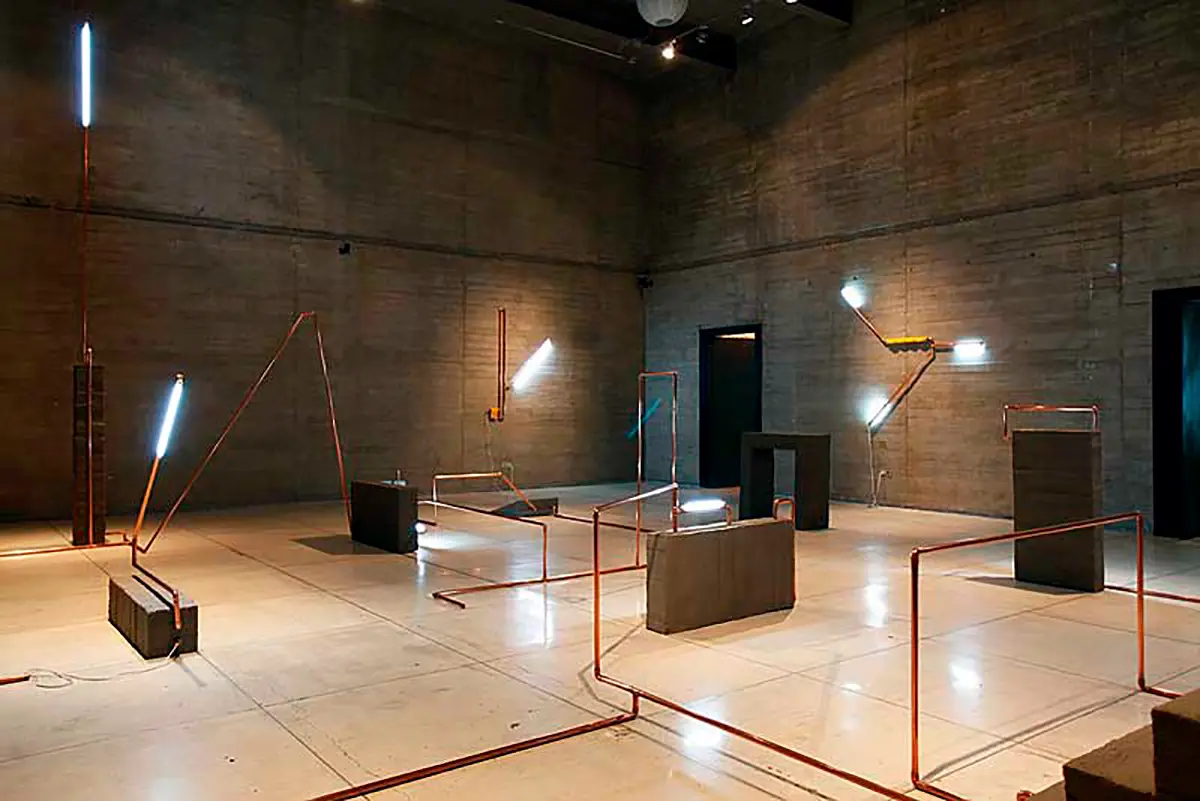
Rendón’s most recent work (exhibited alongside the monumental installation he created on-site for his show at Central Arts Project) wonders, in emotional terms (regarding the very projection that his lines and surfaces can possess for the viewer’s imagination) about the abolition of the functionality on the basis of its celebration. Starting with materials that include copper, industrial felt, concrete, halogen lamps, and electrical installations, Rendón unfurls and articulates formal compositions that imitate the formal trace of a black oeuvre conjured in its aesthetic uselessness. In each of his Circuitos de iluminación (given that thanks to the copper tubing, the wiring, the electrical installations, and the lamps, they are literally that), he appeals from the title to emblematic figures of the Enlightenment, in a tribute offered through semantic tautology. Physical and philosophical, real and immanent lights, reflection and paradox of a commonplace supported—again, literally—by the skeleton that outlines a series of buildings that distance themselves to propose rhetoric of construction materials.
Thus, Leibniz is represented by a copper tube bent into a half-T to serve as the base for three halogen lamps, while Pascal is a helix of three bent tubes (also ending in halogen), and Newton is a braiding of industrial felt supported by a rectangular structure of S-shaped tubes. Ricardo Rendón bends copper tubes to allude to geometric shapes filled with formal tensions and overflowing symmetries. His approach to functionality, in material and use terms, flirts at times with what could be called the raw extreme of a designer’s lamp. It is the played edge that remains between ornamental use and spatial meditation, a provocation from the borderline of that which determines a sculptural will that encompasses space as it enunciates it.
It was on the basis of these considerations that Rendón developed his on-site installation Hacia una arquitectura posible for this show. Starting with the gallery space, he arranged a series of concrete blocks that reference, with their ornamental lack of proportion, their use in construction. A column, a rectangular body with the base on one of its short sides, a rectangular body with the base on one of its long sides, a rectangular body bent on one of its ends to form a corner, a rectangular arch, an inclined plane, and a staircase are the starting points for a modular game of extensions that transforms and determines the space it occupies (for that, of course, and given the real weight of the concrete used, moving and repositioning it requires a pulley). The spatial dynamism of bodies and lines achieved by Rendón demands a Gestalt from the viewer as he or she walks through the work and finishes the intangible walls that project themselves onto the experience-borne need to fill space from a predetermined sense of lines that are refusing to be, in their material evidence, a mere three-dimensional drawing.
It is, in the end, a field of games, such as those set up in a park, but arranged for the mind, always ready to connect dots and extend surfaces.
RICARDO POHLENZ