
Like any other artistic proposal by Neuenschwander, this exhibition is based on two essential pillars: inconsequentiality and interdependency as two powerful subterranean channels capable of subverting any plan.
Organized by the New Museum of Arts, in collaboration with the Irish Museum of Modern Art, the exhibition titled A Day Like Any Other constitutes the first retrospective of Rivane Neuenschwander.
Neuenschwander’s proposal inherited the innovative spirit of the “Tropicália” movement, during the 1960s, and revolutionized the national landscape of the Brazilian visual arts. It is a proposal that is always interested in the interactive component. Her work implies a dialogue with viewers that immediately disrupts energy transferences, given the direct involvement of the recipient—if such a category can include here—in the construction of the work. It is possible to say that Neuenschwander is interested in the influx of life that may be contained in the most irrelevant of objects; a sort of animist sense that is reactivated as if by magic through every transfer that generates human interaction with the object.
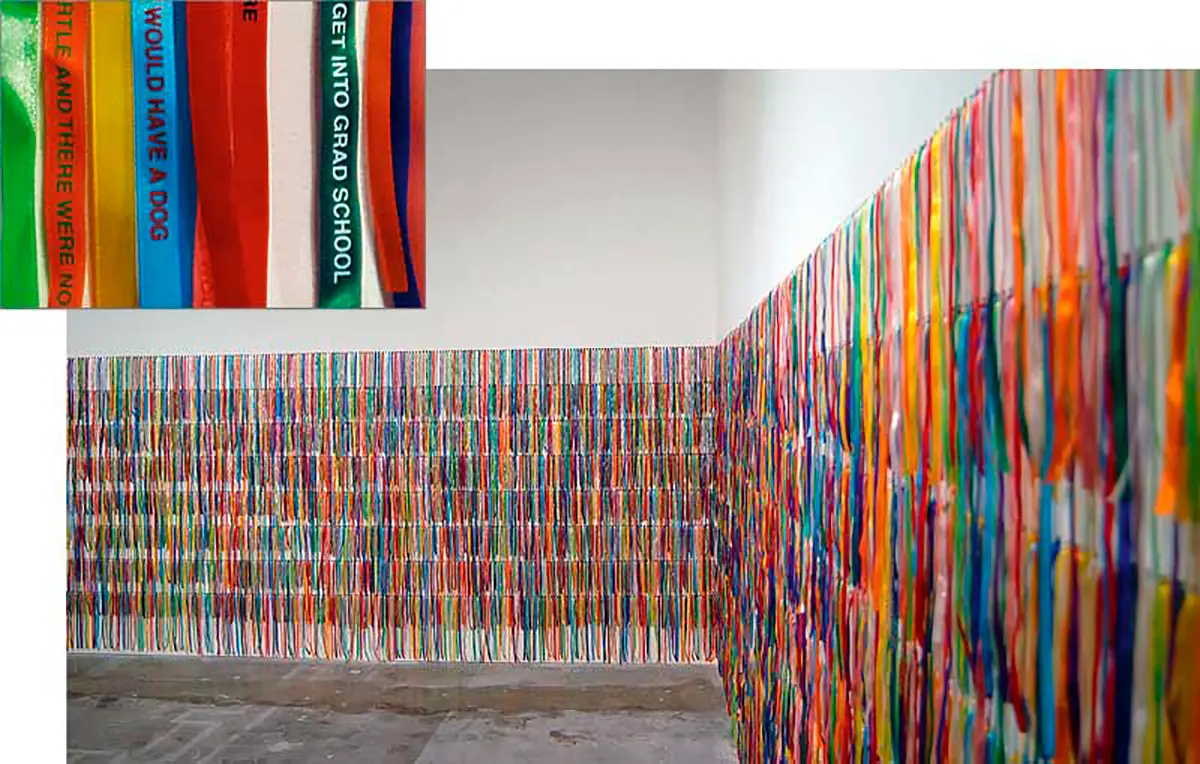
Such is the power contained in works like Eu desejo o seu desejo (I Wish Your Wish, 2003). It is a colorful installation formed by a cascade of multi-color ribbons—each with a written phrase that, when reading as a group, communicate several desires that are rather dissimilar—that feed from visitors. These are encouraged to interact by writing something on the ribbons as they grab the ones already marked with a thought. The ribbons with the new wishes must be tagged on the same wall where the rest of the ribbons hang. These wishes that are now on paper will become the next desires to be printed.
The work Eu desejo o seu desejo (I Wish Your Wish) was inspired by a long-standing tradition among the faithful to take part in a procession that ends at the Church of Nosso Senhor do Bonfim in Bahia. The practice of this pilgrimage dictates that any wishes or requests by the pilgrims—written on wish ribbons and tied at the wrist—will be granted once the ribbon becomes separated from the person and falls. The interesting thing about the poetic of this installation by Neuenschwander is the way in which our body becomes the receptacle that activates another person’s wish, while the fulfillment of our own wish can only be attained through the sacrifice of another person’s wish.
This sense of transference and perdurability of the ephemeral that this artist sometimes identifies as “ephemeral materialism,” is also at the core of the work Involuntary Sculptures (2001). Neuenschwander spent a long time collecting these small doodles that we produce almost unconsciously using materials available in our environments such as napkins, sponges, and loops. These spontaneous statuettes are dignified on minuscule pedestals that confer the pieces of their status as works of art. Like in almost all other works by Rivane Neuenschwander, absence to plays a central role in Involuntary Sculptures. After the initial amusement, these statuettes generate, we become overwhelmed by a melancholy that causes us to attempt a reconstruction of the person behind that vestige we are suddenly confronted with.
Inspired by Samuel Beckett’s homonymous work, the piece entitled First Love (2005) contains that same melancholic undercurrent. It is an interactive installation in which an expert in spoken sketches reconstructs an image recorded in the memory of first love.
It is not casual that many of the inspirations by Neuenschwander come from sources other than the visual arts. The change in attitude towards life and art prompted by Tropicália definitely permeated all areas of culture: from literature, with the concrete poetry movement; to music, with Joao Gilberto and Elis Regina: and films, with the Cinema Novo, spearheaded by Glauber Rocha; to the visual arts, with artists like Lygia Clark, Hélio Oiticica, Cildo Meireles, and Waltercio Caldas.
Several works included in A Day Like Any Other were inspired by films. Such is the case of O Inquilino (The Tenant, 2010)—based on Roman Polanski’s film from 1976—or The Conversation (2010), inspired by Francis Ford Coppola’s film of the same name, in which an expert on espionage becomes paranoid and begins to feel watched and followed all the time. For the creation of the installation, Neuenschwander demanded that several listening devices be hidden in different parts of the room; the most unsuspected kind. With a desperate frenzy, the artist endeavored to dismantle the carpet, walls, and face ceiling until she was able to find all of the hidden monitoring devices. The increasing anxiety and the physical effort contained in the desperate gestures to find the devices were recorded and now serve as a sound environment for the destroyed room.
Shown in the US, the piece acquired new significance after the enactment of the so-called Patriot Act, approved in that country seven weeks after the 9/11 terrorist attacks.
Chove Chuve (Rain Rains) is an installation of minimalist resemblance in which the processual becomes the crucial element. It consists of aluminum cubes dangling from the ceiling that correspond with other cubes lying on the floor. Every suspended cube has a small perforation that allows water to drip through it, which creates the effect of a delicate and rhythmic drizzle. As a sort of reminder, a nearby staircase brings the framework that makes the rain possible to the forefront. Every four hours, the water transferred to the cubes on the floor must be manually returned to the suspended cubes, thus turning the miracle into something perpetual.
Rivane Neuenschwander: A Day Like Any Other is a poetic chant to life achieved through minimal gestures; precisely where the grace of existing lies.
JANET BATET