
The first rule to approach the latest work by Víctor Hugo Irazábal can be taken straight out of the title that identifies his most recent exhibition: Abrasiones (Abrasions). It is a term that describes the action of eroding something by rubbing two things together. It is a sort of erosion produced by friction. It is also associated with the repeated rubbing that leads to appearances and disappearances more than to disintegrations. This clue offered by the artist is not solely inscribed in the utilization of the technique in question but also alludes specifically to the original way in which our pre-Columbian ancestors used to record their testimonies on stones. Irazábal conveys both motivations in his work: abrasions as a technique that originates in petroglyphs and the evocation of the very presence of a pristine spirit rooted to evidence a connection with the Amazons and the recognition of an anthropological ancestry. Supported by these contexts, Irazábal centers on three endeavors: the creation of pictorial pieces permeated by signs and environments; an installation that takes over and reactivates the surface of a wall; and lastly, the presentation of a video that gathers the process and the effects associated with an intervention of the Orinoco River using 87.5 yards of painted canvas.
The works in this exhibition refer to pictograms of the pre-Colombian- world and the Amazon of today. They do not solely evoke the signs on the stones but also the ornaments placed on the skin of the inhabitants who today live in our rainforests. It is visual information that has become stronger today. Thus, it no longer just serves to formally allude to or describe something, as it now also crystalizes the intuitive mark and the instinctive weight of timeless and subjectivized signs. Beyond the nostalgia associated with atavistic codes, Irazábal’s work evidences the recovery of internalized gestures that are brought to the forefront to be updated into new visual repercussions.
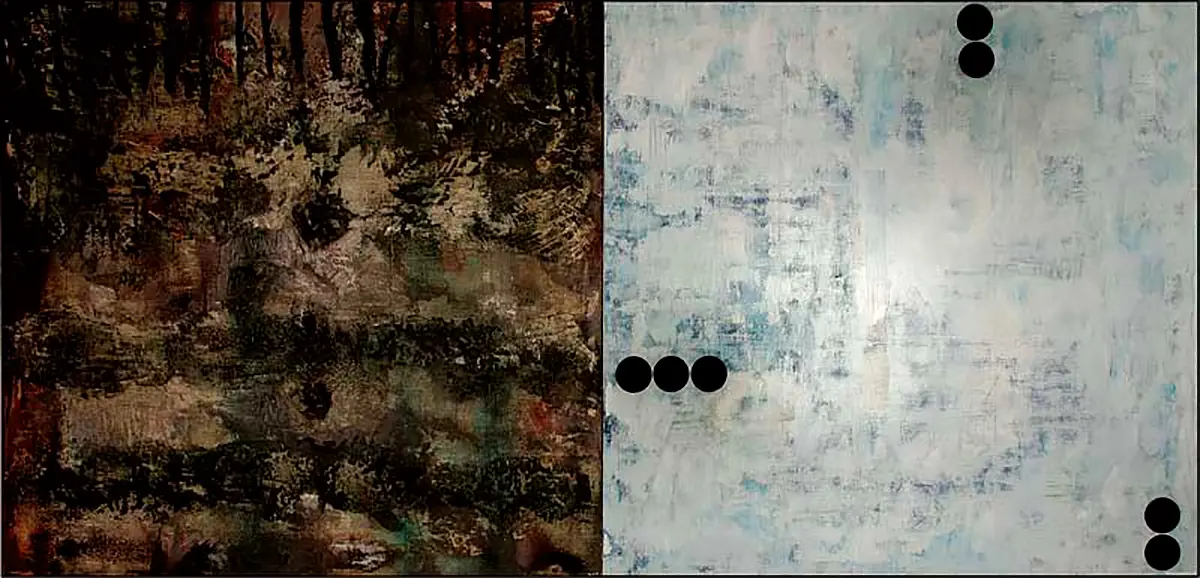
Besides the paintings, the exhibition also includes a frontal mural that re-sematicizes antagonistic and antithetic issues into an expansive resonance of nuclei generated as part of a widespread and strange network. Here, the idea of the point is affirmed as a unique visual code that is also a hegemonic and symbolic resource. It flourishes to shape nodes that are interconnected through the chiquichique, a singularly looking fiber with a capricious, expansive presence. Its ductile and rigid nature leads it to assume the defiant condition of a vegetable wire that stimulates open-minded suggestions to the imagination. The idea of the process also prevails here as a guiding resource, as the possibility of environmental effects offers clues to the defining resolution of the work. The ensuing result is inscribed as abstract poetry of magical and subtle suggestions. Likewise, it is important to underscore the feeling of fulfillment that emanates from the frontality of a space charged with primal energies. There is also the suggestion of a transformation of depths in which past and present attention to the same plane of clarification. Here Víctor Hugo Irazábal alludes to signs that are deep-rooted in our ancient past and the subjectivity of a profound spirit.
It is important to note the role that the point plays in his creations. It does not just represent the simple data that is part of visual grammar. It also projects the memory and of its presence in the more meaningful petroglyphs of the Amazons. From the plasticity and symbolism of the point emerges Irazábal’s intervention on the Amazonian landscape and, more specifically, on the waters of the Orinoco River. The artist gave 87.5 yards of dotted canvas to a local laundry and then allowed the process generated by this action to unfold. Here the perilous convex and concave folds, the discontinued sequences, and the transparent effects generate visual paths of plural resonances. Images of images and trajectories suggested by the lines of lesser resistance—offered by the water currents—are promoted. Aside from having their own meaning, the stimulating effects refer to fictions of a surprising lyricism and resounding musical attributes. Even the canvas achieves highly energetic organic connotations and challenging perceptions. The idea of addressing the intentions of the project also takes over the artist’s will to transform each encounter into a model of new curiosities. It is precisely this submissive surrender to unforeseen developments, that promotes the various destinations of the canvas. By the initiative and input of the local neighbors, the work is transformed into tablecloths and bedsheets. Pants and skirts, curtains, and coffee filters are eventually incorporated into the homes of the neighborhood. The backbone of the work is thus transfigured to prolong its presence and reoriented to legitimate the human connotation of a utilitarian design. It is clear that Irazábal brings his work to the limit of its possibilities in order to caress the limitless nature of its projections. His deepest inspiration answers to the dimensions of the Heideggerian reflections: “A limit is not where something stops… but that which serves as the basis for something else to begin.”
VÍCTOR GUÉDEZ