
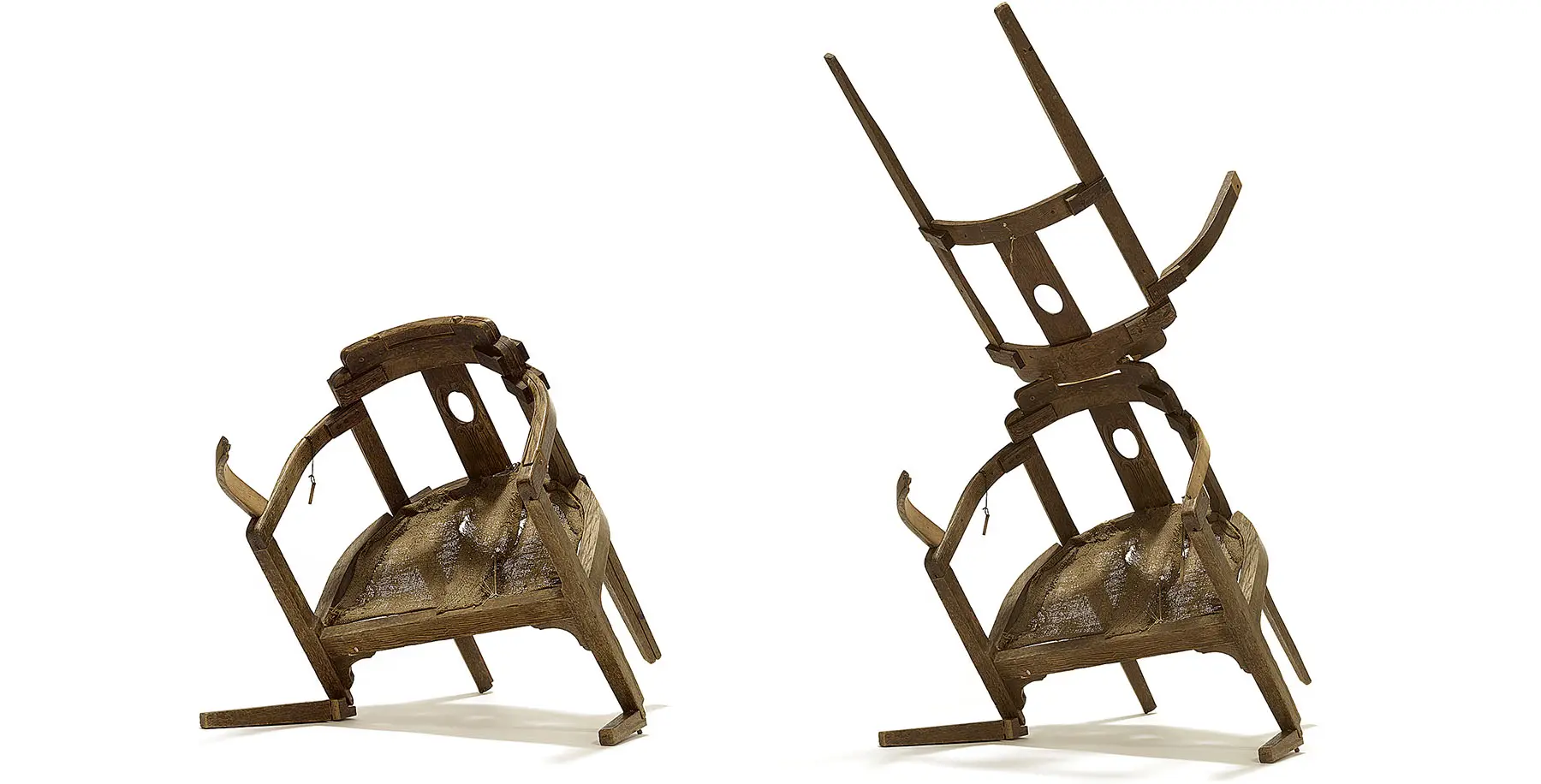
Seldom does the title of an art show define with such precision the conceptual and formal underpinnings of the work it presents. It was over two decades ago that Wifredo Díaz Valdez started developing this project of constructing by deconstructing, of capturing woodworking wonders by generating the first surprise and, immediately afterward, a powerful sense of amazement. I use the noun wonder because his sculptures bring forth an atmosphere capable of breaking regular, recognizable borders and transforming natural, wholly everyday elements into facts of astonishing singularity. A banal object, an old piece of debris, can become a special event, possessed of a seductive uniqueness, of a kind of poetry sustained by a rough lyricism. If Díaz didn’t clearly display great craftsmanship and skill in each of his works, one would be forgiven for thinking of something close to magic, a kind of prestidigitation defended by rigorous strategies rather than by ingenious artifice, by traps that are as enchanting as they are ephemeral. At the same time, if said craftsmanship and skill were not readily verifiable at the level of woodworking with mythical aspirations, viewers could believe themselves to be facing an expert admixture of mechanical engineering and obsessive dismantling. Because all of Díaz’s formal narratives seem to seek the development of vehement mechanics stubbornly intent on extricating the skin of what is apparent. If such a thing is possible, an un-maker of mysteries whose investigative efforts end up generating even greater mysteries.
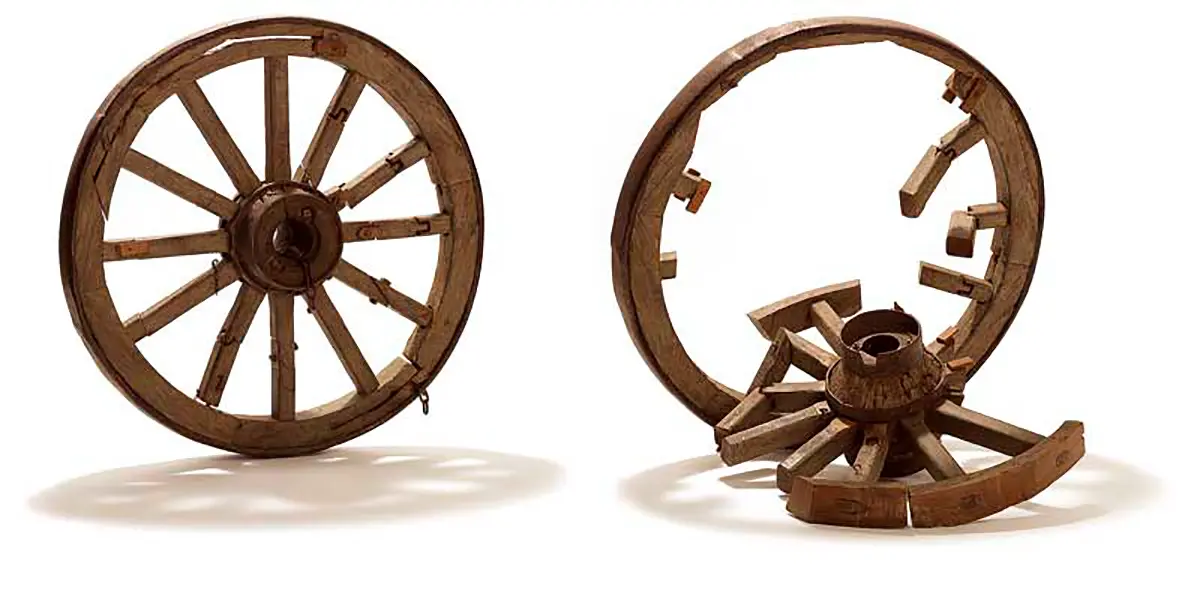
Díaz’s manufacturing criteria are simple at the bottom. He takes an object, a piece of furniture—in wood, of course; only exceptionally with a metallic part—and starts to look at it closely, in a kind of communicative ceremony between object and artist, between the material element and the maker of wonders. Speaking of wonders, the first and perhaps most important of them all is Díaz’s ability to sustain throughout an entire career certain defining characteristics without pursuing visible variations, while nevertheless achieving impeccable clarity. To administer almost invariant resources with a noted capacity for reinterpretation, knowing how to remain faithful and avoid routinization and exhaustion, revivifying ways of saying and accessing a vigorously renewed form of seductiveness. The artist has expressed this often. He is not afraid of repetition because the same formal resource, the same deconstructive game, generates different results—different wonders—when applied to different objects. Obviously, this is because of his ability to select planes and multiply entanglements, provoking renewed surprise, an always inaugural emergence. Surely, because all technical displays are defended by a strong vocation for play, an inexhaustible unfolding of games and counter-games that are taking to extremes of choreographic intention. “The playful part, which is what one learns as one goes through life: everything is a game. Life’s element of divertimento; things are not rigidly established. I am always intrigued by the dynamic of knowing that things that are today, things that are taken for truths, are very transitory. It works today, but maybe it didn’t yesterday and perhaps it won’t tomorrow,” he argued in an interview with Hans Michael Herzog, the show’s curator, included in the catalog. This preoccupation with games is evident in the deconstructions he attempts with a kind of gymnastics club that is able to transform into a spaceship invisibly piloted by a “gaucho-like” space hero, a very Latin American, solitary navigator eternally orbiting a planet where everything can be an antique fair, a joyful paradise of old toys. Also in an ancient bocce game, an old-time sport once popular in the River Plate region, that unfurls into unsuspected, multiplied planes, mutating the spherical placidity of the original in a rhythmic, unstoppable emergence of red, almost flesh-like interiors, concretizing marvelous spatial rhythms. Also, a formerly opulent chair that now redeems its decay by playfully transforming into a being of almost titanic aspirations, arousing a strange admixture of unease and hesitant laughter. Note that we have talked of playful exercises, not playful results. Whatever the object, this deconstructive process is guided by enjoyment and persistent investigation. But the result, the wonder that is finally constructed, has a stirring, rough poetic power.
Wifredo Díaz Valdez is not prone to go treading into the dense theoretical thickets that are an almost overwhelming phenomenon among so many conspicuous figures in contemporary Latin American art. Yet, his work is based on a visceral, lived-in discourse learned in the hardships of Uruguay’s rural world, specifically the border region of Treinta y Tres. He seeks to nourish that discourse, and knows how to find the wondrous in scarcity and to render the discarded into a continuously replenished creative source. Far from the hermetic laboratories of high artistic erudition. Close, very close, to a vitality that is smelled, touched, and even digested. Avoiding the easy populism of the badly anthropological. “Everybody wanted to know which had been my school. It was a long process, a life process. Now, with distance, I can summarize it and compress the time, and so it appears as something spontaneous as if a light had come on all of a sudden. But no, it wasn’t like a light being turned on. There is no genius here. What there is great dedication, perseverance, and work,” the artist says in the interview mentioned above. Later, he notes: “For this land that I tread, works that had their aesthetic origin in the countryside were much more authentic. That was one way to seek an identity.”
Visiting this impeccable selection of artworks, organized into an austere, air-filled display, we clearly perceive those creative assumptions. Slowly, the feeling grows that Wifredo Díaz Valdez is one of Uruguay’s artists with the clearest sense of identity. Without big lights flashing in an operatic fashion. With the slow and flavorful passage of the days, with all the furnishings of the journey. With the magic that transforms them into a fascinating establishment of wonders.
NOTE
1. Wifredo Díaz Valdez: Construir desconstruyendo, Daros Museum. Zürich, Switzerland
ALFREDO TORRES
Retired professor of public teaching. Art theorist in private centers.