
In a presentation that is half homage and a half show, Alejandra Seeber (Buenos Aires, 1968) successfully commanded at the Galería Vasari a careful rendition of Anthropometries, the first from a series of famous performances by Yves Klein (France, 1928-1962) that used women covered in blue paint as “living paintbrushes.” Under the artist’s direction, who indicated their movements, they would then paint canvases with their bodies to the tune of the Monotonous Symphony composed by Klein himself. It consisted of a single note repeated for twenty minutes and followed by another twenty minutes of silence. It was played live by 10 musicians and conducted by Klein.
A judo expert and follower of Zen philosophy, Klein believed that color represents the “materialization of sensibility.” Thus, he would give great importance to the color blue because, in his opinion, it represented the most intangible aspect of nature; the blue color of the sky and the blue color of the sea are impalpable without the help of other agents. The artist researched and found that blue embodied his cosmological vision. He even created a unique type of deep blue: the International Klein Blue. It is a widely-held view that Klein—who died at the age of 34—contributed, through his artistic practice, to the expansion of the work of art concept and pioneered trends, attitudes, and states of minds, such as Happening, Performance Art, Land Art, and Body Art.
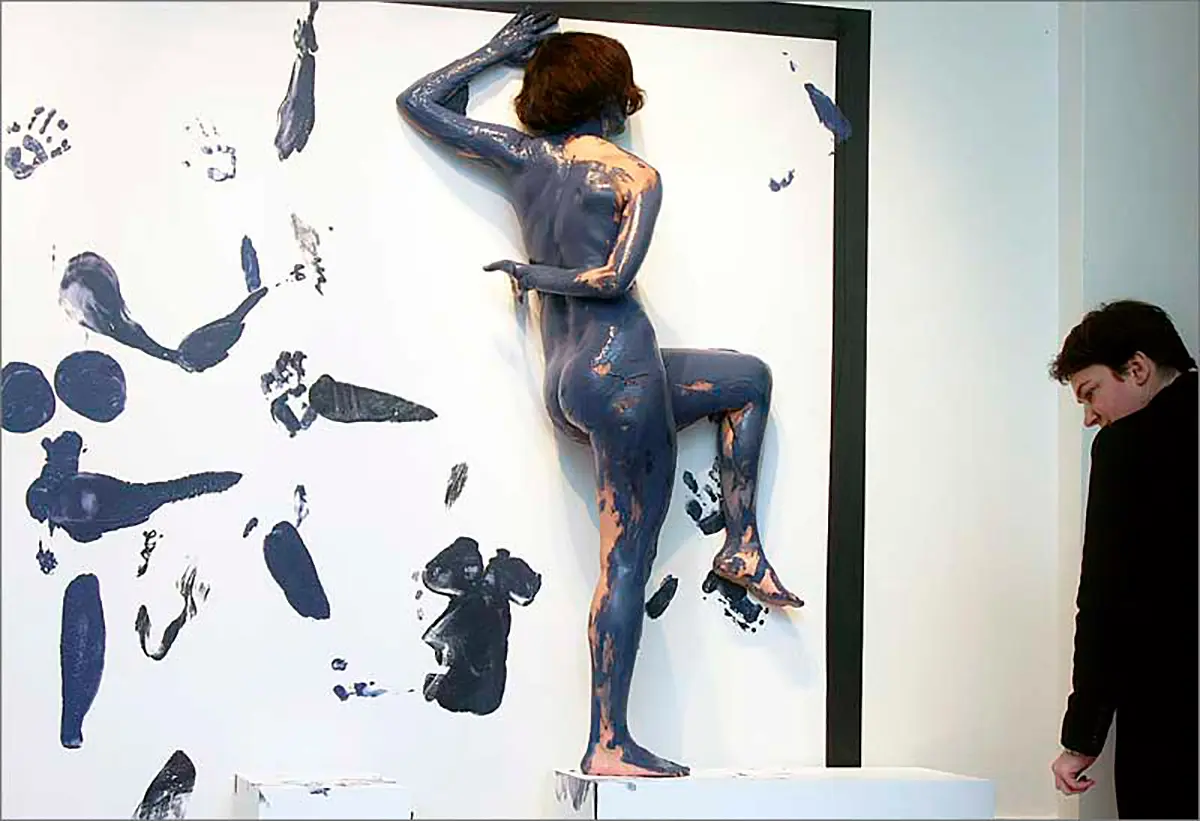
Seeber’s performance was on August 17 at 19:30 sharp at the Galería Vasari; a space smaller than the one of the Galerie Internationale d’Art Contemporain in Paris, where Klein presented his happening on March 9, 1960. Like the French artist did before her, Seeber also sported a sort of black-tie outfit, but with a pink bowtie and a flowered blue shirt. Using similar gestures, she conducted a ceremony—which requested, and received, the trust of the attendees—that was fervently applauded when it concluded.
This time around there were women who played the Monotonous Symphony, as five nude actresses and dancers covered in blue paint—Seeber Paint—printed marks on the canvas, paper, and mats with their bodies. Seeber pointed out that “This performance represented the opportunity to see one of the famous Anthropometries, fifty years after the fact, and to measure its impact. It was also a way of using models as paintbrushes and the entire performance as a large painting machine. It represented a reflection on the place of the artist and the place of women.”
From the gallery window, a heart-shaped neon light with the caption Yves and I—the name of the action/exhibition—announced that something unusual was going to occur, or was already happening, inside the gallery. While a fragment of the historic performance can be viewed on YouTube, the silence that invaded the event once the nude women appeared was unusual. They followed Seeber’s instructions and repeated the gestures of their predecessors—but differentiated themselves from the former women for their slender and graceful bodies. In trying to compare both performances, it becomes clear that the filmed action cannot be compared to the “live” one. Each produced a different reaction in the viewers—in the instance of the latter, the silence became unexpectedly deafening, even as the people of Buenos Aires are not particularly known for being shy about their bodies.
Seeber acknowledges the influence of Klein’s painting in her work in recent years. They are populated by ambiguous patches and a certain informal aesthetic. Grouped or by themselves, the images confirmed that Seeber’s entire work is closely associated with painting. Her experimentation is multifaceted and never the same, even as she approaches her work digitally, through ceramic, glass, or paintbrushes—sable or “living”— and even when, as it occurred in this tribute to Klein, the artist was never in direct contact with the materiality of paint—just as the French artist was not.
Klein’s conceptual proposal, as it relates to immateriality, became “the reactualization of an attractive problem” in Seeber’s version; it is linked to “painting, the body, and women,” as pointed at the introductory text of the exhibition, written by art historian Cintia Mezza.
The women got covered in paint and slid across the floor and walls as if in a dance, offering generous and graceful movements in a friendly environment. It was a show without incidents.
But why once again show women as objects rather than individuals? Why not show a group of nude men for these new anthropometries instead?
Seeder, who spends her time between New York and Buenos Aires, would eventually show the works that were created during the performance also at Galería Vasari, while a video—not uploaded online—renewed her tribute to Klein ad infinitum.
VICTORIA VERLICHAK