
A characteristic of artists that I have always admired and one that has fascinated me for many years is the fundamental urge to make art. There are scores of painters who paint every day, not having sold a picture in years; photographers with files full of prints that will never see the light of day; the printmaker publishing one more suite of forever unseen prints. Observing this phenomenon in friends for many years, it has become clear that in many cases this is not so much an urge as a necessity—rather more like breathing.
The provocative exhibition Antonio Manuel: I want to act, not represent!, at the Americas Society graphically illustrates this primal need to create, as well as raising a number of other profound questions regarding the act of creation and the potential effects of artistic creation upon society or a culture. The show, which will be documented with the publication in November 2011 of a comprehensive catalog, is focused on the most brutal years of the military dictatorship in Brazil, 1968-1974. These were years during which nearly every attempt of Antonio Manuel to exhibit his work—either in or out of Brazil—was in some way thwarted by the regime. The artist, in turn, reinvented the manner in which he presented works of art. He not only found new ways of expressing himself but new substrata upon which to present works of art.
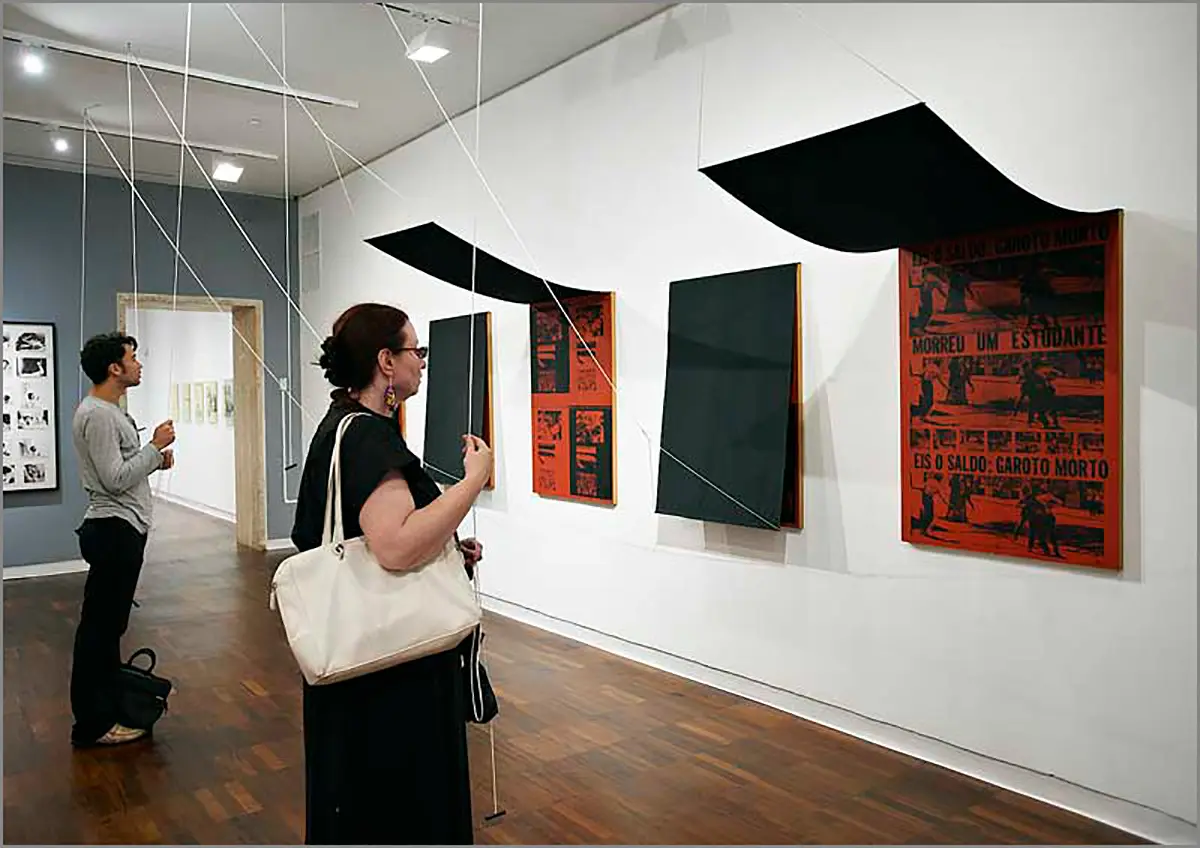
While the works here are concentrated chronologically, the exhibition includes works on paper, photography, film, and sculpture, as well as documentation of interventions. The latter of these media really provides a virtual substratum for the entire exhibition, as it was these acts of intervention that allowed (as is noted in the press release for the show) the artist to “…actively infiltrate an oppressive system that was driven to keep subversive work dormant.” Because Antonio Manuel is not widely known in the United States (this is his first solo exhibition here) it takes a casual viewer some quick-stepping to place the artist within the landscape of the art of the Americas and then a moment of reduction to narrow the scope to time and place. Once that is done, the works here present an admirable summary of the activity of this artist within the years covered and force the viewer to extrapolate from that the influence of these works beyond Brazil in the late sixties and seventies. The catalog will provide a vital document, as very little has been published in English on Manuel, although he was included in Houston’s Inverted Utopias and the Guggenheim’s Brazil: Body and Soul.
Physically bracketed in the Americas Society’s gallery space between the early, nearly lyrical, work done on newsprint and the exquisitely, subliminally violent Urna Quente (Hot Ballot Box), special mention needs to be made of the flan series and Corpobra (The Body is the Work). The flan referred to here is a flexible mold of a type developed in the first quarter of the 19th century that allowed for the transfer of flat type to the curved drum that actually prints on paper. The image of text and photographs on a flan is a positive one in that it reads like a newspaper. Antonio Manuel collected these discarded molds and intervened upon them by highlighting and obscuring both text and image. As works of art, then, these present arresting visual images and make marked political statements and, effectively, introduce a new medium. Corpobra is at the crux of the show. An interactive/audience participatory sculpture, it documents a performative moment when, after being completely edited out of (censored from) the National Salon at the Museu de Arte Moderna do Rio de Janeiro in 1970, Manuel stripped at the opening and mounted the main staircase. The sculpture presents an image of the artist nearly nude. By releasing a cord on the back of the boxed image, the viewer can reveal the artist as he appeared at the opening, completely nude. This act strikes at the heart of the exhibit: to act is to create.
Thoughtfully selected and carefully curated by Claudia Calirman and Gabriela Rangel, there is much more here to be seen and engaged with, including two absorbing short films and take-away copies of Clandestinos that have been translated into English. The Americas Society is to be commended for presenting a show that is not necessarily going to appeal to the average museum-goer, but that introduces to this country an artist who refused to be silenced and who continues to contribute profoundly to the cultural structure of modern Brazil.
CLAYTON KIRKING