
Two exhibitions opened simultaneously in the spaces of Galería Oficina #1: The Typical Venezuelan Picture by Ara Koshiro (Maracaibo, 1967), and El Teide: Mis Raíces Canarias (The Teide: My Canary Island Roots), by Hayfer Brea (Caracas, 1975).
In The Typical Venezuelan Picture, the first solo exhibition by Koshiro, the artist delves into a search centered on the possibilities of proposing a graphic representation of Venezuela that conveys the fractures and enormous contrasts that are part of its contemporary historic, political and social reality.
By relying on a discourse that visually emphasizes the fragility, precariousness, and fleeting nature of things –a narrative reflected in the title of the exhibition, borrowed from a phrase in the novel País Portátil (Portable Country), by Adriano González-León– Koshiro uses phrases, maps, symbols, and images from official representations of the country. In doing so, she embarks on a critical revision of their meanings, as she introduces hidden references, ruptures, fragmentations, and dislocations in her work.
From a series of similar pieces, the work entitled Puente Angostura (Angostura Bridge) relies on an absent image that Koshiro brings back by looking into the memories generated by the idealized landscapes found in postcards. In a critical gesture that is also charged with a poetic gaze, the artist elaborates a pencil drawing that copies the texts and images that are printed on the back of these postcards. The piece refers, in name, to a landscape that although absent, can be imagined to be highly exotic. At the same time, the pencil drawing and the fragility of the handmade copy, convey Koshiro's sharp gaze concerning visual –and mental– representations of a country with a complex and overwhelming reality.
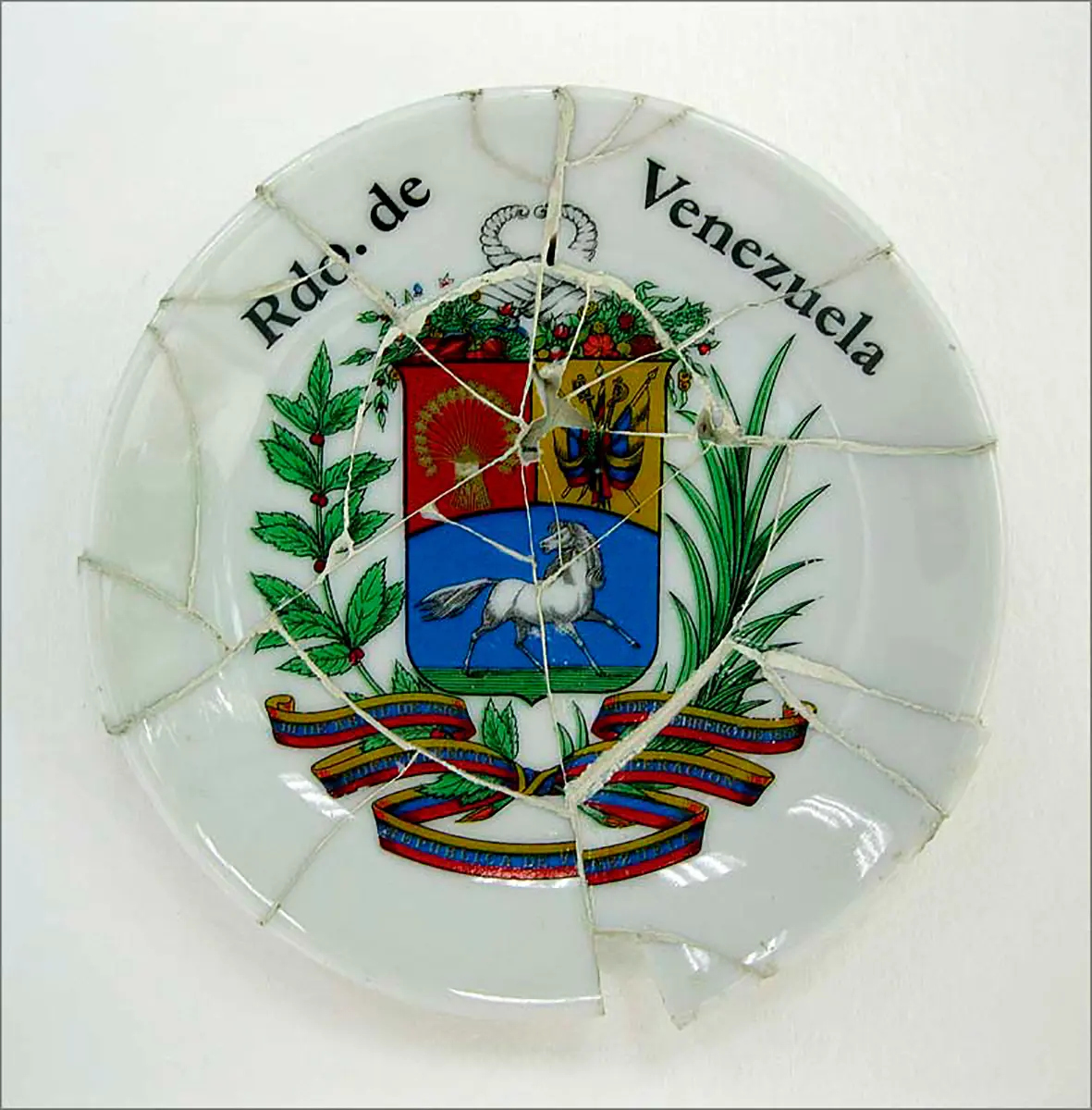
Recuerdo de Venezuela (Souvenir from Venezuela) is an eloquent work. Relying once again on a sharp irony, Koshiro takes a porcelain plate that was decorated as a souvenir with the national coat of arms and the phrase Souvenir from Venezuela inscribed on it. The artist shows a plate that had been broken and that was then ineptly restored with epoxy glue, in an act that cannot hide the fractures to which the object was subjected. Over-sentimentality –as an expression of the precarious– lack of skill and the fragmentary, are the themes summoned in this piece of compelling meanings.
Hayfer Brea has been creating an extremely sophisticated work in which the image of the El Ávila mountain –an elevation that separates Caracas from the coast– is repeated as shape, line, and as the evocation of multiple references.
In El Teide: Mis Raíces Canarias, Brea works in a proposal that combines approaches centered on the representation of the landscape and on his personal family story.
An exhibition that summons memories without leaving behind the artist's usual visual preoccupations and the construction of something that could be called a "minimal graphic" approach whose references feed of Brea's own artistic history.
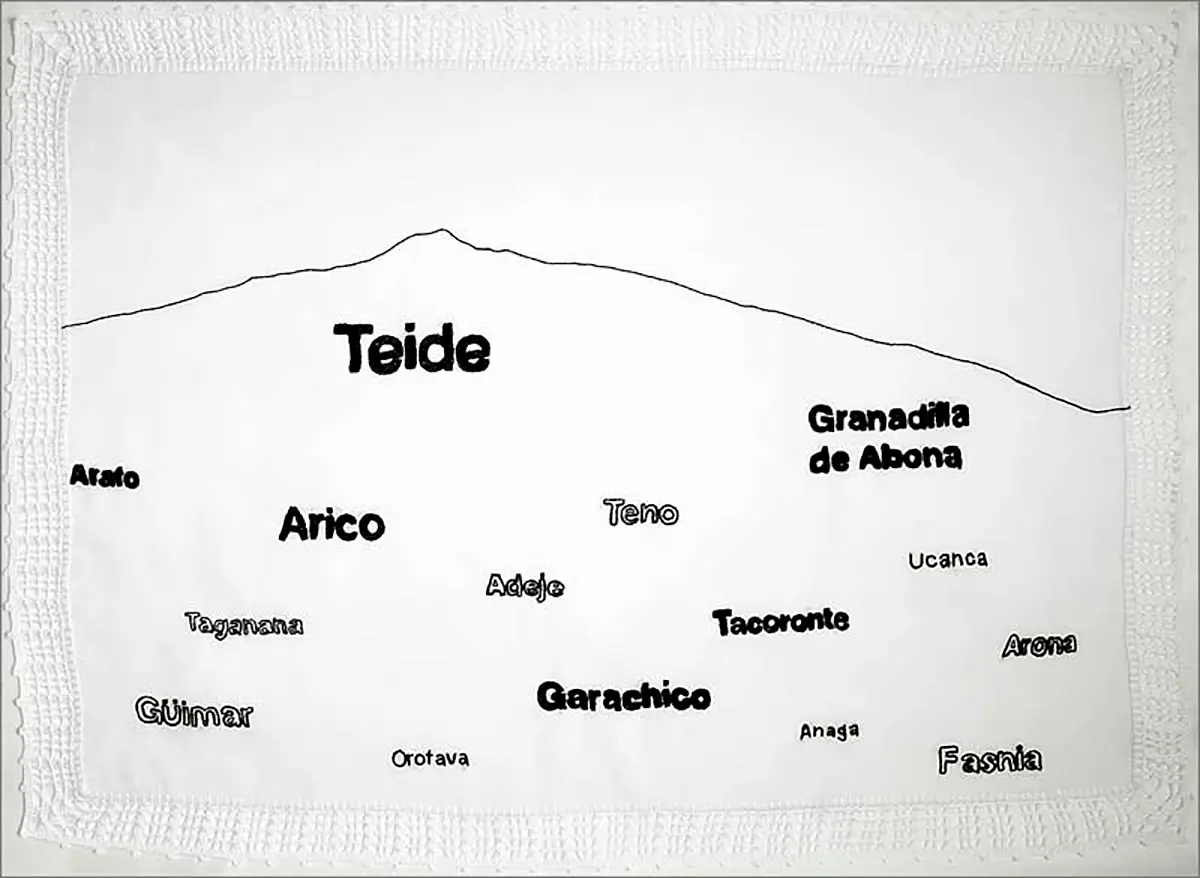
One can also observe in this exhibition a tribute to the ancestors –people and landscapes– from the past. In Teide and other similar works, the artist bases his work on the embroideries created on white fabric in the manner of the decorative rugs that are often used in homes, and that are part of the traditional crafts of the Canary Islands. In these pieces, Brea's mother and grandmother drew with thread –following the typical minimal representations of El Ávila by Brea, where one line becomes the sign of the mountain– the topographic outline of the Teide and other elevations from the island. Brea resorts to words to comment on the conflict between two cultures, two landscapes, and two realities. In Teide, the very words that are part of the geography of the Canary Islands are the ones that can be found embroidered under the topographic line. In other works, Brea places words from the Guanche language that is now part of our own jargon. With this, Brea demonstrates the manner in which words not only populate the plane of the canvas, but also the life of the artist and the country. He also conveys how personal stories overlap to form the history of a town and its people.
The exhibition includes photographs of members of Brea's family, in the Canary Islands, and in Caracas. There are tourist brochures and other elements that address the cultural particularities and geography of the Canary Islands.
Línea (Teide-Ávila) + Lava is an installation and, perhaps, one of the most emotionally charged pieces of the exhibition. The artist draws the outline of a mountain on the wall that is Teide and El Ávila at the same time, united by the continuity of a line that speaks of migrations, time, memories, history, family, and life. He places the fragments of volcanic rock –alluding to the telluric– as a magma that shapes culture and history.
KATHERINE CHACÓN