
Very seldom do we find, in a random walk through the galleries, an object such as this. It is a female street dog, typical perhaps of Bogotá, mummified and feeding the bronze-cast figures of Romulus and Remus. A strange object that raises suspicions about history and culture. It raises suspicions about the foundational ideas behind cities, communities, and, why not, Colombia itself. This object commands us to re-read myths of fratricidal brothers who founded cities and of animals that possess no lineage or home yet are capable of great solidarity.
After leaving the gallery, I consulted the writings of Roberto Espósito, which prompt us to deactivate practices of identity that, according to him, triggered wars and massacres throughout the previous century. To this inventory of blood, we must add the fact that such practices of identity have also contributed to rendering difference invisible.
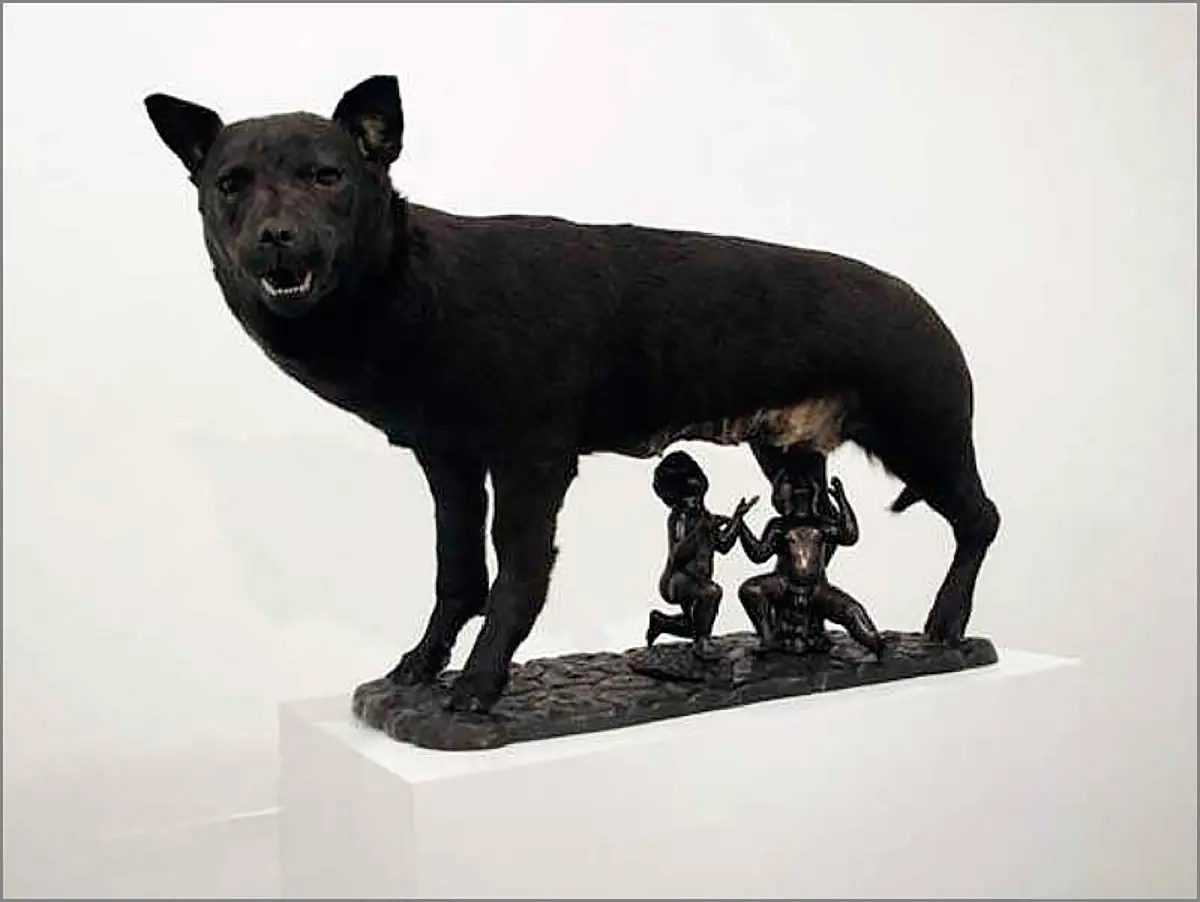
I consulted Espósito because I am convinced that one of the functions of contemporary art is to foster acts of de-idealization, just like this object does: a street dog. “They gave her to me dead at the municipal dog pound, and I had her stuffed,” the artist says. With all that this act contains in terms of the abandonment of despised animals in the city, here assuming the role of the foundational mythology for a place or for the viewer herself: fed by a street dog.
Centuries of idealization, centuries of images that take an uncontaminated, clean, colonizing aspect and exhibit it as a model, a notion of origin, have generated practices of persecution against communities and selves. How often do we Colombians blame our unresolved problems on our indigenous slave roots, considered lesser than our European legacy. How much shame of one’s own body. How many vampires mirrors, as Joan Fontcuberta would put it, where my reflection cannot be accepted because it doesn’t resemble an ideal. How much mistreatment of voiceless children and invisible animals. Against such historical practices, de-idealization makes it possible to build communities empowered to exercise their right to difference, and also to expand the map of possible emotional and physical geographies. And even to defeat the boredom and enclosure implied in retelling the same story from the same place. An example of this is Jeff Koons’ works, which transform kitsch, lineage-free discourses into a kind of objectual “solid-state” and make it possible for them to be “seen.”
Carlos Castro was born in Bogotá in 1975 and has devoted himself to the construction of objects that can be called disenchantment machines, objects that do not believe overly in the present, that carry in them pieces of the past, decadent and strange objects. But I am not talking about Dada or Surrealist objects, strange as an anti-mathematical exercise; his objects are strange because they seek out a thoughtful gaze on the history and context of Colombia from a certain distance.
I must admit that seeing a model of Bogotá’s Plaza de Bolívar inside an aquarium is initially a disconcerting experience, but then it becomes one of reflective quietude. Fish come in and out of the National Capitol, move around the statue of Bolívar, and it is as if the aquarium were a slow-motion machine in an institutional space. I am referring to Obra mediocre (2006).
I have also experienced Castro’s music boxes built using shiv-type knives, some deformed, half wrapped in rags, hand-made by unknown subjects. These knives, captured by the police around Caracas Avenue or Sixth Street in Bogotá, produce sounds, old Italian military marches, faraway yet resonant and familiar as discourse. Risus Sativus (2011), Parti di male (2011).
In the same process-like perception that Castro’s work proposes, I saw Simón Bolívar being devoured by pigeons. Across from the statue at Plaza de Bolívar in Bogotá, Carlos Castro built a replica in bread and the pigeons ate the hero, the “liberator”, very slowly. I am referring to El que no sufre no vive (2009).
These objects open up the possibility of an exploratory observation; they are images in process, open, neither idealization nor terror but a slow awakening experienced by the viewer. Like the disenchantment that brings perception closer to reality, not abruptly but through the generation of doubt, perhaps laughter, acceptance, rejection, worry, as it calls forth complexity and unveils symptoms.
Particularly significant in Castro’s work is his dedication to the design and construction of objects that are always a more intimate reflection. Confronted with an object, the body of the viewer is always implied, and in Castro’s case so is space itself because his objects are a certain kind of living room furniture. Sometimes I see them as the objects that Jules Verne could have in his study, the objects of an explorer of systems of meaning. Objects like the construction of a certain artificial intelligence that objectivizes that which is impossible to name and that in some cases, as in Imperio, can become the evidence of a spirit of the times in its solid state, in the state of furniture, in the state of the object.
NATALIA GUTIÉRREZ