
The exhibition by Catalina Parra at Galería D 21 is initially presented as a series of graphic works inspired by the social and political conflicts in Argentina. The Chilean artist lived in Buenos Aires from 2000 to 2009, where she went to work as a Cultural Attaché. According to her, back then she had no time to work on any artistic production. Today she does so from New York, the city in which she now lives. “Creating art represents a way of taking ownership of the places,” confesses Parra during a visit to the homeland she left in 1980 after receiving the Guggenheim Fellowship that brought her to New York.
The exhibition is a sort of logbook of her time in Buenos Aires. She revisits this territory and revives her experiences there from memory, from the images she gathered during her walks through the city or with the help of periodicals and other printed media. Her approach is also based on the manipulation of these elements, strategies she develops to piece together fragments of her experience, as she attempts to reclaim the city she remembers and also to go beyond the simple anecdote.
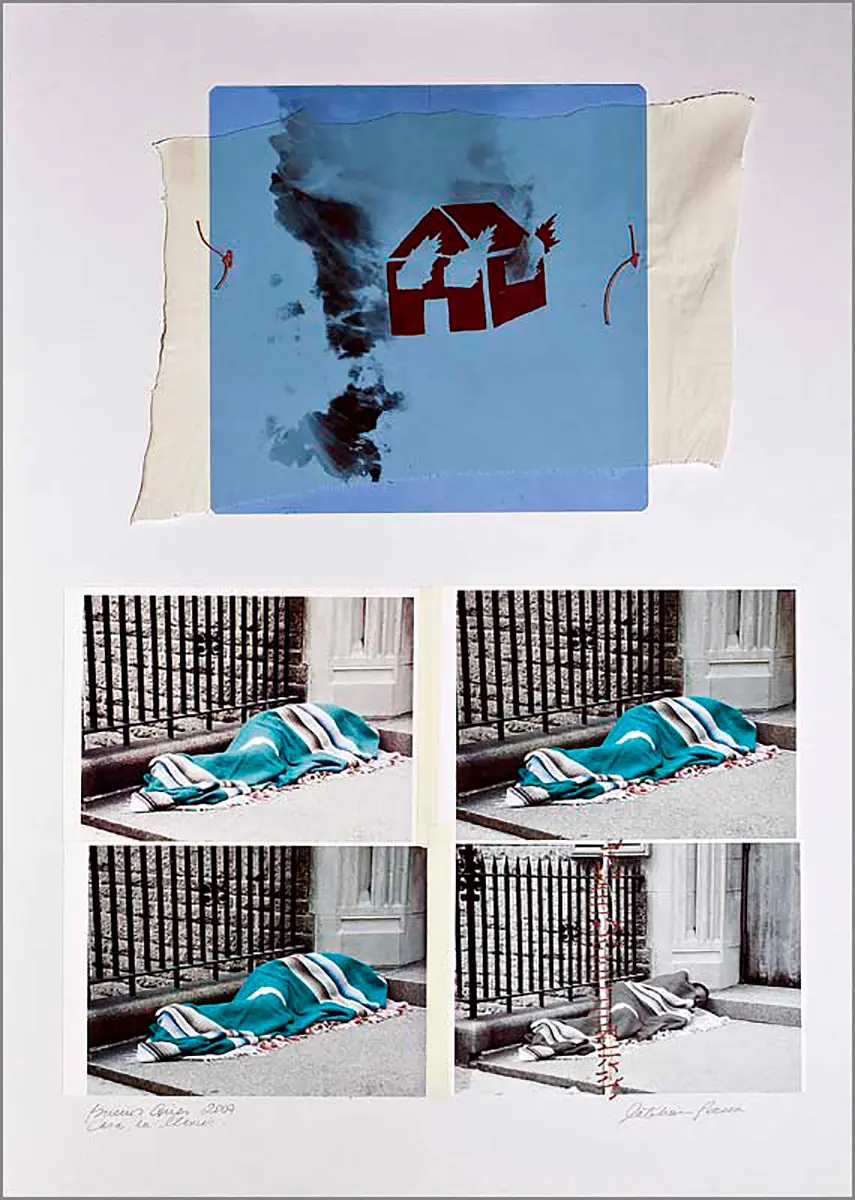
Why Buenos Aires? The autobiographical tone is mostly political in nature. In the photos of her collages it is possible to discover news events, urban situations, and also icons of identity: homeless people sleeping on the streets, demonstrations on Plaza de Mayo, tango, soccer, the neighborhood, urban landscapes, the floods that affect the city every winter, or the Discoteca Cromañón, where dozens of people lost their lives in 2004 because of a fire. They are cut-out images that Parra puts together with a variety of materials, such as map fragments, radiographies of intoxicated lungs, stained or burned papers, canvas, fragments of newspaper headlines, and manuscripts. These are aesthetic and semantic discourses that the artist neatly pastes together, transfers, or combines, as she deconstructs the linear or uniform reading of the representations.
There is a recurrent way in which Parra assembles and combines these fragmented materials: a prevalent operation in her visual proposals since the end of the 1970s: sewing. In Chile during that time, she created a work that was a milestone for her career and for the local art scene: Imbunches was an installation of images found in the press that coexisted with everyday objects, a scratched map, and a group of copies of El Mercurio (the emblematic newspaper of the Chilean right) pressed in between the transparent acrylic glass. 1 The stitches were repeated in all of the objects like an operation that united and transferred the images read as a social body. Chile lived under a dictatorship and the metaphor came from the Imbunche, a mythological character from Chiloe (in the south of Chile) that was sewn on all of the orifices of his body—among other rituals that turned him into a servant of warlocks.
Catalina Parra is a self-taught artist and the daughter of Nicanor Parra, the celebrated Chilean anti-poet. Her production, enriched in several art epicenters, continues to have great simplicity and lucidity. During those years when she shared the scene with Eugenio Dittborn and Enrique Lihn, she exhibited perhaps a “dirtier” and more impassioned materiality. Today her work conveys a neatness that maximizes the effect of the stain and the handmade work influenced by minimalism, and a way of working conceptualism through poetry, with the re-contextualization of the elements, as well as through suggestion.
Catalina Parra’s strategy continues to have transformative power. The artist gathers the dispersed remnants that preserved a fixated memory in the socio-political processes and in the cracks of a country projected as one that is developing. Some images contain the stigma of the stereotype established by mass media that took social and political situations and emptied them of their meaning. Parra takes advantage of this void to graphically, pictorially, and conceptually recombine the photographs of her “found” objects, as she organizes the materials under a certain containing geometry, with the use of a minimal chromatic range in which black, blue, and white backgrounds generally prevail to suggest the colors of the Argentinean flag. Thus the cutout images share the space within the piece with X-rays that function as veils. There are burns on the surface that are read as stains, and also scrapes like irregular lines across the canvas; segmented maps like geographies in construction; orifices that lead to other spaces: broken papers, press clippings, texts or urban landscapes; fissures, erosions, and remnants that can be mended. The cuts and seams become scars, demarcations, or borders.
The collages by Catalina Parra present a subverted landscape, a fragmented territory formed by layers of leather, plastic, and paper, whose “tectonic” fissures are fractures in a territory that is also an injured body; a body with sutures attempted to gather dreams, memories, life experiences, traces and remnants of an identity. And this body is not solely Argentina but it is also all those other territories—Latin America perhaps—in which the utopia of development confronts the reality of constant suffering.
NOTE
1. Milan Ivelic and Gaspar Galaz. Chile Arte Actual. Ediciones Universitarias de Valparaíso of the Universidad Católica de Valparaíso. Chile, 1988.
CAROLINA LARA