
Nowadays, when the contemporaneous has become more contemporaneous than ever due to the historic acceleration and the short-term attention span instilled by the electronic era—among other influences—the visual arts are interconnected to sound ever more frequently. The end of the 1980s saw in Linz, on the bank of the Rhine in Austria, the emergence of ARS Electronica, the most avant-garde festival dedicated to sound integration. Three decades later, this encounter of the minds continues to be an inspiring and provoking event—participative or otherwise—that gathers many authors from many fields. Two of such presentations, centered on the already mentioned enclave of sound and image, took place at the Aldrich Contemporary Art Museum—where six concurrent exhibitions opened to celebrate the arrival of summer. Chelpa Ferro, a Brazilian collective, presented Acusma (2008) and Jungle Jam (2010). Both works were under the impeccable curatorship of Mónica Ramírez-Montagut.
The Chelpa Ferro 1 collective was formed by Sergio Mekler and Luis Zerbini—who knew each other from before—in 1995. In speaking about the event this respected and independent artist explained that “a friend that organizes mostly encounters of musicians and poets, invited us to participate. Although we are not musicians, we decided to play the guitar…” 2 Their performance was recorded on a CD and they decided to organize an exhibition to present it. From that moment on, they collaborated in the performance of irreverent acts in frank defiance of the prevalent and enclosed compartmentalization that exists in the world of the visual arts. This apotheosis that combines art and technology, urban and museum environments, as well as the indigenous and the conceptual, permeates everything that the Chepa Ferro collective has been working on since then at the São Paulo Art Biennial, Rio de Janeiro, Bahía, London, etc.
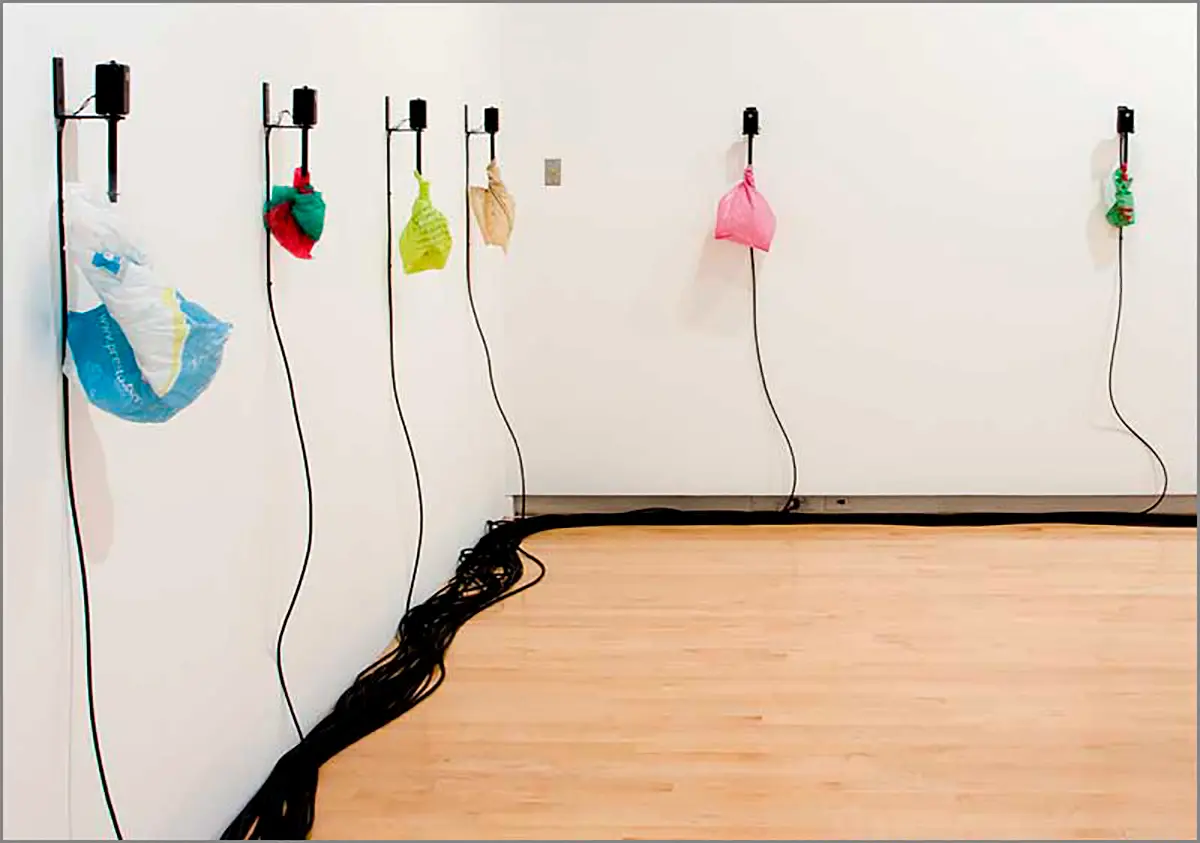
While this relationship between sound and images happens to be intrinsic—and inclusive—in Brazil, it does not just belong to one region of the world. Like their descendants in Brazil, African cultures have also integrated these two elements. The rhythms and colors of capoeira, practiced by the people from Bahia, are shown in the work Jungle Jam. Sound is an elusive presence unlike most of the presences in the visual arts. “Our work is not music, it is sound.” The sounds of Chelpa Ferro are different. They are not bound to dodecaphonic music, nor to a city or to the guitar; they are the noise that permeates the entire world. John Cage said that, to him, the most beautiful music was the music of the city—like the sounds coming from the honks that used to reach his New York apartment. These three authors incorporate electronics, surprises, and strikes that people are exposed to since 9/11. The contemporary society produces automatic surprises. Fright, the unexpected, the distorted utilization of objects, the tendency to overcrowd with sound the visual; all of this is integrated into the concept and outcome that emerges in these two exhibitions and every other exhibition created by this collective.
The artists are also mindful of the visual environment and are careful to hide all the electrical cables from view—also to prevent visitors from tripping over them. Nowadays—like the underwear Madonna made fashionable to wear in the street—the cables of microphones, computers, amplifiers, and fans, are everywhere and expose us to constant risks. They share the space with ceramic pots, bags, and motors. The work titled Acusma alludes more heavily to music with voices that showcase several rhythms and intensities that pronounce numbers instead of on notes. Likewise, Jungle Jam is the space for other antitheses: the noises generated by the guitar have been replaced by everyday ones: blender motors interact with plastic bags. Each bag crashes against the wall and produces different sounds with arrhythmic explosions of movement and diverse colors. The collective’s installations and performances are site-specific as they are modified, reduced, and expanded according to space, in order to encourage the public’s interaction and to avoid the linear interpretations of traditional exhibitions. With the help of a computer, the objects sound and move unexpectedly. Whoever is in the room is not able to hear or move sequentially. Suddenly there are noises coming from the rear, from the left or from the right; or simply, nothing happens until a barrage of acoustic-visual stimuli explodes everywhere. The visual arts showed themselves. At a time when there is no respect for life, images ensure the heart's pulse.
NOTES
1. Chelpa Ferro in Portuguese is slang for Money and Iron.
2. Conversation with the members of Chelpa Ferro at the Aldrich Contemporary Art Museum on June 26, 2011.
GRACIELA KARTOFEL