
I try to write during days when I am light on my feet and in a good mood, but today I somehow prefer to approach my writing differently. It seems more appropriate—even necessary—to be physically tired and emotionally unwilling to write about this exhibition; without a doubt this summer’s most interesting exhibition proposal in Mexico City. I Would Prefer Not to Do It by German-Spanish artist Ignacio Uriarte, is the name of the exhibition, open since the month of July at the Casa del Lago, and woven by Materia de Dibujo/Drawing Issues, the curatorial organization founded and directed by Caroline Montenat.
The show is distributed across three exhibition rooms and a small lobby. The introductory signage of the exhibition explains that the artist studied business administration and comes from a white-collar work environment. The curatorship rightly lays out the connections with the memorable phrase by Melville’s character—also a white-collar worker—that gives this exhibition its title and that is in the short story Bartleby the Scrivener: A Story of Wall Street.
It is more convenient to begin the exhibition at the smaller exhibition area, where three separate animations are projected on the wall. One of these—with audio that faintly invades the room amid a typing sound that appears to come from a typewriter—would seem particularly appropriate for setting the tone for the rest of the show. The piece Vorwärts Rückwärts (2005), plays with letters that move right and leftover an invisible line, as they (de)form one or two words that could yield an infinite number of words—or none at all if the composition were to become static. The Derridean event of the différance becomes almost “visible,” as to differ is to be inscribed in the difference. Everything, nothing, and in the middle: the gesture that wants to subtract time.
Standing out in the next room is Rotación 1 (Rotation One, 2011), a work of confined optimism with an almost Klein blue horizon similar to dawn amid Bond sheets and a wall that plays with the boundaries of its geometry to expand the possibilities of its confinement. It is the first sign of the tenor that timidly appears to germinate Uriarte’s work: a sort of minimal—essential—poetry, prompted by a defeated state.
In another work, three Bic Monochromes (2005) are accompanied by a set of headphones that promises to “complete” the experience. Emanating from them is the continued trace from a pen that comes and goes animated by an instinct that has little or even nothing to do with the final sight. Listening to the work makes it almost unnecessary to continue observing it, as a slot takes shape and allows the body to flee. What occurs between looking at the image and listening to the audio is reminiscent of the distance between the written and the spoken word addressed by Husserl. When Uriarte’s drawn piece is listened to, the materiality of the drawing becomes irrelevant and is transformed into a pure gesture that merges us with it to form what Husserl called a state of “pure self-affection,” when the voice is enounced to the body. It would be interesting to see if each of the works could achieve an even stronger effect by being displayed alone and not as part of a group. In my opinion, being part of a group cancels their potency at a distance.
A larger exhibition room presents an intelligent selection of works by Uriarte, produced between 2004 and 2011. A different kind of horizon expands across one of the walls in the work titled Two Folds: once again, in a sequence of Bond sheets, these two folds suggest a duplicated state. Crossed by the center of the sheet—that like keystone channels and contains the weight of forces to the sides—the folds intersect one another and flee to their extremes across the opposite diagonal. This almost inconsequential gesture that leaves its mark on the paper assimilates with special eloquence the conceptual gestures created with the body during the 1960s and 1970s. It denotes a constrained corporeity amid the codified gestures of the applied surroundings, but one that still includes the ability to imagine another destiny.
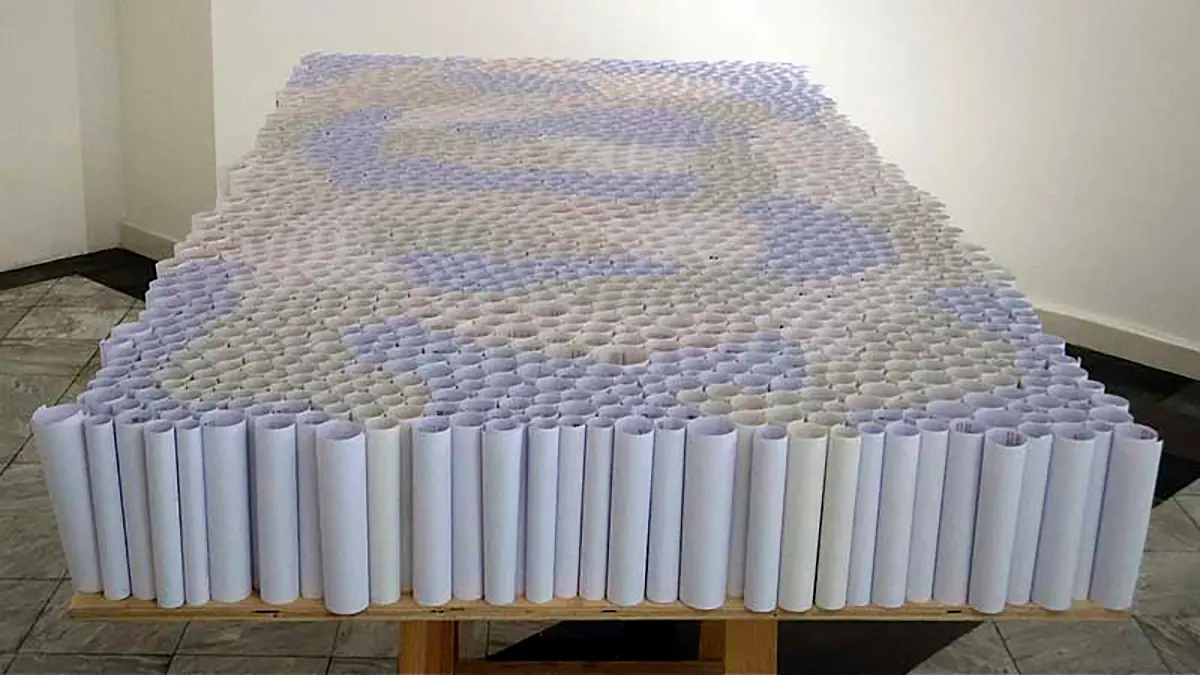
This very impulse is also explored in the central piece of the exhibition. Titled The A-4 Cycle (2009), it consists of a wooden plank that, as an improvised table, supports a small sea of hollow papers. Rolled up on its chants, a contained universe of Bond sheets with letterheads from several firms presents a subtly voluptuous accommodation that follows the white variations of the “white”—but sometimes bluish or yellowish—paper. The transitions among the rolls of paper that can be guessed from above offer an unexpected poetic encounter that animates the generality from the most common feature of its elements.
Anticipating this horizontal landscape that appears to be waiting for us as a reward, at the back of the exhibition room some other pieces retain the time they have accumulated. They are intelligent explorations of the possibilities of drawing and sculpting with minimal elements. The work All My Days (2004) becomes the work that ends—and reinitiates—the walk of the exhibition. A double sheet of paper printed on a computer contains a list of dates, written with a very small font, that represents all the days in the life of the artist, including his birth on July 13, 1973. The spacing between each date is equally minimal—although equivalent to the font. Nonetheless, the spacing between the columns and rows of words creates a sort of swell—almost trivial—that entertains the gaze as if wanting to reassure that the movement of life does exist underneath this minimal list.
MARCELA QUIROZ LUNA