
Archivos, inventarios, ensayos y notas sobre la pintura, an exhibition of works by Luis Hernández Mellizo at Nueve Ochenta Gallery, revolves around an investigation of painting, and specifically the activity of the painter.
The works presented in this show are the product of the artist's exhaustive exploration, with all the processes this entails: experimentation, trial, and error, hits, and misses. This effort drove a reflection about the art-society phenomenon, articulated in broad strokes that encompass painting from the decorative conception of a wall, through the reinterpretation of classic styles, to the contemporary status of the craft, its evolution, and the transformations it is experiencing.
The show includes a large selection of varied exercises, works that date from 2004 to the present. They summarize what has preoccupied Hernández Mellizo in recent years: with this exhibition, the artist unveils several questions he has pursued over time, for example, whether art has any utility in a society such as Colombia's, or what could be the function of the artist in such a country with its influences and resources.
Some of the works on display connect with Hernández Mellizo's earliest series, for example, a white painting on white paper, 14 meters in length, is part of a project executed on grid paper, where Hernández gave himself the "job" of painting inside each square for a period of 40 days, 8 hours a day; the painting is untitled, "the issue was just to work, to do something with my craft as a painter, thus the strict time constraints."
Another work included in the exhibition was a bucket with a TV monitor on top; the monitor displays a video titled It is hard to make a living as an artist, which consists of a loop sequence showing work about Francisco Antonio Cano's iconic (in the history of Colombia's painting) Horizontes, from 1914, with a paint-roller painter in the background. This video was made at the Museo de Antioquia on an occasion when Hernández Mellizo was visiting. This work wants to question the idea of the contemporary painter counterpoised to the idea of the virtuosic painter from a century ago. Similarly, the show includes a small, multicolored chair; the colors correspond to the typography in the book that supports one of the wobbly chai's leg: the ABC del Arte published by Phaidon, one of the conventional instructional manuals for learning the art.
A drawing placed at the center of the gallery depicts a painter in a kneeling position, the logo of a well-known paint brand; the image is simplified here into an outline, and the thick wall-painting brush is replaced by a more delicate artist brush. The image repeats several times in a circle shape, representing a vicious circle of painters. All of this work attempts to situate itself in that imprecise borderline of the art of painting and propose its own commentary.
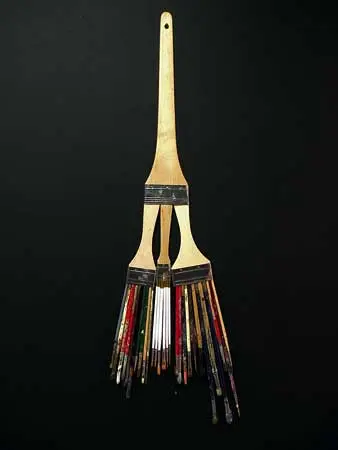
A set of large brushes made of smaller, more delicate ones is perhaps the best summation of the animating idea behind this project, which examines the way in which painting is seen by various agents such as the media, books, academia, and the general public. The project revisits virtuosic and utilitarian painting; in other words, it refers to the full spectrum of what is meant with the term "painting": art as well as an element of construction, where the action of painting produces results that depend on the context or the intention.
DIANA MARCELA CÁRDENAS