
“Perhaps I am too much of a romantic, but for me, art must be stirring.” With this, María José Arjona closed a long conversation that started with the earliest light of day and ended as night was falling. During the entire time I observed her gestures, her facial features, and once again realized that her body and her work are governed by the same line, as subtle and gentle as it is powerful. When I mentioned to her the connection I see between her physiognomy and her oeuvre, she was adamant that the presence of her body in her art is not related to issues of identity, that her body has become an entity in itself. More than an individual entity, though, her body alludes to the human as such; to that which, beyond geographical borders and gender demarcations, brings us together in a violent, technified world traversed by language and power. Her actions bring into focus the beauty and fragility of life, but also the powerful forces that oppress it.
Nick Kaye 1 traces the history of performance art in the US, starting with this genre’s links with experimental dance and theater. In the case of performance art in Colombia, under entirely different circumstances, two paradigmatic women, María Teresa Hincapié (1954-2008) and María José Arjona have also generated connections with those two fields, the former with theater and the latter with dance.
María José Arjona already has a significant career in art and has presented her work in different countries, mainly in the United States (where she has lived for the past ten years) and Europe. On two occasions she has collaborated with Marina Abramovic: Cleaning the House (2009) and the retrospective The Artist is Present, at MoMA (2010), 2 which makes Abramovic her mentor. Arjona studied dance since childhood, but a knee injury cut her career short, and moved on to study art at the ASAB. 3 She talks of that school as decisive in her education, both thanks to the experimental program followed at the time and to the professors in charge. From the standpoint of theory, Consuelo Pabón taught her what the body actually is, through the ideas of Deleuze; David Lozano and Gabriela Salamanca showed hr the plastic dimension of space. Another determining factor was the placement of the beautiful Republican-era building where the school was housed, a few steps from what was the Cartucho zone. The building contributed to her sensitization towards space, and the neighborhood taught hr about a different side of the city. For the first time in her life, she has access to a place populated by prostitutes, drug sellers, and consumers, a place filled with violence and squalor but also with displays of profound solidarity. In the course of her studies, she experienced a certain difficulty in drawing: she was intimidated by easels, feeling that facing it was like facing a wall that impeded her movements, but once she started drawing on the floor, she was able to use her body more freely and started to feel the need to incorporate it into her work. While still a student she took part in Fabulation Actions, 4 an itinerant show curated by Consuelo Pabón, with the performance 360 días. 5 Around that time she met María Teresa Hincapié, her other mentor, from whom she learned about the notion of time and long-duration performance; later, Hincapié brought her to the Valenzuela Klenner Gallery, where Arjona presented Time Construction. 6 In 2001 she traveled to New York and her work began to be presented in international galleries and events.
I see the refinement, gentleness, and strength present in her performances as related to draftsmanship, with the line that extends on the paper outlining a trajectory or articulating a shape. In her case, drawing unfolds in the space-time of the world we inhabit, in “real space and time,” and its substance is time.
“I believe artists are above all manufacturers of the time,” she says. “Time generates the matter the humans domesticated, along with space. A performance artist uses her body more forcefully than any other, in order to manufacture time with her own body. And such manufacturing of time on the basis of the body is what in a way installs a vision, and that is why the continuity that performance art provides in space-time is so important.”7
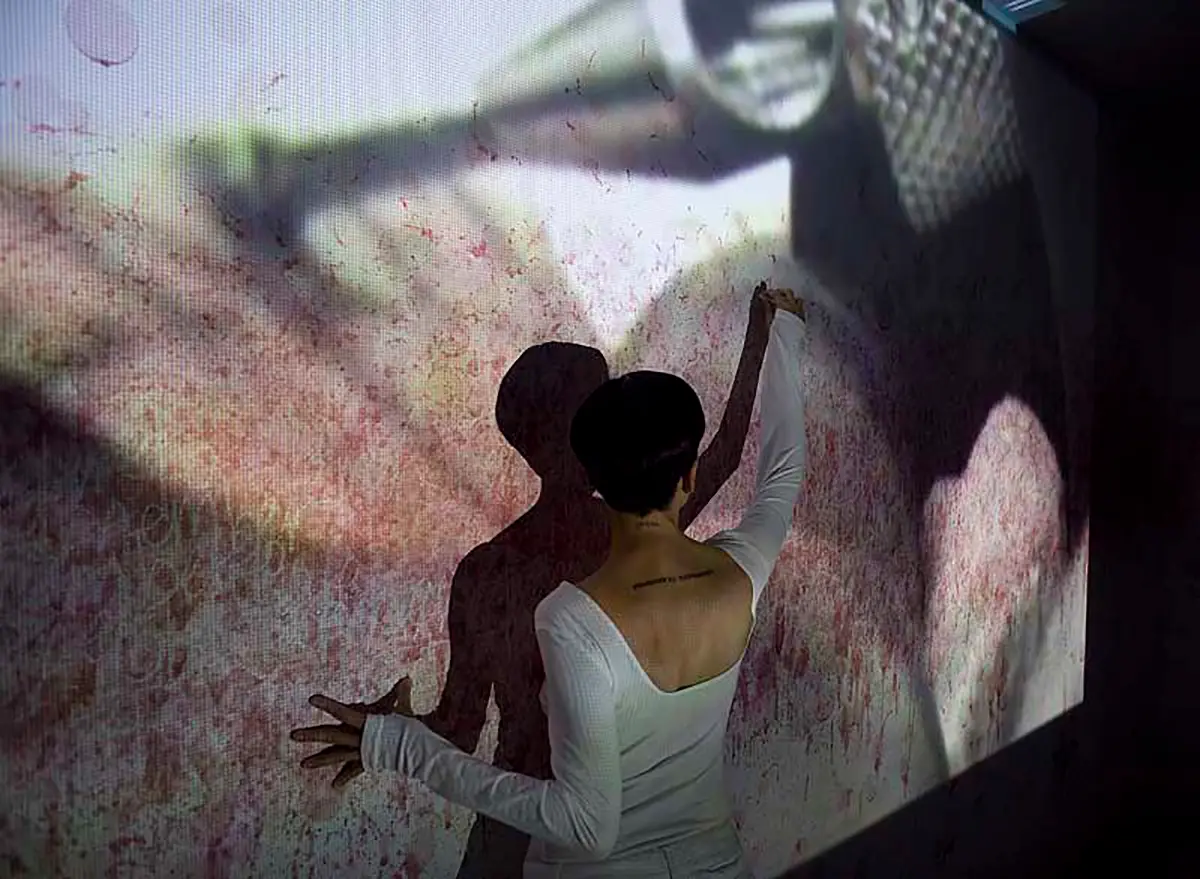
The refinement seen in her actions comes from her experiences in dance, particularly with Butoh dance, 8 which she encountered with Sankai Juku. This filiation between dance and performance art makes me think of Susan K. Langer, who formulates a crucial theory for the understanding of these two artistic genres that share a temporal dimension. 9 Dance is a “virtual image,” an “apparition of active powers, a dynamic image (…) expressing the nature of human feelings, this is to say, the rhythms and connections, the crises and ruptures, the complexity and richness of that which is sometimes called a human being’s ‘inner life’.” 10 Later on, she defines inner life as that which quintessentially human, “what living in the world feels like.” That “living in the contemporary world,” a world that is violent and technified, is expressed in the performance art of María José Arjona, who seeks to express with her body “a series of questions about violence and the effects that that force has on the body itself.” 11 These questions are articulated in three moments that define her most recent work: “The body is not a word, and cannot be defined as such. If we want to define it, it is the expression of all the definitions contained in all the words.” According to Arjona, this sentence defines the first moment, the White Series (2008-009), comprised of Untitled and What is Performance Art?, Karaoke, Remember to Remember, and History. Actions executed in an entirely white space that is transformed as her body acts in allusion to love, violence, history, memory, and time—in allusion to a large number of words that connect with the experience of living in the world, which in her actions are named through the body.
Another moment is Vires (2010-2011), a drawing traced in a different color. Arjona, always clad in black, belted dresses, offers her body to the public, who have the power of creating the performance by executing actions on the artist. The body is here a device for the human acts of others to be expressed in the performance’s space-time.
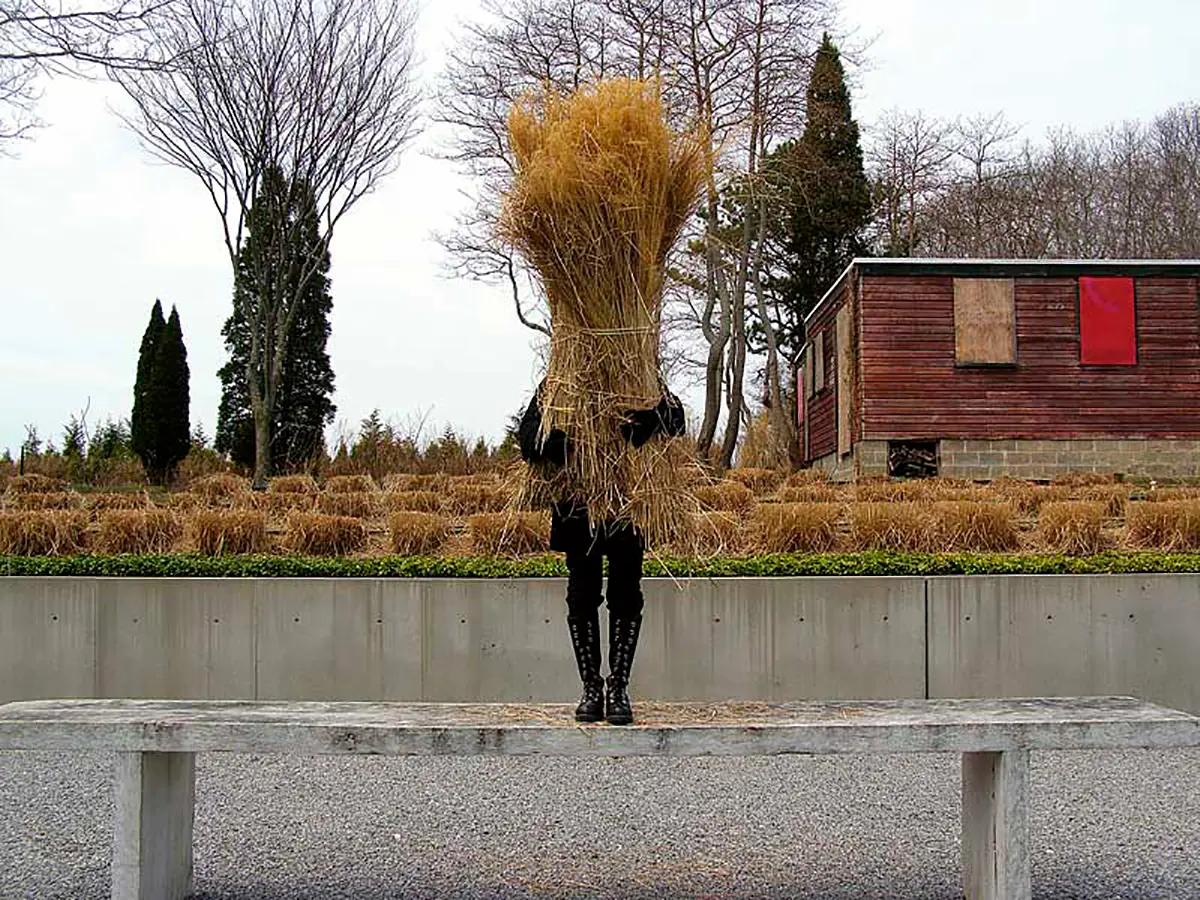
And between these two lines, one black, one white, there is A line of thought, a line of action, a line (2009). Eight performances executed during Arjona’s residence at the impeccable Watermill Center, in New York 12. There, Arjona’s body challenged the perfection of the architecture and landscape (the geometry of the design is extended into nature.) Some of the actions brought forth the presence of a quadruped, her body moving like a “four-legged” animal, or eating from the floor, subjected to difficult postures and gestures. Others, in consonance with the site itself, she creates drawings using stacks of hay or lets her body fall like a droplet of black ink on minimalistic objects.
In recent years, María José Arjona has presented several works in Colombia: she participated in Without Remedy(2008) with Return and in No more chicha! with Lineamentum (2009), both shows curated by Mariángela Méndez and organized by Galería Alcuadrado, in Bogotá; Walk Slowly and Vires (2010).
The first three works are related to the experience of returning to Colombia, her native country so strongly scarred by violence, as so many artists have made clear. Yet unlike some, Arjona’s intent is not to reveal violence: she wants viewers to experience a different time, one opposed to violence, and her actions become acts of resistance.
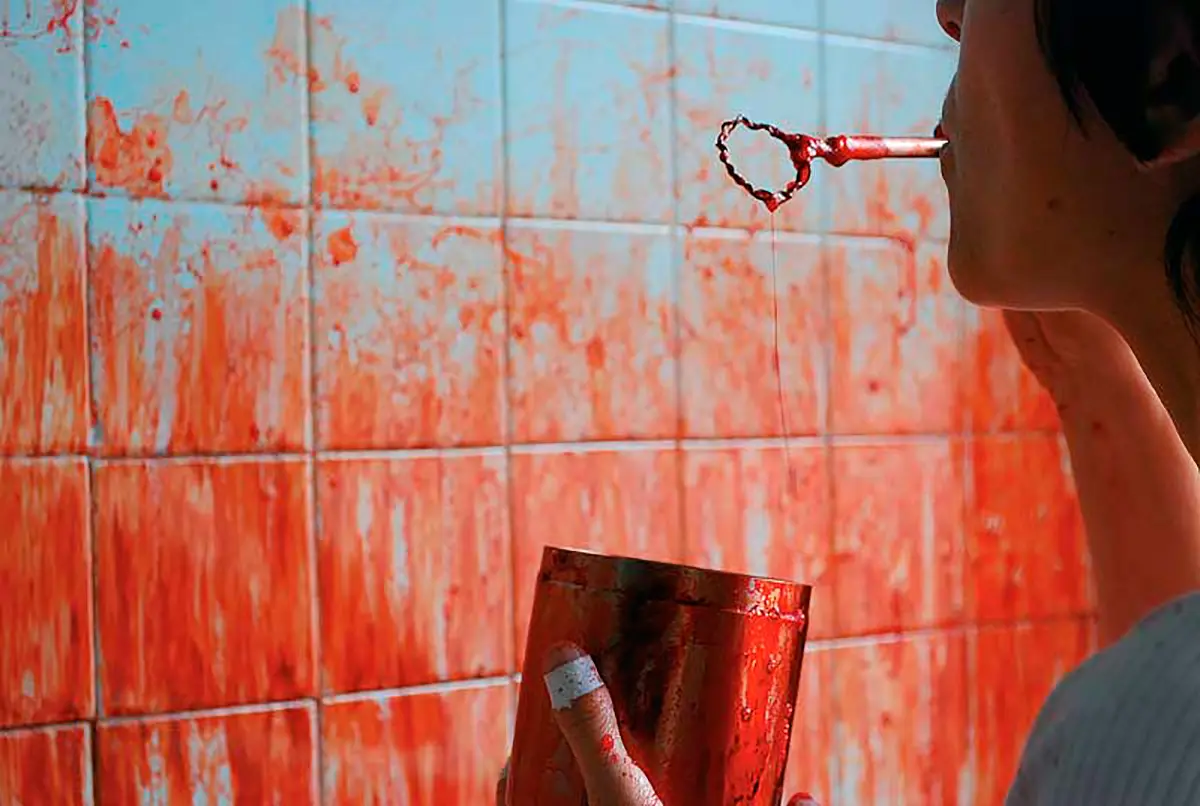
Without Remedy proposed a tour of the spaces of an abandoned hospital. Each artist occupied a space; Arjona chose the surgery rooms. What I found in my visit were walls in greenish tile, dripped (drawn) on with a transparent red liquid. At first, the appearance of the space, while chilling, seemed somewhat obvious to me: blood in an operating room. But my perception shifted entirely when I saw Arjona, dressed in white, her back turned to the viewer, cleaning those stains with soap suds that she kept blowing as she moved around the space. Her very presence was stunning and moving.
The time dimension she highlights as essential to performance art is made explicit in the process of Return, a variation of the White Series. The stained walls were the result of an action not seen by the audience, where she blew the red liquid onto the green tiles. Once covered, the public action began, where, using the same procedure, blowing soap, she cleaned them. It is that action that takes place in time when the work acquires its full dimension and meaning. The work resides in the process of executing a simple yet exhausting action (eight hours a day) that resulted in a now stained, now clean wall. What is important is what takes place in the duration, or, as Arjona says, “in the time produced by her own body” that modifies the space.
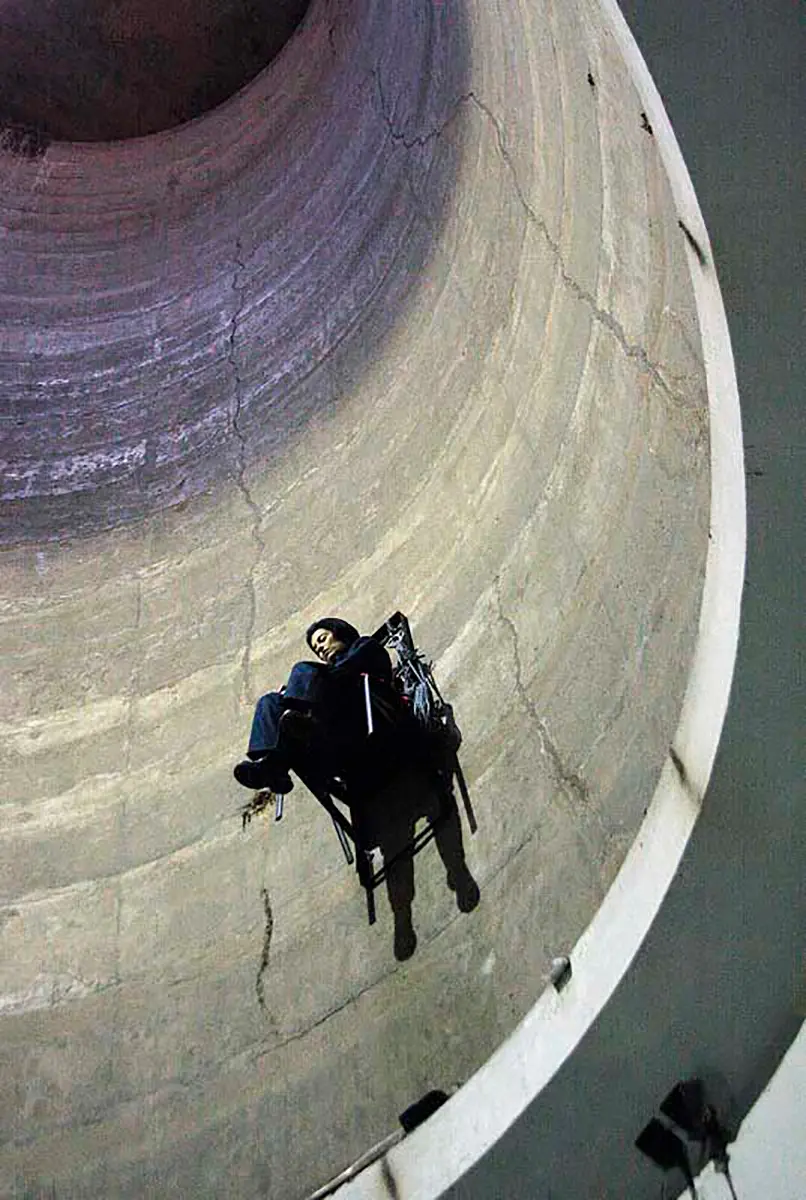
¡No more chicha! took place in the former plant of the Andina brewery, now in disuse. On this occasion, María José Arjona chose one of the plant’s old spaces and screwed to the wall, eight meters above the floor, a small chair; below, on the floor, a small water mirror reflected the image. For fourteen days, in eight-hour stretches, she played a Tibetan singing bowl, used by monks in meditation. The prodigious sound generated by her action ascended through the silo, and, through the effect of reflection, also seemed to descend, leaving viewers in a contemplative state, in a time that was “other.” Lineamentum is a Latin word that means “drawn line”; regarding that, Arjona said: “I wanted to re-draw space with my body, to generate a virtual space within space and a transcendental vision. The silo was transformed almost into a cathedral, a temple. Time stopped and allowed for another possibility of experience.” 13 Again there is a connection to drawing, with a line that is gently traced with the body and over time, which deeply affected all who saw her performance.
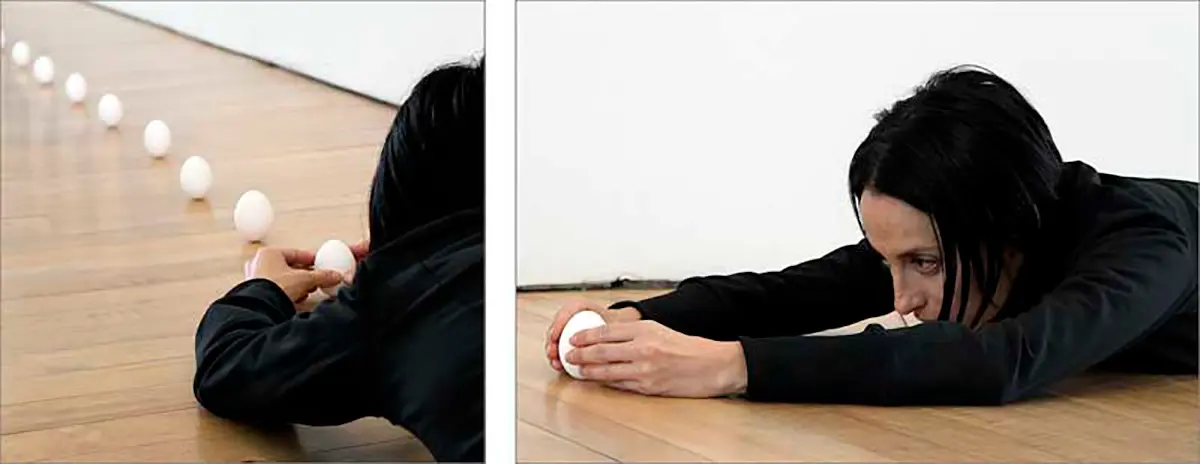
Camine despacio (2011), a re-staging of 365 días, was held in the third-floor vestibule of the Museo del Banco de la República, as part of the show Arte ≠ vida: acciones por artistas de las Américas, 1960-2000. The original action was to stand up 365 eggs for 12 hours, at the Museo de Arte Contemporáneo in Santa Marta. On that occasion, Arjona was dressed in white and kept the eggs on her lap. For the new version, she repeated the action for a period of eight hours, dressed in black, which lent the action a different character. Her action consisted of standing up the eggs while lying on the floor, applying to each movement that she had learned from Butoh dancing. This forced her to remain on the floor for long stretches, moving her hands with great gentleness and concentration to achieve the required balance. For an entire day, she continued with this difficult exercise in focus and discipline, covering the space-time after time, drawing a white line with great conviction and decisiveness while attentive viewers followed her action and others passed through the vestibule.
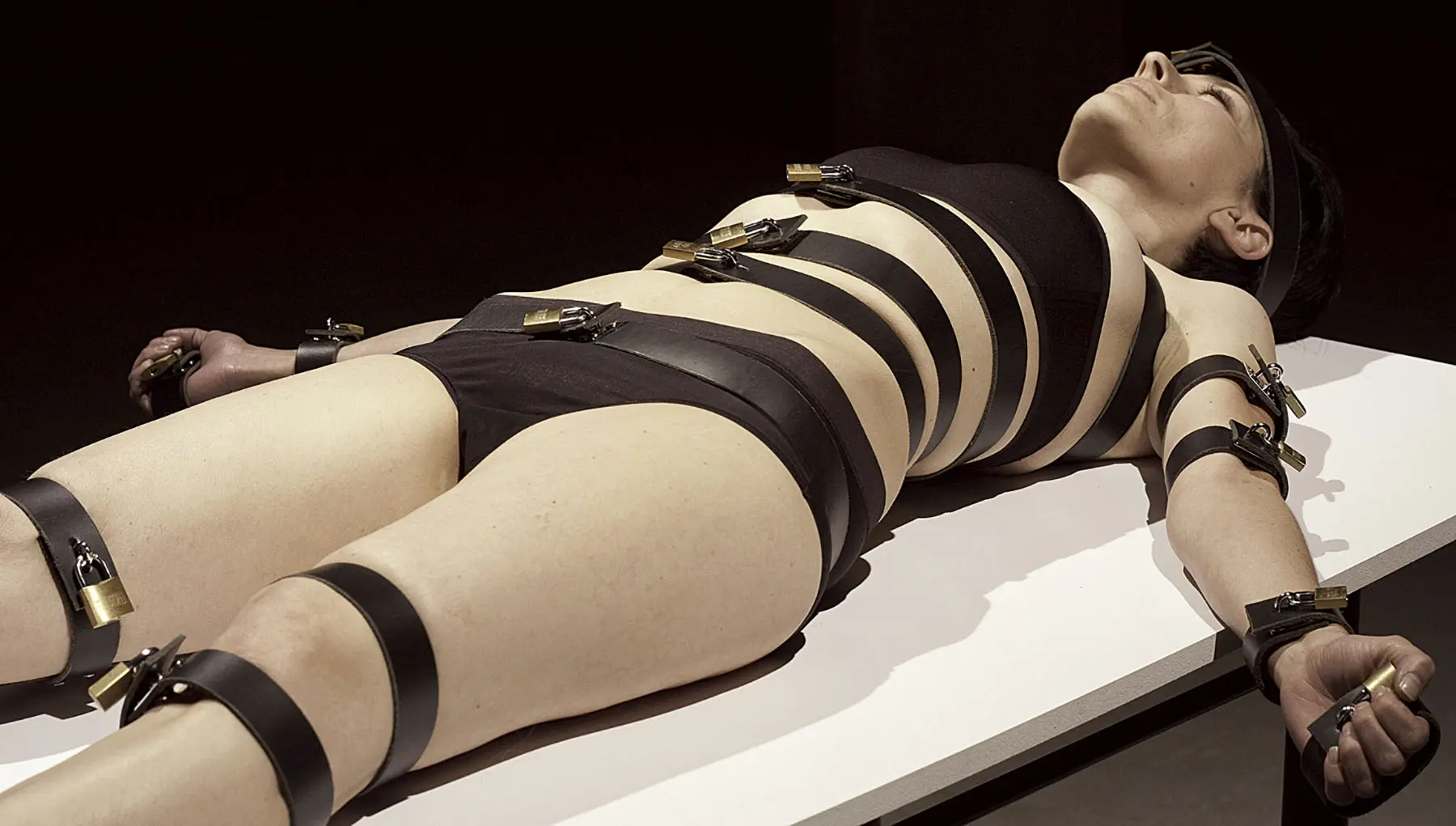
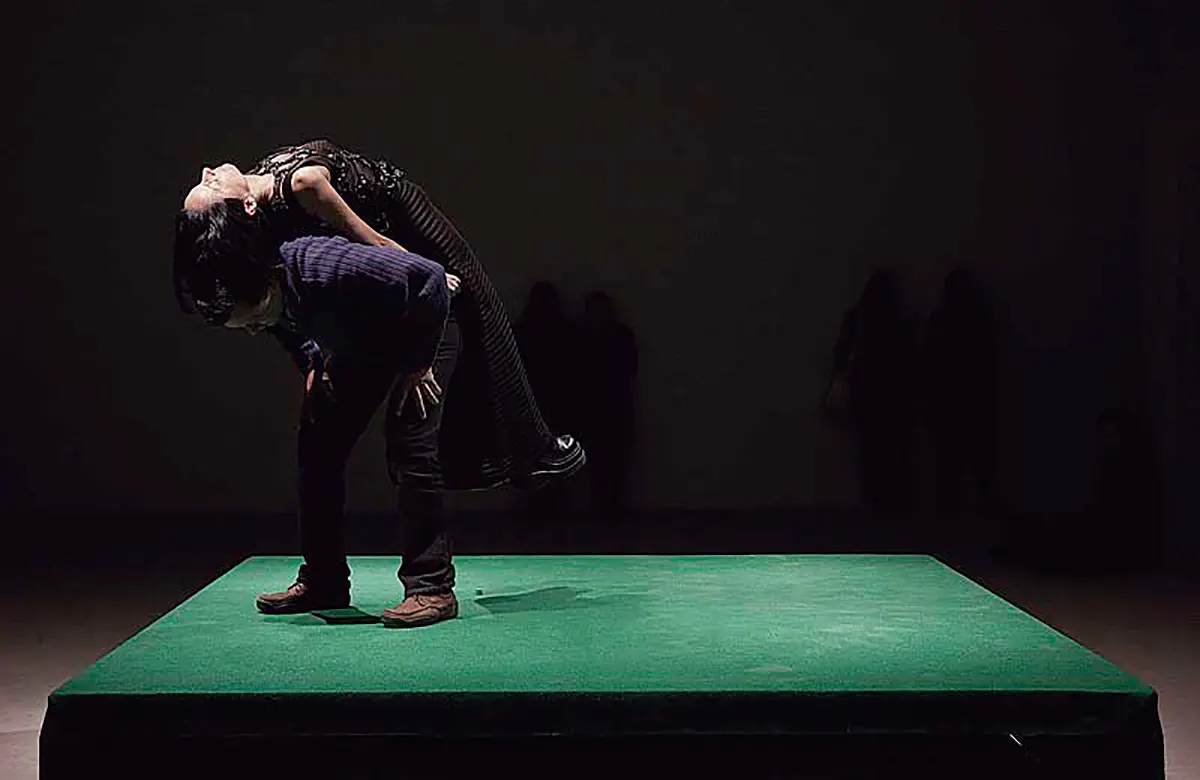
Vires was presented in several Italian cities and was recently seen in NC-Arte, in Bogotá. 14 The three actions that comprised this presentation placed viewers at the center. With a diamond inside her mouth, her body tied to the walls with belts (On Force, Desire and the objects of Desire), Arjona offered her body to the public, which had access to the diamond. Some opted, brutally, for violence, and attempted to pry her mouth open (it remained always closed); others attempted to persuade her with words. In On Luck, Fate and Choice, Arjona chose someone from the audience, invited them to the platform (covered in green felt, like a gaming table) where she stood, and asked them to roll the dice. It was the viewer who was subject to actions on the part of the artist: on this occasion, all I witnessed were shows of affection, and there were highly moving moments with the participation of aged audience members. In her last presentation, On Knowledge and Liberation, Arjona remains tied to a table with several belts; each belt has a lock, and it is up to the audience to free her by opening the locks after patiently sifting through thirty different keys to find the right one. I was able to observe great expressions of respect among all the participants who approached her body. The marks left by the belts were clearly visible when the artist finally stood up after two hours tied down to the table.
María José Arjona offered her body as a strategy for activating her audience and pushing it into action, and also to move it emotionally. The actions were really performed by those who one by one opened the locks, those who tried to capture the diamond, those who rose to the platform; they assumed very different attitudes, displaying the various ways in which we are in the world. The presence of María José Arjona’s disciplined body, prepared for intense, long actions, made evident that the fine, delicate, elegant line it traces in each performance moves on the surface of the world to conjoin beauty and refinement with subjugation and violence. Arjona’s works move us and make us waver between those other fragile lines separating life from death, art from life.
NOTES
1. Nick Kaye. Postmodernism and Performance. New York, Saint Martin Press, 1994.
2. On this occasion, she was the only performance artist invited to re-stage Abramovic’s works, among a group of people from the dance and theater worlds.
3. Universidad Distrital Art School, Bogotá.
4. Actos de fabulación was part of the project Pentágono, Investigaciones sobre arte contemporáneo en Colombia, Bogotá, Ministerio de Cultura, 2000.
5. http://www.youtube.com/watch?v=fhAJQ4v yqcw&feature=related, February 2, 2011.
6. http://www.youtube.com/watch?v=V3vqS8X VTOk&feature=related, February 2, 2011.
7. http://www.youtube.com/watch?v=2GWvjtl Dwew&feature=related
8. (…) Butoh is not only a new technique or academic style; rather, it seeks to find in the deepest recesses of the human person, through the articulation of body language, a common sense, a serene universality, even if at times it refers to cruelty or brutality. But its perception can differ between individuals. http://www.danzaballet.com/modules.php?name =News&file=article&sid=2617, February 24, 2011.
9. Ibid., p. 79
10. Susanne K. Langer, Los problemas del arte, Buenos Aires, Editorial Infinito, 1966, pp. 14-21.
11. http://www.colarte.com/recuentos/visuales/ArjonaMariaJose/recuento.htm?nomartista=Arjona %2CMaria+Jose&idartista=17582 February 3, 2009.
12. The Watermill Center is a performance laboratory founded Robert Wilson in 1996. Since 1996 it has an artist residency program. María José Arjona was one of the artists chosen in 2009.
13. “María José Arjona in De cuerpo presente,” Rodrigo Restrepo, Arcadia magazine. http://books.google.com/books/
14. This presentation, held in mid-September, had the support of Gloria Saldarriaga and Omayra Alvarado. The show included a roundtable discussion with Italian curators Eugenio Viola and Julia Draganovic, joined by Arjona. The discussion was moderated by María Belén Sáez de Ibarra.
MARTA RODRÍGUEZ
Art critic. Professor at Universidad Nacional de Colombia