
Lining a tight turn into the main exhibition space, three self-portraits by Rubén Ortiz-Torres from the late 1980s lay out the show’s autobiographical nature. The artist collaborated with the curator Amy Galpin to present 44 works which include oil and gouache paintings, pencil sketches, as well as new photographic prints, and two videos created from negatives and Super 8 film from the period. The works are grouped by medium and theme in the main space and, in an adjoining hallway, a video, and seven black and white photographs form a neat row.
The show’s title Portrait of the Artist as a Young Man offers James Joyce’s autobiographical novel as an appropriate touchstone to consider the panorama of the successful artist’s development between 1983 and 1992. The traditional orientation of the private instruction and art studies at UNAM in Mexico City undertaken by Ortiz-Torres is evident in the show’s nudes, portraiture, landscapes, mythological themes, and Catholic symbolism. The selection of early works leaves no doubt of his mastery of both photography and oil painting or the experimental nature of his forays into film.
Ortiz-Torres’s aptitude for provocative amalgamations appears in these earlier works as a tension created by his assertion of contemporary ownership over conservative subjects. For example, small nudes fluidly rendered in gouache are punctuated with a spray of silver paint or elements from a Letterset. The video Leda y el cisne (2011) shows a woman in regular clothing standing in a bathtub throwing feathers over herself. A shirtless, androgynous male appears as Zeus, an unlikely embodiment with parachute pants and bleached hair. Though derived from classical myth, crude staging on a residential rooftop renders the rough imagery unexpectedly mundane.
While Joyce’s Irish protagonist suffers from the imposition of the English language, Ortiz-Torres embraced the initially British musical form of punk rock in the 1980s. Despite the ban on rock concerts then in effect, several photographs recall the active punk rock scene in Mexico City. On one wall, large black and white photographs, including a richly textured image of graffiti from 1984 A, suggests the conventionality of anarchism as the basis for punk rock taking root. In smaller, off-kilter portraits, Ortiz-Torres captures various friends in punk accouterments hemmed in by Peñafiel bottles, an espresso machine, or decorated walls. One of the few color photographs shows an unidentified man wearing a concert t-shirt standing in a cemetery at dusk. Cropped so that we do not see the face of the man, the image shows him flanked by a raised tomb recently adorned with flowers. Proclaiming “The Clash,” the t-shirt carries sound while defining the encounter of the traditional and modern
In Joyce’s story, the writer achieves maturity after leaving his native city. Ortiz-Torres departed Mexico City in 1989 or 1990 to attend Cal Arts. Flanking an open doorway in the main gallery, two oil paintings, created in Los Angeles after his arrival, convey his experience of the migration as a corporeal breach. On the left side, the portrait Passport shows half of the artist’s face with the faces of other foreign classmates spliced to comprise the other half. On the right side, Passage depicts the artist Daniela Rossell with a cut on her bare upper arm, an injury sustained by his former girlfriend just prior to his departure. While Passport suggests a shared consciousness with others who have left their native countries, both paintings convey a loss of personal coherence realized in physical terms.
Unlike Joyce’s alienated protagonist, the young Ortiz-Torres benefited from a liked-minded artistic circle in Mexico City. Pages from a notebook display pencil sketches of Diana Hardwicke, Carlos Amorales, Carlos Arias, and Gustavo Marcovich, who provided inspiration and support to the art student. They and others proceeded to form a diaspora of sorts in cities like Los Angeles, San Diego, and Tijuana, where they, along with Ortiz-Torres, continue to generate films, art, music, and exhibitions.
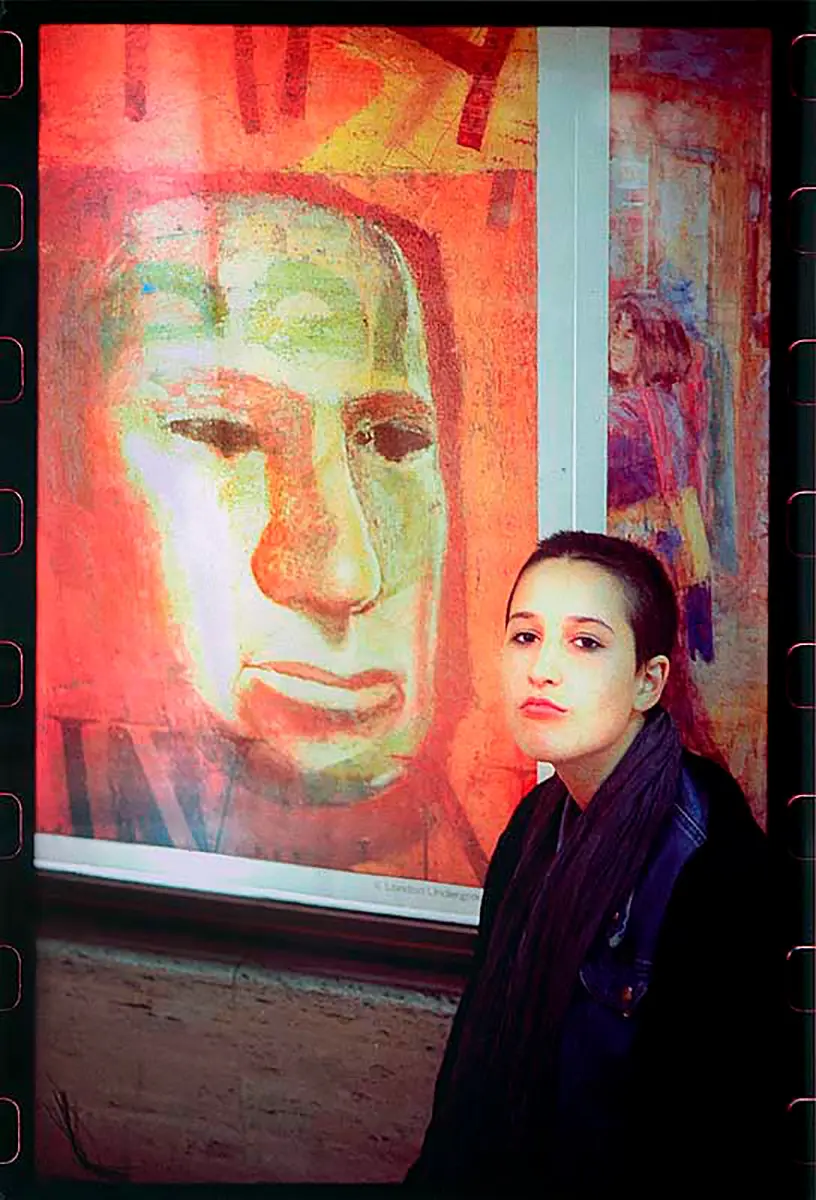
A ramification of leaving the cocoon of Mexico City is intimated in his photograph of Natasha Fuentes taken in London in 1992. Seated next to a painting showing a rendering of a head without hair similar to her crew cut, she mimics the figure’s jutting lower jaw. Fuentes, who died in 1995, seems to identify with an image of Mexico abroad. The photograph’s title Aura, taken from the 1962 novella by her father Carlos Fuentes, offers another basis to interpret the works in the exhibition. In addressing mortality, Aura suggests the photographic portrait as an immutable record of unbridled youth, unbridled in terms of love but also in the usual sense of breaking free.
ELIZABETH A. WATSON