
The exhibition Sandra Gamarra: At the Same Time is part of the evocative project entitled The Cabinet, organized by Bass Museum of Art Director Silvia K. Cubiñá, with the objective of exploring the creative possibilities stemming from a dialogue—initiated by contemporary artists—with the permanent collection of that Museum, a collection that contains works that date from the Middle Ages to the 20th Century.
Although originally intended as a proposal limited to the area of the cabinet or exhibition room adjacent to the Taplin gallery—where the masterworks from the collection are exhibited, the artists, like Isaac Julien and Ellen Harvey—participating in this non-chronological exhibition, redefined the original boundaries of the show and extended the area of their interventions. In Sandra Gamarra’s case, the Peruvian artist (Lima, 1972) chose to intervene the main gallery with texts as she also installed in several other areas works that carry conceptual preoccupations about representation and reality, to the field of the different lectures that result from the interaction between the works and the viewers. Her versions of the works place viewers in the act of “going through the mirror” and entering the artwork.
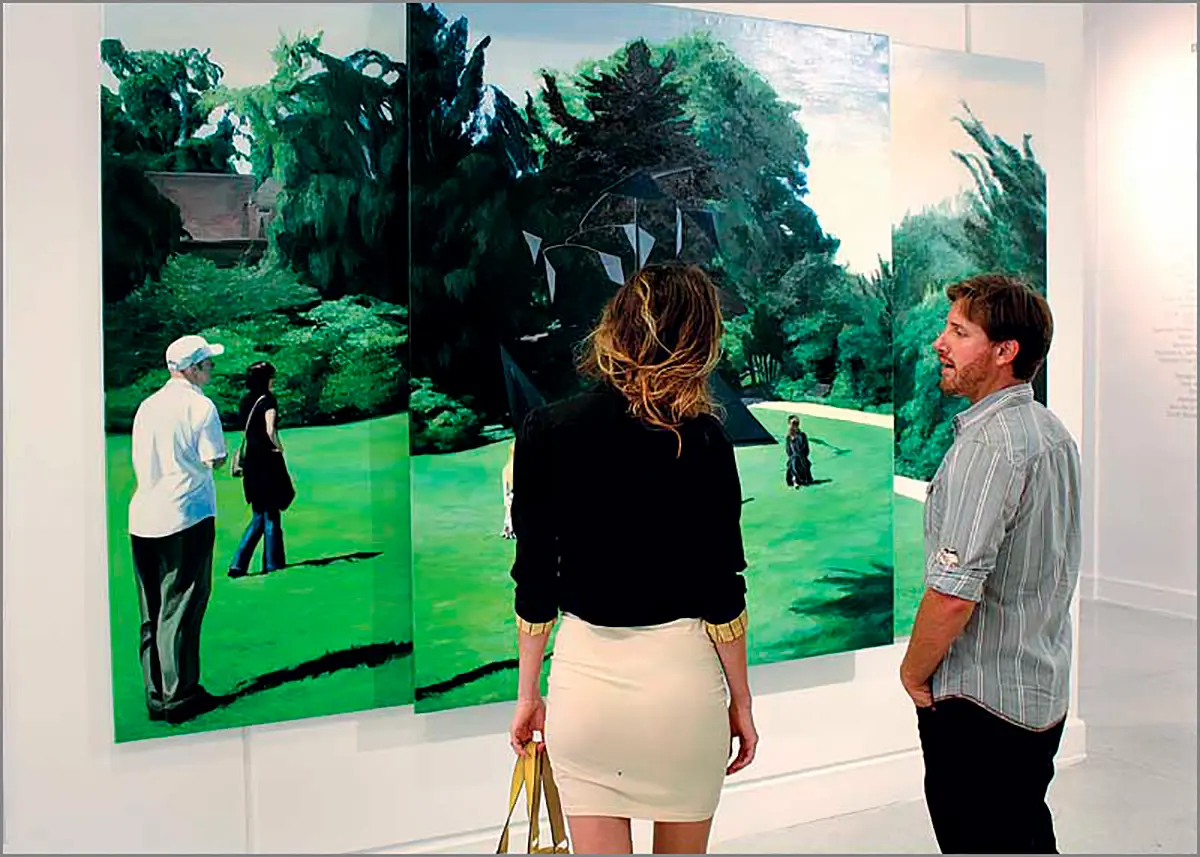
The thirteen oil paintings from her series At the Same Time—also the title of her exhibition—establish a close relationship between the viewers and the works, based on the act of contemplation. To attain this closeness, Gamarra sometimes employs resources like the integration of the colors found in the cloths of the visitors with the tones used in the works—in order to visually erase the time gap that exists between contemporaneity and the past. And she does not solely manage to bring different centuries together, but orders of reality as well, as viewers become part of that which is being represented.
Because of the relationship, Gamarra establishes between painting, photography, and reality, it is impossible not to be reminded of the photography-based oil paintings by Gerhard Richter. Nonetheless, Gamarra’s strategy and purpose are not the same as Richter’s. She took photographs of museum visitors as they were observing works from the permanent collection. Her interpretation of the scenes achieves to redefine what a work of art is.
More important than the act of copying, is representing the work of art in the context in which it is observed, as a fetish-object integrated to the body of the observer. Thus, every oil painting contains the observer and the observed and refers to the notion of receptivity.
Gamarra’s subjects bring the mystical origins of the contemplative act to the forefront—not without some distance—and propose the museum as a place of peregrination where people go to observe objects to which the collective imagery has conferred value and legitimacy through an act of faith. Doubt is nonetheless suggested as viewers are transformed into part of a new object—the work now exhibited—that, as this review demonstrates, demands contemplation.
This sacralization of the work of art—a theme Gamarra approaches in series like The Apostles—is present in the work Fátima, a large-size triptych that the artist installed outside the exhibition room destined for the cabinet, in front of the museum’s internal staircase. This oil painting depicts an abstract sculpture installed in a garden. Several people surround the sculpture as if they have just ended a peregrination, including a woman in a posture reminiscent of the representational iconography of this Virgin’s apparition in Portugal.
Representing the act of contemplation is herein transformed into a strategy to erase the boundaries between fiction and reality, and to question the framework in which works or arts are inscribed as well as their interpretations. In this sense, Gamarra points to an overflow of discourses about art. Thus, her subtle intervention of texts to explain the works of art through newspaper clippings. Here, the chronological rupture is achieved through a textual strategy that establishes parallels between the content of works of art created centuries back, and contemporary events. She endeavors to inject the present into the history of art or to at least extend its boundaries, in order to demonstrate a sort of extemporary resonance among that which constitutes a classical work and that which appears in the mass media.
This hermeneutic attitude, after all, is not that far from the generalized understanding of things associated with our human condition, and its relationship with the transcendent—it is timeless. Nonetheless, in this period of sacralization of the iconographic in art, where some works are invested with a mystical halo whose existence nobody can challenge—to avoid being accused of not knowing how to see, as it occurred in the classic short story The Emperor’s New Clothes—it is precisely a strategy such as the representation of the contemplative gaze, the thing that would allow for an essential reflexive distance. Without being sharp but with an acute ability for observation, Sandra Gamarra relates the conversion of the work of art into a new fetish, as she establishes a healthy distance through the doubtful gaze.
ADRIANA HERRERA TÉLLEZ