
What are Biennials for? What are the value and the role of these institutions whose origins hark back to 1895, when they were established in Venice under a model of national representations that was followed for so long?
Art biennials spread widely in the second half of the Twentieth Century; today, there are over one hundred, dispersed throughout the world, in every single continent. They are transnational mega-exhibitions of contemporary art that promote a nomadic existence for artists and curators and constitute a modality of insertion of the visual arts in the process of the “spectacularization” of culture, a feature of capitalistic globalization. Debates aside, in peripheral countries these shows are important ways to attract new audiences, and also an opportunity for those interested in the field to maintain contact with current, diversified productions. In Brazil, three important visual arts biennials are active: São Paulo (1951), Porto Alegre (1997), and Curitiba (1999).

The Sixth Edition of the International Biennial of Contemporary Art of Curitiba opened on September 17th and will close on November 20th. Its long roster of sponsors—corporate and institutional support—is evidence of a shared effort behind the project, with a budget that, as was announced, was really not equal to the generally high cost of these events. The sustained high quality of the works on exhibit, something rather uncommon in such large-scale art shows, is a pleasant surprise, as is their excellent distribution in beautiful historical buildings in a discreet and precise museography.
The Biennial’s general curatorship was shared by Ticio Escobar and Adolf Hug, with Adriana Almada and Paz Guevara as co-curators. The event’s overarching title, Beyond the Crisis, alludes, according to the curatorial texts, to a cross-roads moment in history that incites creativity and opens up a space for critique. It is interesting to note that, in an era of globalized biennials, the theme explored in Curitiba connects to those expressed in the title Do you Believe in Reality? at the 2004 Taipei Biennial. In both instances, art sets its gaze on “what lies beyond the ultimate frontier: the extra-artistic, the outside world, history as it happens, the culture of others.” 1
This proposal, which challenges artists and curators to analyze issues of anthropology, economics, politics, and society, can also function as a prompt for reflection among visitors. As Ticio Escobar puts it, “Art is, precisely, one the most effective devices at the disposal of contemporary culture for the discussion of its own assumptions, the renewal of its values and its codes, and for our collective perception not to languish on a fixed conception of the social.” 2
The exhibition, which includes 70 artists from 36 countries, is arranged in 22 spaces throughout the city. The main site is the magnificent Museu Oscar Niemeyer, which hosted the opening ceremony. An important selection of works is on display at the MON, with a predominance of photography, video, and some installations. Interestingly, some artists incorporate new technologies (digital photography and video) into their documentary practice, with a realistic approach to issues and topics affecting several regions of the contemporary world. Such is the case, for instance, with Aliz Kazma’s videos about the activity of steel mills, Darren Almond’s videos on Indonesia’s sulfur mines, or George Osodi’s work on gold mining in Ghana. The viewer wavers between the beauty of the images and the harshness of the topics.
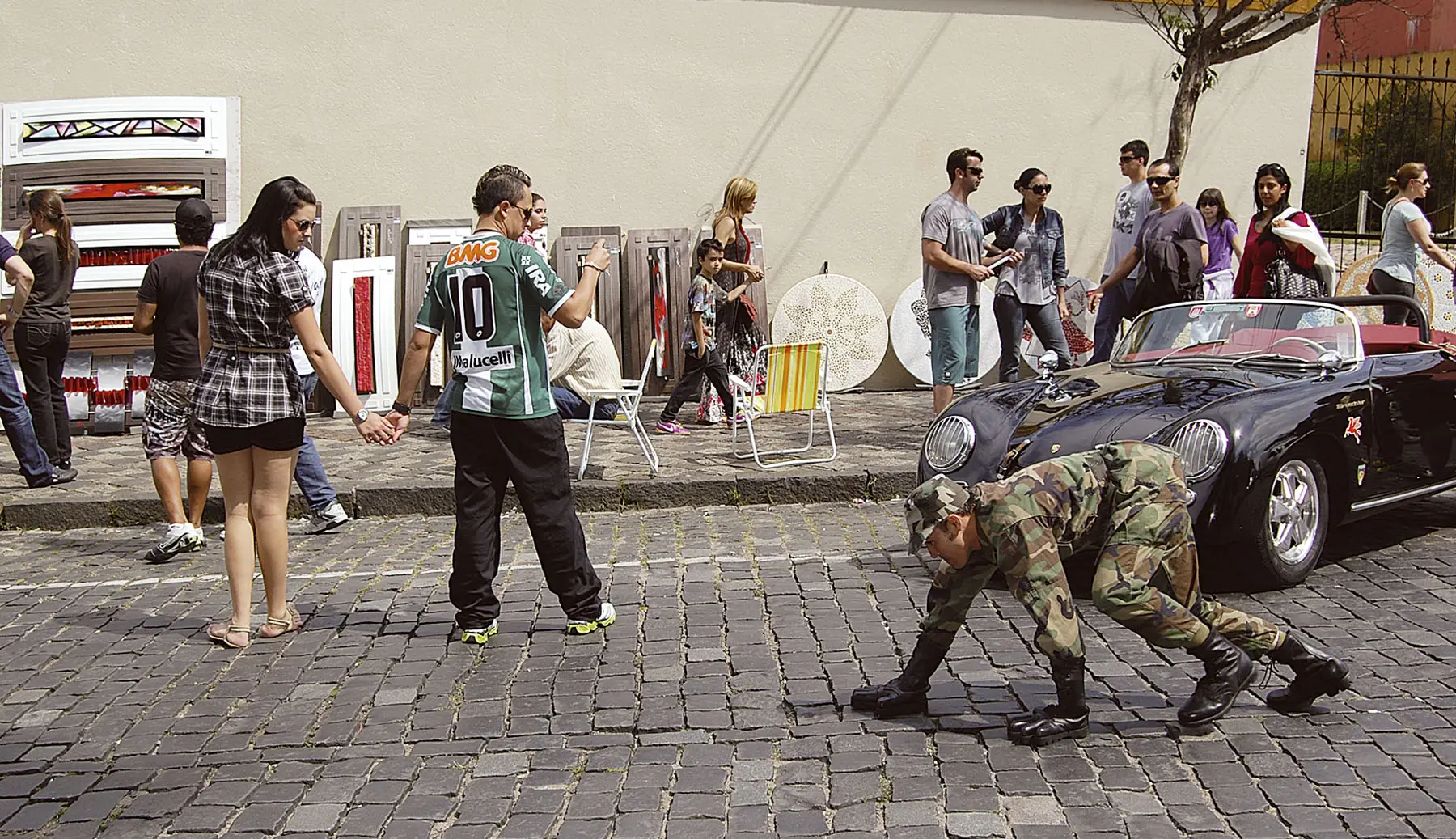
Ronda, a rather unsettling performance by Cuba’s Adonis Flores, was presented during the opening. Dressed in military camouflage, donning paw-shaped boots in his hands, the artist moved around in all fours, mimicking a wild animal. Flores, whose topic is war and life in the military, participates in the Biennial also with photographs depicting skulls as decorative objects. Equally beautiful and merciless are Camilo Restrepo’s photographs, huge and extremely realistic images of pipes used in poor neighborhoods for the consumption of hard drugs, like crack cocaine. The artist collects the pipes and photographs them against a black backdrop, giving them the status of works of art. He also makes an ironic, corrosive commentary on the art-theoretical debates around the issues of representation, revisiting Magritte as he writes in cursive on the black background of his photographs the sentence: This is not a pipe.
Joanna Rajkowska’s investigation of Polish immigration to Curitiba results in an interesting proposal. Old photographs documenting the passage of the Zeppelin over the city accompany large photographic panels taken by the artist in the same locations as they exist today. Rajkowska introduces the imaginary image of the Zeppelin into contemporary locations. In his Kayapoemas, Neville d’Almeida also intervenes with red tracings photographs of the Kaiapo native tribe. Both works generate friction on differentiated cultural spaces, producing clashes between systems of meaning.
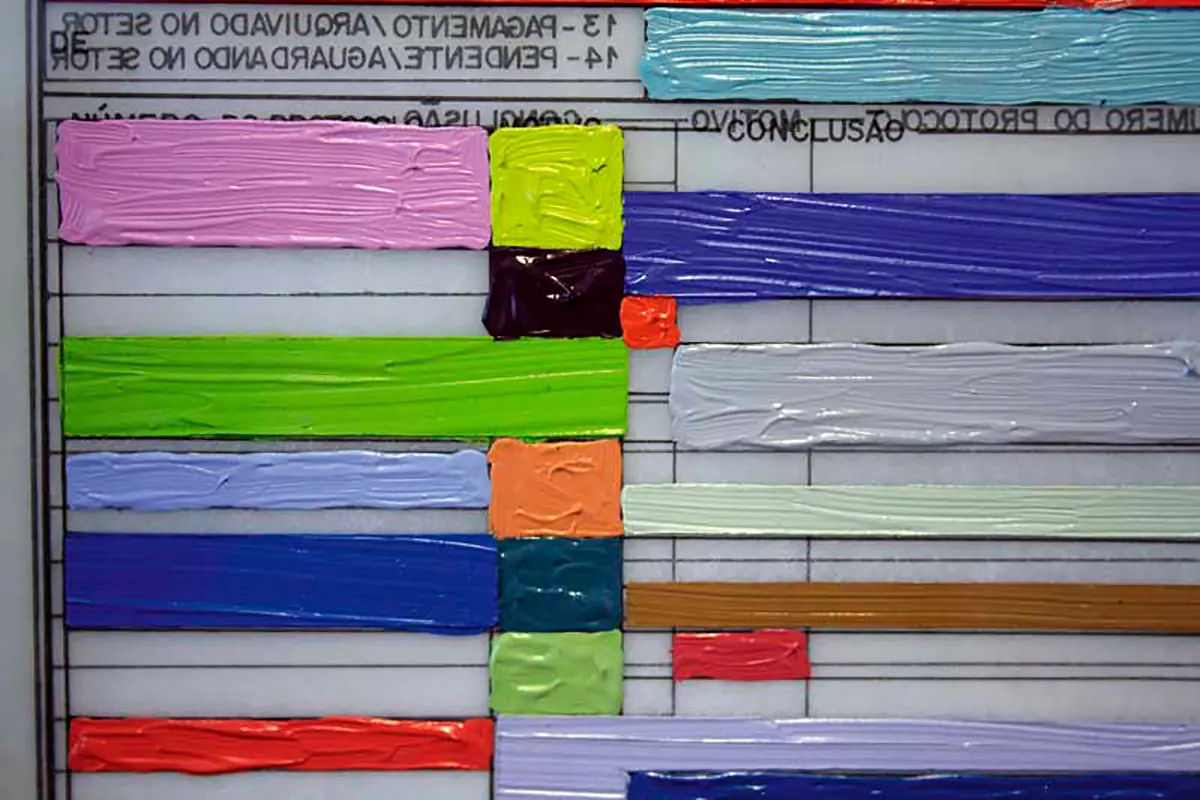
At the Andrade Muricy house, the dominant presence of painting indicates the intention of questioning hegemonic canons in that artistic modality. With subtle and delicate works, Felipe Scandelari and Livia Piantavani explore the media and procedures of their craft, questioning the validity of manual work in a technological world. A video by Christian Jankowski is also among the works on exhibit here: some musicians acting as painters, dancing and playing their instruments as they draw and throw colors at their canvases. This allegorical process raises unanswered questions and wondering.
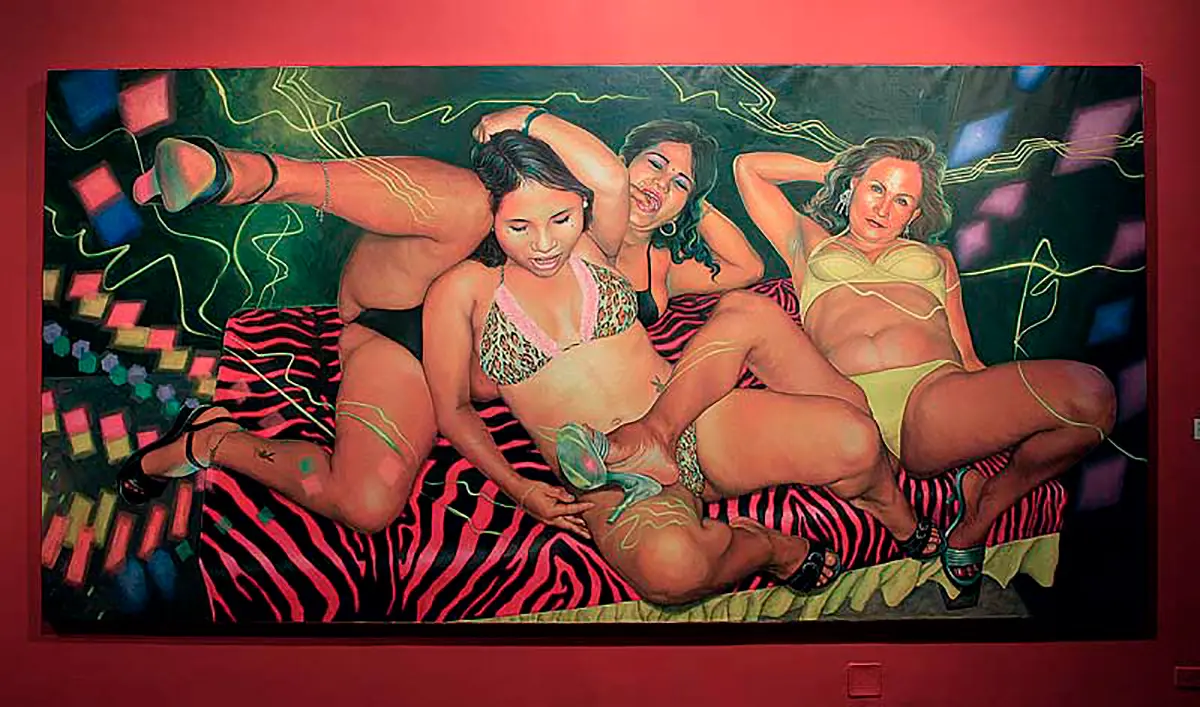
The crisis is a silent presence, a vague threat of upcoming events, in works by Duncan Wyllie, Eduardo Berliner, and Farah Atassi. They leave behind all pretension of beauty, turning ruins and decay into the ideal topic for the critique of a world that is coming undone. Christian Bendayán also objects to traditional canons of beauty, developing works that point out contradictions in colors and themes that approach the popular world and the ambiguities of the transvestite world. The selection of works presented in this space affords a wide perspective for reflections about the artistic practice of painting, a rich corpus for study and analysis.

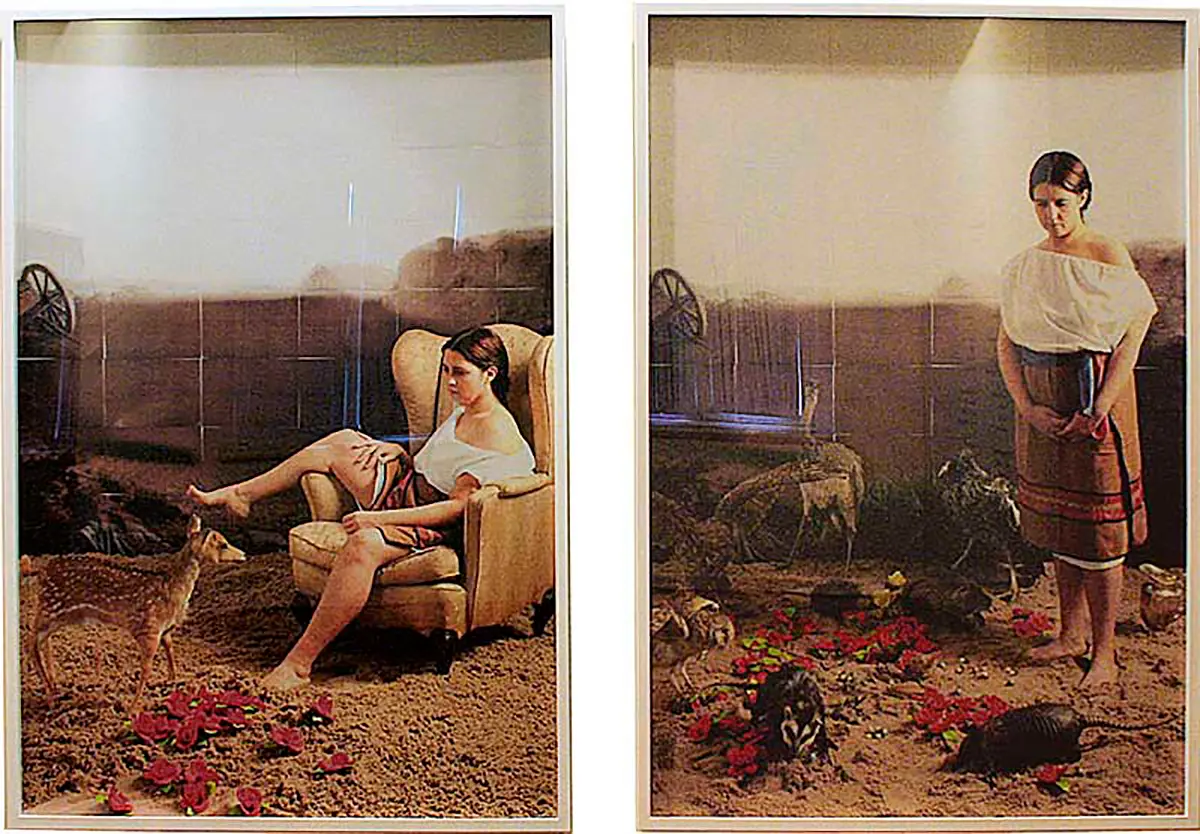
The Museu da Fotografia Cidade de Curitiba hosted a show of works by Auguste François, a French diplomat and amateur photographer who in the Nineteenth Century did documentary work, ethnographic in character, in Paraguay. In the same architectural complex, at the Museu da Gravura, the audience encounters an important selection of works in various techniques. Liliana Porter and Jaqueline Lacasa use photography for an ironic and critical approach to Western culture. Porter looks at mass culture and its symbols, expressing suspicion of insignificant everyday objects. Twisting signs, Porter extracts from them a shifted meaning and unveils the closeness of the sinister. Lacasa, in turn, deploys erudite artistic icons, in this case, the Uruguayan painter Juan Manuel Blanes and his La Paraguaya. Calling her work La Uruguaya, Lacasa sets photographs that revisit visual elements from Blanes’ painting. Similarly ironic are the videos presented by Alejandro Paz and Javier López-Erika Meza, who set in conflict signs from indigenous and Western cultures. Paz presents a Guatemalan Indian woman running on a straw mat, and López-Meza depicts a Toba Indian giving a speech in the Guarini tongue, according to the rhetorical norms of marketing. These “montages” allude to the tension present in an ambiguous and conflicted coexistence with “the other” in the globalized world.
On exhibit at the Museu Alfredo Andersen are works by Andersen himself, who lived until his demise in Curitiba, and installation by Chinese artist Zang Enli, who recreates shadows from his own studio in highly diluted colors, on the museum walls. Two eras, two painters, two studios are set to dialog in this proposal. The Biennial’s engagement with the local context can be also appreciated in the participation of invited curators Artur Freitas, Eliane Prolik, and Simone Landal. In the General Catalog, they highlight the presence of ten artists who reside in the state of Paraná and are included in the official show. The integration of local artists and curators into the show, besides giving greater visibility to the arts produced in the state, favors the reception of the Biennial in the local art world.
Two original proposals related to mass media are connected to video art. One of them is the presentation of Fabio Noronha’s work in a movie theater, the Cineplex Batel, located in a shopping mall in the city. The other one is the exhibition of a selection of Argentinean video art in the public transport vehicles servicing the Porto Alegre-Curitiba route. Cristian Segura’s project is titled Entre Bienales, an allusion to the events held in the two cities connected by those buses.
A distinctive feature of the Curitiba Biennial from its inception is its dispersion and articulation in different public and private spaces, institutional or not. 3 Reaching its sixth edition, the Vento Sul Bienal de Curitiba has carried in its very name a proposal of spatial and conceptual dispersion, promoting interconnections wherever the wind blows. The current proposal—Beyond the Crisis—it questions limits, zigzagging over national borders and borders between cultures, exhibition spaces, and artistic philosophies. Good winds are carrying it.
NOTES
1. Escobar, Ticio. El arte fuera de sí. Asuncion, Museo del Barro / FONDEC, 2004.
2. Ticio Escobar's text in General Catalog offers an important reflection on the issue in the visual arts field.
3. The program includes interventions in public spaces, but they were not open yet when I visited the show.
MARÍA AMALIA BULHÕES