
Presented from May 29 through July 17, the recent exhibition by Víctor Lucena somehow marks the reencounter of this artist with the Venezuelan public, after 20 years without showing his work in the country. He has always had an attentive audience interested in his work and one that is aware of his international relevance. For these reasons, from the time the exhibition opened, it became the place of encounter for followers of his work and for the cultural art scene in Caracas.
Lucena belongs to a generation of creators who, during the mid-1970s—amid the euphoria of the intense processes that transformed the universe of the visual arts—discovered in Minimal Art and Neo-Constructivism two different artistic currents that nonetheless shared the same conceptualist approach. Lucena centered his attention on them and, through them, reaffirmed his need to create art, to follow a path and to build the work that eventually made him one of the most internationally recognized Venezuelans, for his commitment to the cause of art as a cognitive process that offers viewers the possibility of a deeper understanding of the world around them.
In the exhibition in La Cuadra (The Block) Lucena exhibits a piece that does not propose anything new in the way of meaningful changes as compared to his earlier work. On the contrary, it represents a sort of continuity that takes into consideration his more than 30-year experience as researcher and creator concerned with the depiction of space; particularly when it comes to the works shown in 1989 at the Museo de Bellas Artes. In this sense, the artist commented: “The approach of this exhibition is the same as I have been proposing from my beginnings as an artist, only they have been synthesized.”
His is a search that has also become deeper and more complex with the incorporation of new concepts and theories like the ones presented in Space Shock. Generally speaking, they can be understood as the interpretations of the space that stem from conflicting or confrontational situations. But in visual terms, these are based on the perceptible distortion of linearity and volume.
Most of the works exhibited are two-dimensional works created on aluminum, bronze, and copper surfaces. The artist constructs on these materials some sort of two-dimensional installations in which he contrasts the regularity of classical orthogonal forms: the square and the rectangle are set against circular and ellipsoid forms, in order to elicit ambiguous perceptions, as cuts and folds are generated and leave open the possibility of incorporating the walls into the dialectic of the work. This resource for visual stimulation is perhaps not as intense in the works on paper, but it is just as compelling and suggestive of the perceptive phenomena, and it is based on the use of color and the organization on the surface of the forms that configure the work.
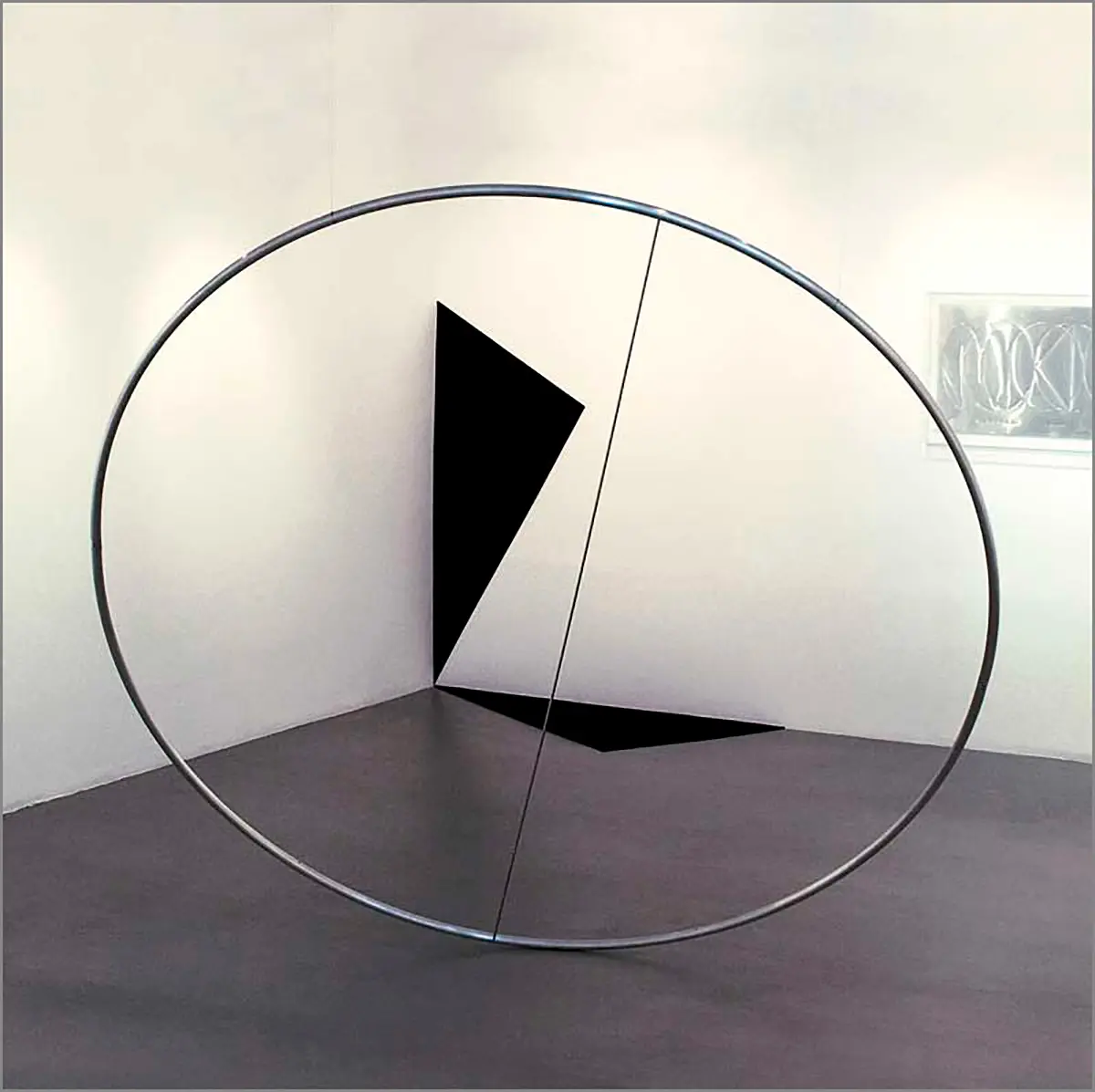
Perhaps the most relevant piece of this exhibition is Space Shock Dimension N, 1986-2011. Fashioned with several materials, the work consists of two parts: a large aluminum circle that measures 220 cm (86.6 in) in diameter, placed in the middle of the room; and another component made of two identical rectangular triangles joined at one of their vertexes, but one placed on the vertical plane and the other on the horizontal one. This placement creates the effect of a three-dimensional form instead of the conceptual artifice that it is; one that at times robs viewers of their rationality. Both pieces play a sort of unity/impossible unity in the space because of their perceived placement—which changes as the viewer moves around the room. This visual effect dramatically changes the aspect of the work from a flat figure to a three-dimensional form. Observed frontally, the perfect circle visually incorporates the two triangles. And from another position, the perfect circle visually incorporates the two triangles, and, from another position yet, it gets distended to become an eclipse that leads to variations, sometimes imperceptible, between one form and the other. This is perhaps the most compelling example of the concept behind Space Shock that Lucena has incorporated in his work.
Víctor Lucena has crafted a carefully conceived exhibition that harmoniously adapts to the spaces in the gallery. The group of works is the product of profound reflection, of the ample knowledge acquired by the artist and his sharp artistic gaze, which seems to calmly understand its purpose. To paraphrase the commentary by Umbro Apollonio about Lucerna’s art: we can say that his work is ludic, and that comes from a reflexive nature as it does form an ironic understanding of the perceptive fact.
FREDDY CARREÑO