
In recent years a generation of artists has become established who, despite having different agendas and attitudes, have found common ground by employing photography as the actual medium with which to convey their ideas. Whether as a distancing device, a means to deconstruct visual tropes, or a method of ironic commentary on truth and the authority of images, these works have been traditionally kept separate from “true photography” by critics, photographic historians, other photographers, and the artists themselves. Much rhetorical posturing has been devoted to the general argument that these artists are not photographers and their artwork is not to be considered photography. One such artist is Vik Muniz. In a career that has demonstrated a wide variety of media and practices, Muniz frequently returns to the vehicle of the photograph, as he has done with his most recent exhibition at Sikkema Jenkins gallery in New York City.
In this series of large-scale digital C-prints Muniz has provided reconstructions of various well-known paintings that have been fabricated out of torn strips and cutouts from various magazines. In essence, this series has its roots in photomontage, which was a favored technique among Dadaists, the Soviet avant-garde and political artists, with such “postmodern” icons as Barbara Kruger re-investing the art form with a renewed vitality and critical acceptance in the 1980s. Photomontage involves taking pre-existing photographic source material, often from the mass media, and physically deconstructing it only to reassemble the various scraps into new images. These new works were either then exhibited as unique collages or the extra step was taken to re-photograph them and offer the photograph of the collage as the finished product. As a general rule, photomontage has been accepted as a core part of the history of photography, despite the fact that it offers the same sort of commentaries on the medium as do the works by Muniz and his cohorts that are today kept out of the photographic discourse. With this series, Muniz forces one to consider the odd critical relativism at play: why are artists who use photography today kept out of its history when photomontage is accepted as a part of that same history?
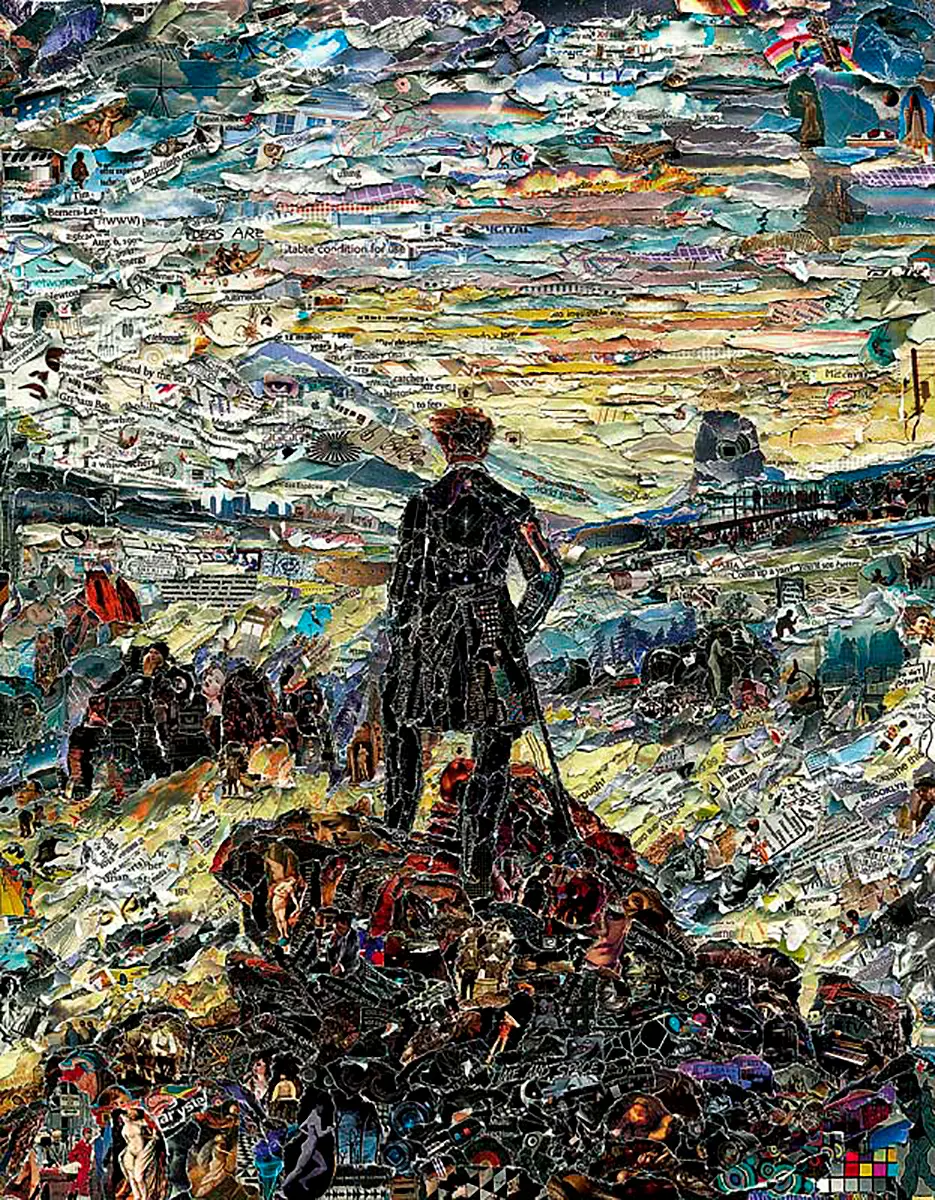
Muniz updates traditional photomontage in many ways. To begin with, these are all digital C-prints. One can easily see the dot-matrix effect that these large prints reveal. At the same time, they retain the visual quality of the original collage: one easily sees the torn and jagged edges and gets a real sense of texture and overlap. The handmade aspect of the work remains evident which provides another visual contradiction, along with the fact that these colleges have been reconstructed to resemble paintings.
Adding to the visual complexity is the scale of the works. These are much larger than traditional photomontages or even many photographs, and in many cases, they are even larger than the original paintings themselves. If one stands too close the actual painting is not legible; instead one sees an impossibly overwhelming number of words, phrases, and images that come from sources ranging from advertising to fine art reproductions. For example, The Crucifixion After Thomas Eakins, one of the largest works in the exhibition, offers a somber and compelling veristic version of the original. Up close however one sees many enigmatic phrases and multiple images of faces from sources that range from medieval manuscripts to paintings by Georges de la Tour. Wanderer Above the Sea of Media After Casper David Friedrich offers a convincing simulacrum of work by the German artist, albeit dramatically overscaled. From a distance, the glossy “paper” of the collage acts visually like Friedrich’s oil glazes until one gets closer and sees the torn and overlaid strips containing phrases that seem to refer to art and vision.
Like with many photomontages and collages one can debate the relative importance of the parts vis-à-vis the whole. Is each individual image meant to be isolated and identified? Do all the random phrases add up to some meta-text? These questions cannot be dismissed with an easy answer, although in the larger body of Muniz’s art no choice or detail ever seems to be inconsequential. The “readings” of these pictures based upon their constituent elements adds another layer of complexity to a series of works that already cross the line between painting, photography, and collage; abstraction and representation; and the uncanny quality of viewing pictures that are at once familiar and strikingly new. With this series, Muniz demonstrates that there are few artists working today who are conceptually rigorous and visually rewarding.
JOHN ANGELINE