
Initially, the work of Artur Lescher hides in its own evidence, projecting itself from its place in the museographic space as an organic impertinence in the same way in which the plants in a garden manifest themselves, as an uncomfortable because it is so that emerges as an over-meaning and imposes itself in the discovery of its there, cultivated from the standpoint of form to surprise us with its incidence. The way his installations handle volume can equally derive from the consistency of matter that can be considered ungraspable (light reflected on a metallic surface, or its bell-like tolling).
Lescher is always invasive, his work not arranged in the gallery space following the guidelines suggested by the common sense of a museographer: it is not merely the there, but the impact, the influence, the shift implied on the exhibition site by his own bodies and lines. It is not a mise-en-scène; it is a scene originated—like cobwebs or mildew originate—as a substance that at once dirties and embellishes its surroundings: he dominates the space from the margins, reducing and subjecting it to his own needs. He makes it inhabitable.
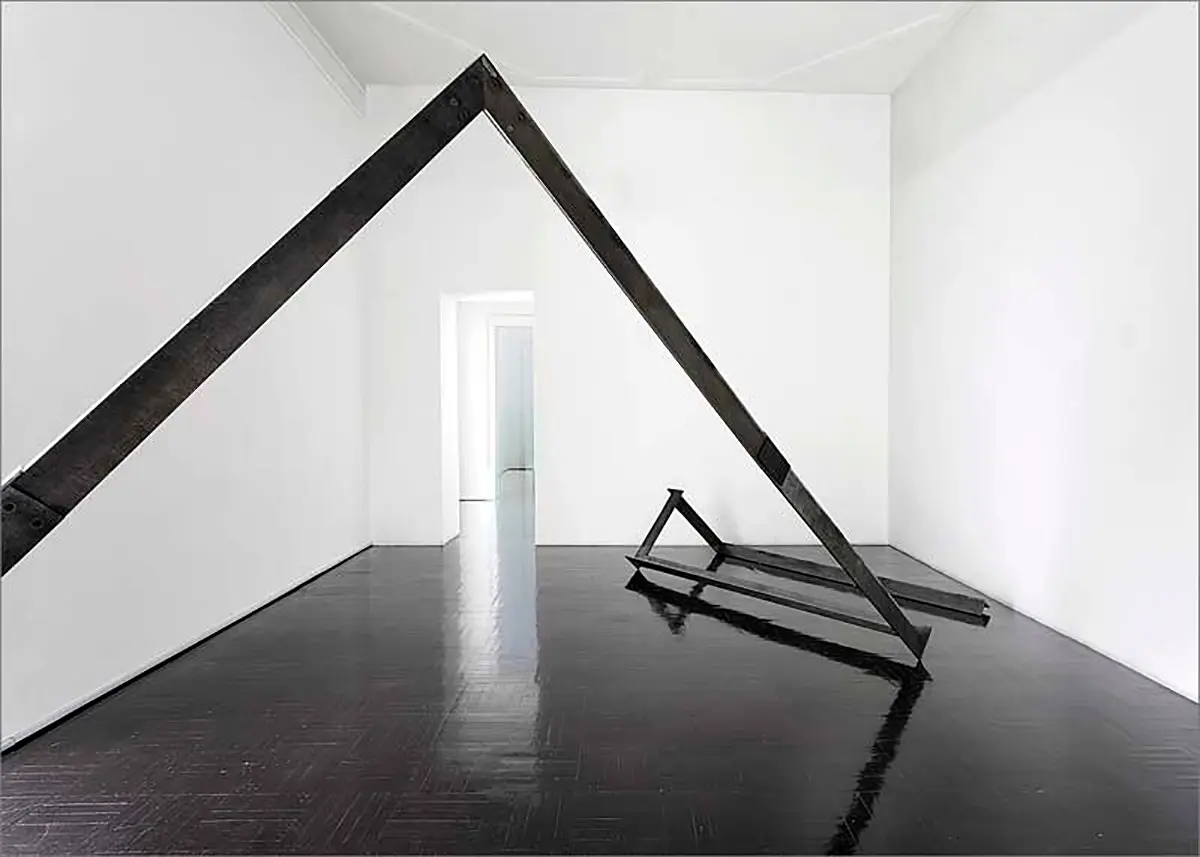
Thus, in the tension achieved on the basis of several lines (we can even ascribe them a vectorial quality) materialized as narrow and oblong pieces of wood set against the wall, something like a body is being said, bent on its folds (or hinges), but also something like its reflection (or, better yet in this case, its shadow), integrated into the composition as a necessary counterweight to its own evidence: a phantom that opens up (or breaks) the wall with the projection of its tracing. A water hole where a mathematical intuition is perceived. Lescher achieves a lyrical representation, in a code reserved for the skilled viewer, for those who know how to see, of negative numbers.
The works that comprise Metamétricos de Artur Lescher exhibition at OMR Gallery were created on-site for this space. The title that defines or characterizes the selection can be read as 'over-measuring', or better yet, as a 'measurement above measuring'. The allusion to measuring conventions may suggest that the grids and rhythms achieved in the installations (they can almost be called sculptures) with wood and hinges appeal to a meter (the physical object used to measure fabric, paper, and other materials) imagined to assess that which is beyond a perceived second dimension (and at times, I’d like to believe, the third one). The Greek prefix meta signals not a transcended space of matter, but space referred to from the standpoint of the irrational.
There aren’t any mirrors here—not, at least, in any obvious way. The metallic surface of the pendulum allows for a minimal reflection of the world, transformed into a line written on the body of an ampoule or vial, a Baroque manner synthesized to its minimal expression.
That line, the synthesis of what is said around it, once again suggests—as in a magisterial exercise in tautology—the abstract content of things, their different measurements. Less apparent is the reflecting vocation of the grids and tensions Lescher achieves with the wood pieces, arranged on the walls like furniture devoid of any functionality (they are similar to clothes racks) that is not the functionality enunciated through of their arrangement in space.
Thus, based on the imprint of those lines set on the exhibition space as vectors that appropriate territory of varying dimensions through the very insinuation of surfaces and projections, Lescher builds a sculpture (a veritable physical intervention) in order to say and inhabit an entire gallery, through of the use of metal beams (which indicates a material paradox in his works.) The quality of the material that defines his lines determines them as objects, beyond the factual uselessness sought by their design. There is a post- (or meta-) furniture irony in Lescher’s works in wood, conjured by the size, weight, and color of the line that traverses the entire gallery. His works do not just occupy space, but invade it, make it their own, redefine it in the same way that fringes redefine a dress. The work’s compositional lines (the angular tension repeated to scale, like a suggested lesson in lines of organic proportion and composition) imply a Pythagorean delight (always as an insinuation of the transcendent made on the basis of abstraction). It is a literal monster in the gallery, one that peeks through its thresholds as a presence that commands and dominates, despite its being just a line (pardon the redundancy) projected onto matter.
It is a true delight to leaf through Lescher’s notebooks; the original contamination of which those bodies projected onto space seem to be devoid, survives there.
RICARDO POHLENZ