
The gaze of those arriving in the gallery is captured by a screen that floats in the middle of a dimly lit room. Darkness overcomes the space, interrupted solely by the light of the two-faceted video and by five small candle holders placed on top of small desks arranged in a single corner. Each one of them arouses in our memories of those monastic scriptoria so often seen in religious paintings throughout history. These desks are allegorical of the religious track followed by the artist in this exhibition. On the surface, we find three wooden puzzles with scenes alluding to the topic and title: Dios Pobre: los Modernos Sermones de Lamento Comunal. Carlos Motta is the author of this video installation in two channels, where light and sound establish the central discourse while photography and wood contribute stage-setting elements of action and intention. The seemingly simple exhibition is in actuality rather complex in its structure of pairs and historical and social references.
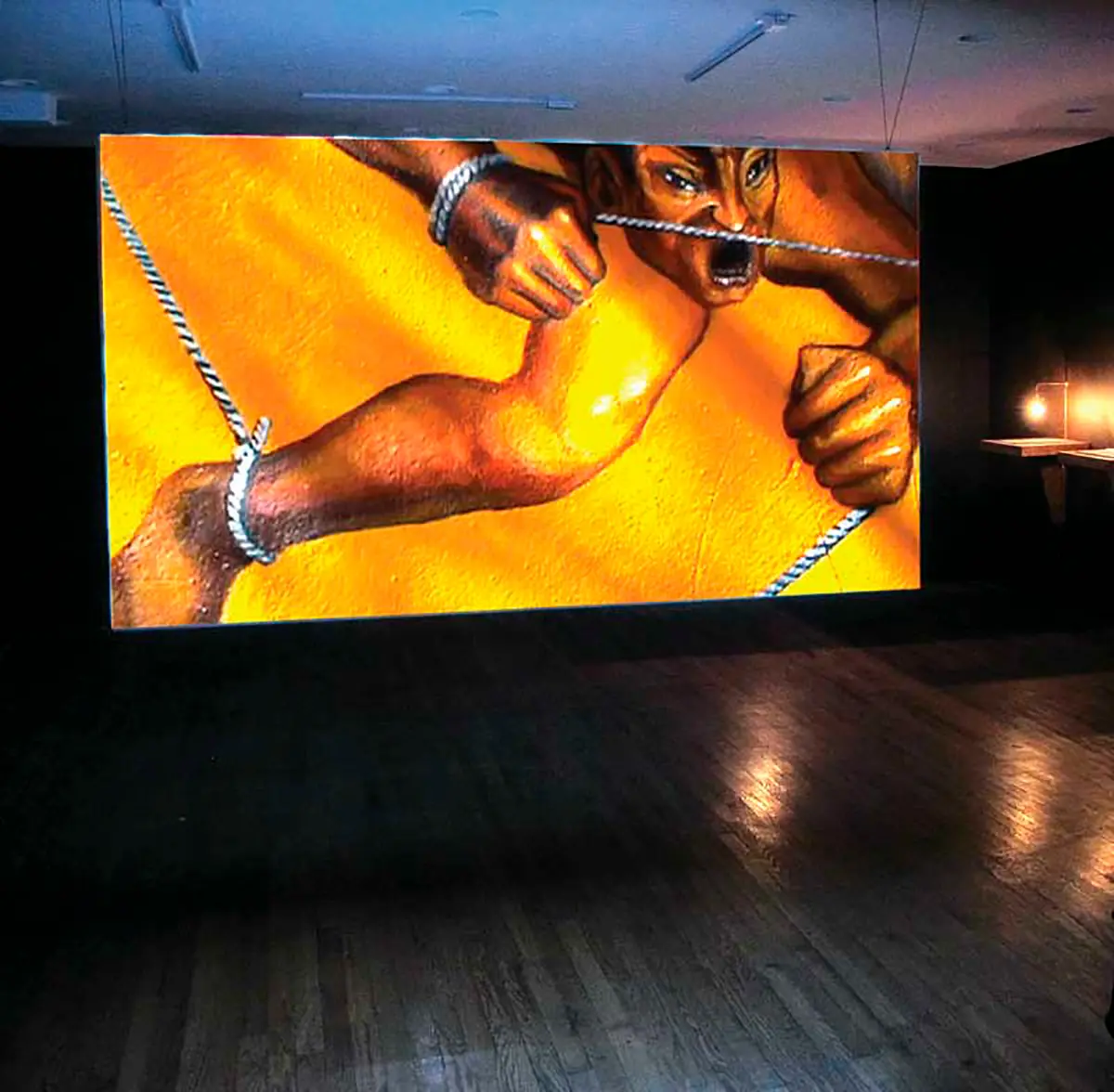
Carlos Motta (Bogotá, 1978) lives and works in New York City. He is a multidisciplinary artist who seeks to establish parameters of historical rectification towards the oppressed of Latin America. The basic elements of his narrative concept are film, documentarianism, historical memory, political history, associations, and reading that courses through time. This video installation was commissioned and partly produced by the Museu Serralves, in commemoration of the 100th anniversary of the Portuguese Republic. Motta planned and executed the work in Portugal, filming a series of performative interventions in Catholic churches in different cities. The result is six videos organized in pairs of thematic correspondence or geographic doublings in a quest for social equity. The videos are set in Europe and Latin America. One channel presents the priests 1 in edited versions of readings made in Portugal. The second channel displays videos with images of religious scenes and archeological sites in Latin America. “For example, if the priest is reading about the oppression of indigenous peoples, the images present the ruins of Copán and the way in which archeological remains have been preserved.” While the duration and dimensions of each video in a pair are exactly matched, they differ in their sound.
“In the installation, the sound of the videos of priests is amplified and dominates the space. Only one side of the video projection has sound. This wants to suggest the way in which religious discourse dominates any other expression…” 2
The concept of two opposed video channels promotes several symbolic readings. The first unpacking refers to the two continents the Old and the New, and immediately brings to the fore the correlation of forced Christianization against respect, and the presence of theologians devoid of arrogance who understand the poverty of many of those whom they serve. Words come down like a waterfall from discourses based on Liberation Theology, with which many priests sympathized. This movement emerged in the 1970s, is crucially (but not exclusively) associated with Latin America.
The need for justice has been and is such that there have even been cases of priests who sought it by means of armed struggle. The puzzles in the show are about precisely that, instruments for struggle. They were created by hand, in wood, by Melinda Shebell. In other facets of his work Motta also credits his technical collaborators.
The priests read, in Portuguese, politico-theological sermons. Their voices are strong but their pace liturgical rather than political. One perceives the habitual monotone of ecclesiastical enunciation, which in this case symbolizes a subtle, sad lament: the repetition of injustice in Latin America. In the two-faceted screens, the side hidden from view from the entrance depicts almost static scenes of reflection and motivation, intercut with the six videos facing the door with their diversity of images and texts. Once again Carlos Motta is able to reboot the social concern of a visual artist, establishing a multi-media baroquism and using the format of the puzzle and the labyrinth to signal and induce us to reconstitute disparate aspects of history. At the same time, he awakens the viewer’s attention by presenting his videos with resources that set in motion the sense of hearing and the body of his audience.
NOTES
1. (Father Almiro Mendes reads texts by liberation theologian Gustavo Gutiérrez (1971), (January 19th, 2011, Ramalde Parish, Porto). Father Antonio Bacelar reads the work of Óscar Romero (1977-80), (January 15th, 2011, the church of San Antonio das Antas, Porto). Father João Lucas reads the writings of Father Antonio Vieira (1653-57), (November 27th, 2010, Singeverga Monastery, Roriz-Santo Tirso). Father José Martins Junior reads the Missionary of the Word, Father Antonio Vieira (November 2nd, 2010, gardens of the Museu Serralves, Porto). Father Manuel Correia Fernandes reads Fray Bartolomé de las Casas, Protector of the Indians (January 9th, 2011, Gardens of the Museu Serralves, Porto). Father José Alberto de Oliveira reads Leonardo Boff, (December 5th, 2010, Sacred Heart chapel, Porto).
2. Quoted from an electronic chat with the author, on the occasion of the exhibition.
GRACIELA KARTOFEL