
Charles Juhasz-Alvarado’s multi-media installations have entered the global arena, drawing recognition as the Puerto Rican representation in biennials from the Caribbean to São Paolo, Moscow to Singapore. Yet rather than emphasizing the universal qualities of his art, Juhasz-Alvarado embraces its puertorriqueñidad (“Puerto Rican-ness”) in all its specificity, requiring more political-cultural context on the part of the spectator, but no less reward in the decoding. Though nationalism has been seen as something of an albatross for artists in the postcolonial Caribbean, Juhasz-Alvarado has moved a few conceptual stages beyond the clichés of essentialist tropical art, proving that identity is not a theme exhausted in the 1980s, but a deep well of expression offering fresh possibilities.
Complicated Stories, Juhasz-Alvarado’s ten-year retrospective organized at Exit Art in New York City in 2008, offered a broad survey of his elaborate installations, combining sculpture, performance, narrative, and sound. The nine large-scale installations re-created from previous settings provide ample proof of this artist’s sculptural prowess, intellectual wit, historic knowledge, and particular brand of political art. Almost Joseph Beuysian in the sense of equating existence as a social being with political being, the artist explains: “Almost all art is by definition political. In one way or another making art in a way that is not for a decorative purpose is a political thing. So most of my projects are political in different ways. They are sometimes directly in relation to our image of size, of scale, internally as Puerto Ricans, or how we are viewed from the outside. Or I deal with very specific resistance situations, circumstances, symbols.”1
His professor from Yale University and mentor, the sculptor Ursula von Rydingsvard, describes Juhasz-Alvarado’s art as political in the best sense of the word, “political, but not preachy, more of a poetic plea.”2Never prescriptive or simplistic in his messages, he invents metaphors involving termites, vehicles, and games to reflect on the Puerto Rican situation. In a nutshell, Puerto Rico passed from Spanish to U.S. sovereignty in 1898; Puerto Ricans became U.S. citizens in 1917. Though self-governing, they remain a Commonwealth of the U.S. (officially Estado Libre Asociado, a free associated state). Puerto Ricans can serve in the U.S. military, are part of the Federal legal system, and have a non-voting representative in Congress. The electorate is almost evenly split between supporters of the status quo and those who favor becoming the fifty-first state. A small percentage, which includes most artists and writers, vote in favor of independence.
The termite serves as both a personal and national symbol. On the one hand, a threat to an artist who works primarily in wood; on the other hand, the termite is the builder and sculptor of the insect world. Juhasz-Alvarado admires its contribution to the ecosystem and tenacious, outsized power. He explains, “through time I have been studying the insect and its behavior trying to think through it in as many terms/angles as possible. I have found many ways to draw parallels with our specific colonial circumstance…[that] had to do more with my awareness of vulnerability. I observed that they were serious competition not only for their use of wood but in their determination and efficiency in spite of all the enemies they have. Through observing them, I feel I have been able to engage in the critical process of understanding life (the will/love/respect for surviving.)3
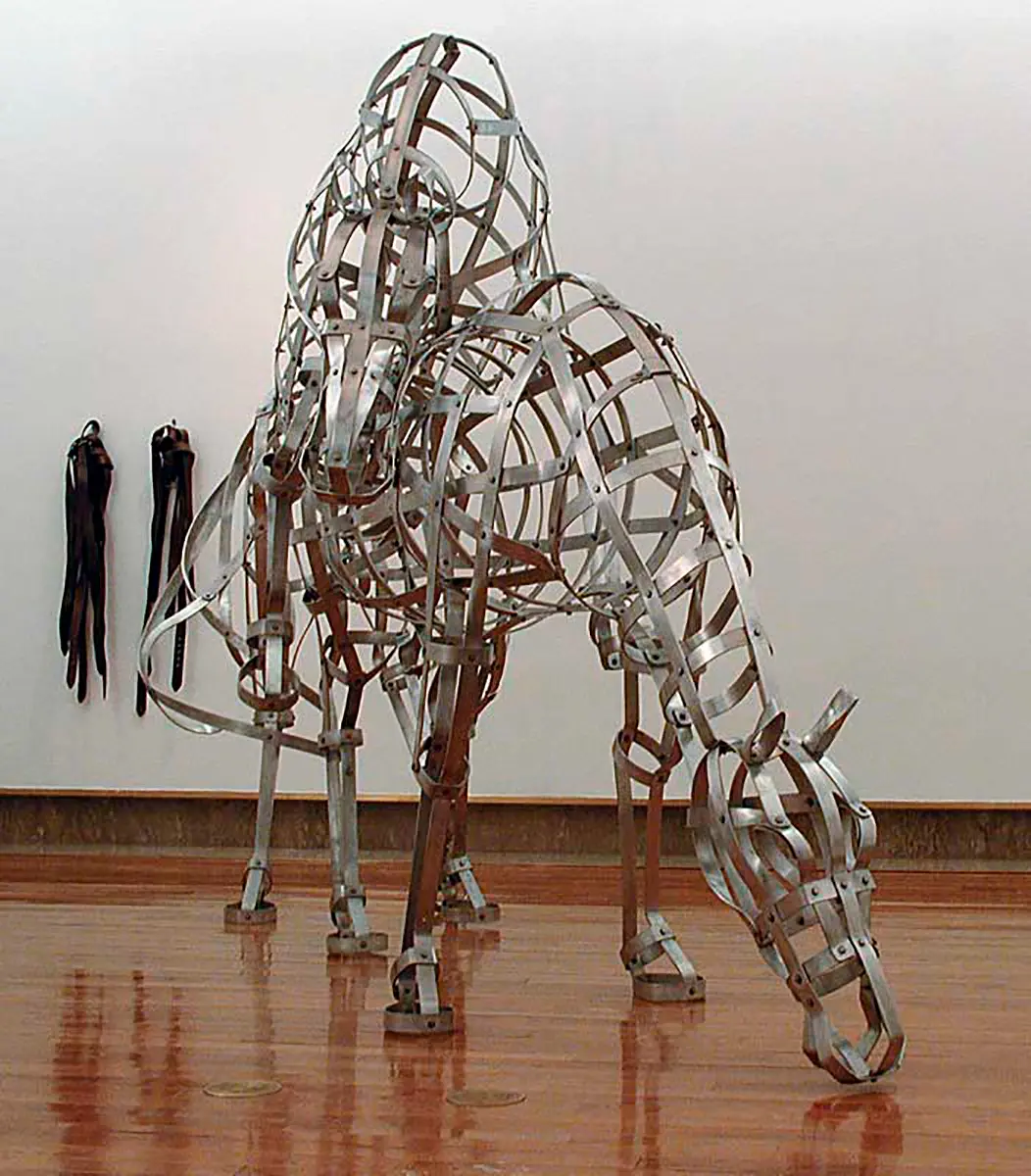
Installations as early as Punto de fuga (Vanishing Point) in 1998 have included tributes in the form of photographs, manufactured mounds, and sculpted termites in multiple incarnations. Punto de fuga, a three-part installation, spread between the Museo de Arte de Ponce and Luigi Marrozzini Gallery in San Juan combines the imagery of three eras of exploration and conquest in the forms of horses, aircraft, and termites. Referencing the first era are two copulating, life-size horses, a means of transportation and domination brought to the new world by the Spaniards. The second two eras juxtapose Northern technology with tropical nature. A life-size propeller plane, with congas for engines, is suspended upside down in the museum, its nose cone subsumed with a termite nest. Nearby stands an Apollo-line space capsule, the Flaming Gaia, also showing evidence of termite infestation. The cavity holds a green velvet-lined love nest that can be entered and occupied by two or more people. This installation is an early example of the artist’s practice of creating a place of experience, which may contain room for contemplation or a multi-sensory experience involving sound or taste; all in the interest of sparking the spectator’s imagination.
The catalog essays by Mayra Santos and Marimar Benítez give a radical interpretation to the termite imagery: it is “a symbol of our silent collective power to reduce to ruins the empire’s technology,” and “these sculptures pose the silent and subversive work of our termite culture in the entrails of empire as a means of retaliation.”4 The artist himself poses a more benign “happy symbiosis” between the two, emphasizing openness to multiple interpretations of a playful work, which has its erotic and historic as well as political sides.5
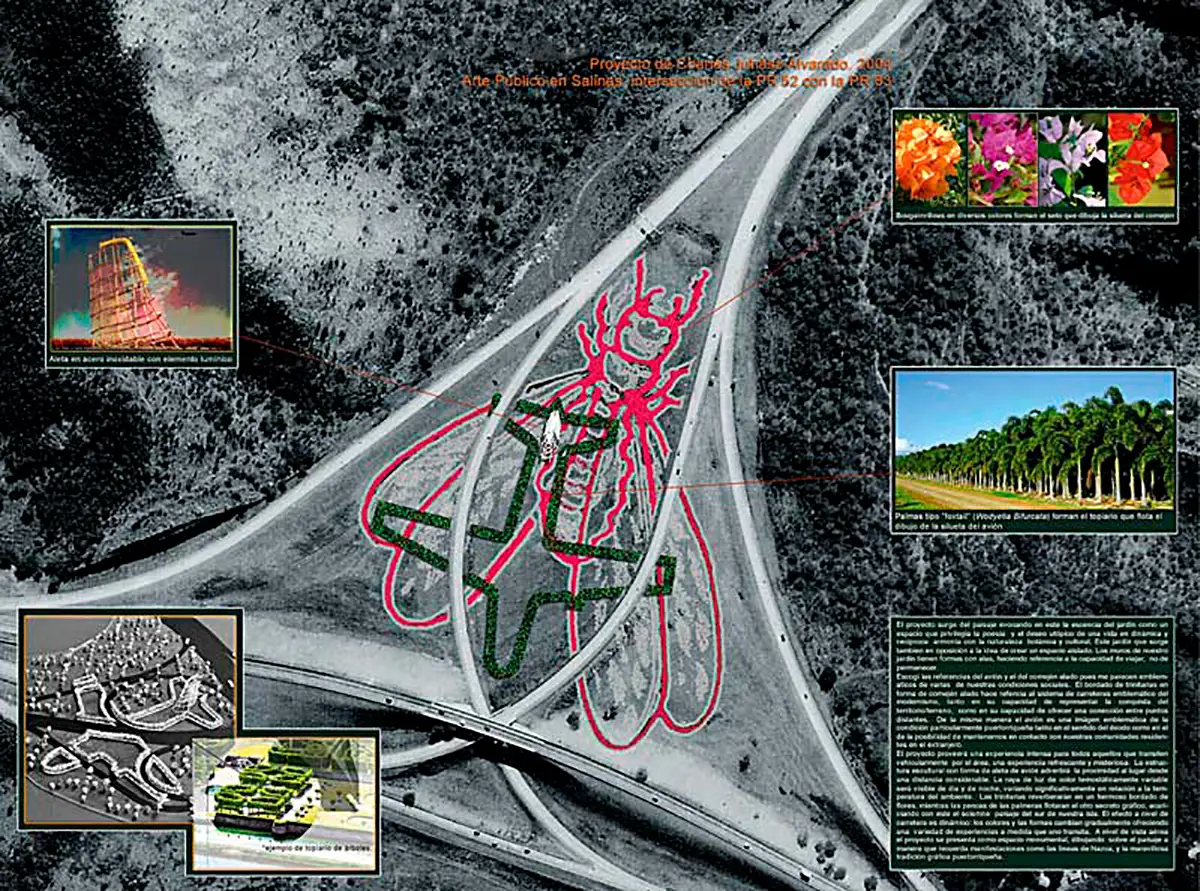
The symbiosis is apparent in the artist’s most colossal use of the imagery in Jardin alado; Jardin en tránsito (Flying Garden; Commuting Garden, 2004-06) a public art project located near Salinas, Puerto Rico. An elegant linear design of palm trees and bougainvilleas juxtaposes one square kilometer-wide termite and airplane. Like Nazca lines, the design is best comprehended by air, but also provides a garden vista for the cars zooming by on the highway interchange surrounding the work. Responding to the history of the site as a former location for sugar plantations, later industrialized in the 20th century, the garden reclaims a desolate highway stretch, transforming it into a place laden with lush growth and symbolic import.
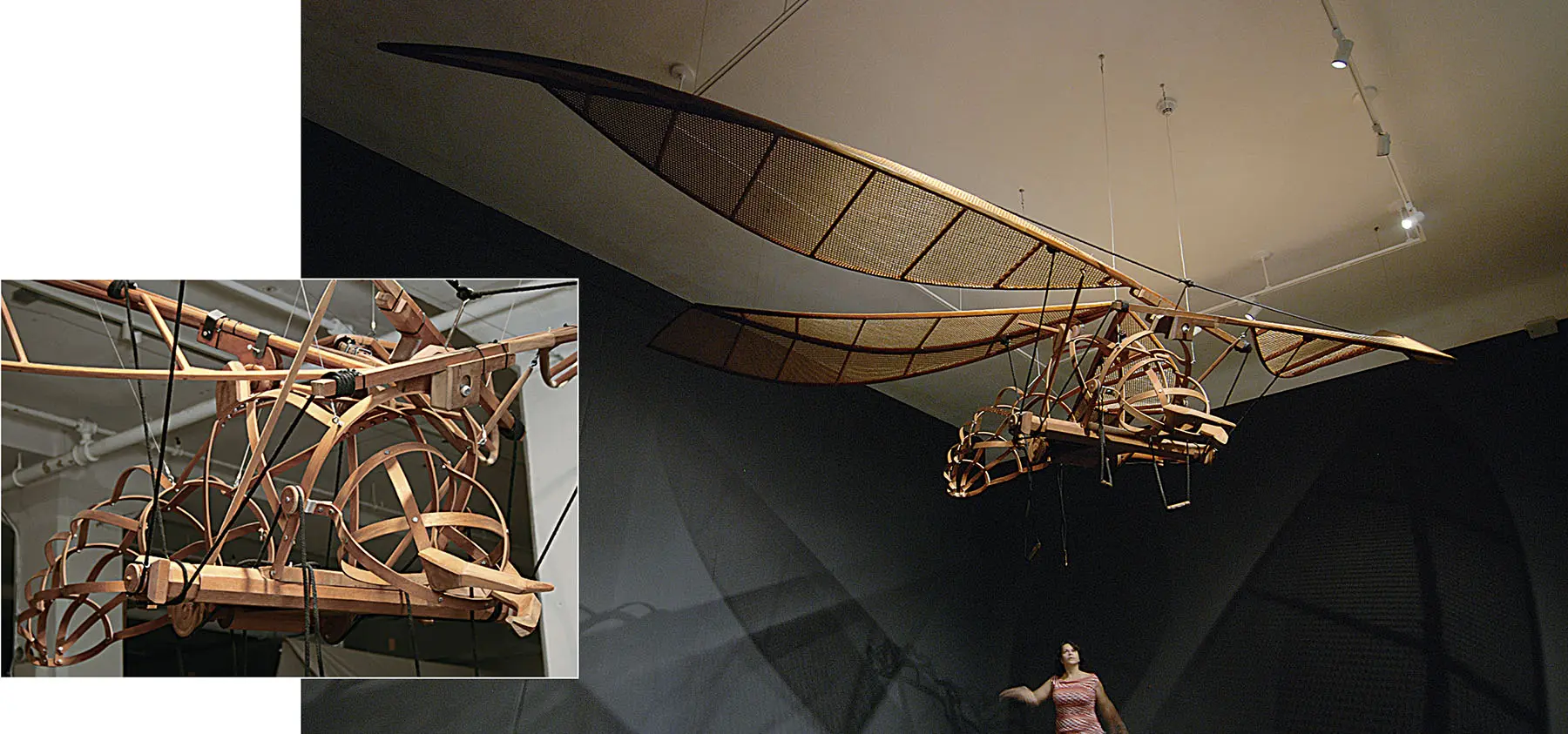
In what has become his still-evolving artistic signature, the latest iteration of the termite is the Polilla renacentista (Renaissance Termite, 2008). Inspired by Leonardo da Vinci’s drawings of flying machines, this linear, beautifully articulated flying insect, carved in mahogany and cedar, is the size of a small glider. The movement of its wings activates a music box contained within the abdomen releasing an audio soundtrack of humming insect songs. Fabian Vélez has collaborated with Juhasz-Alvarado on the audio component of several installations, contributing to the multi-sensory experience. With training in architecture as well as sculpture, Juhasz-Alvarado identifies with the Renaissance master builder-inventor-artist. Polilla renacentista combines the termite and airplane motifs in a finely crafted metaphor for flight of the artistic imagination.
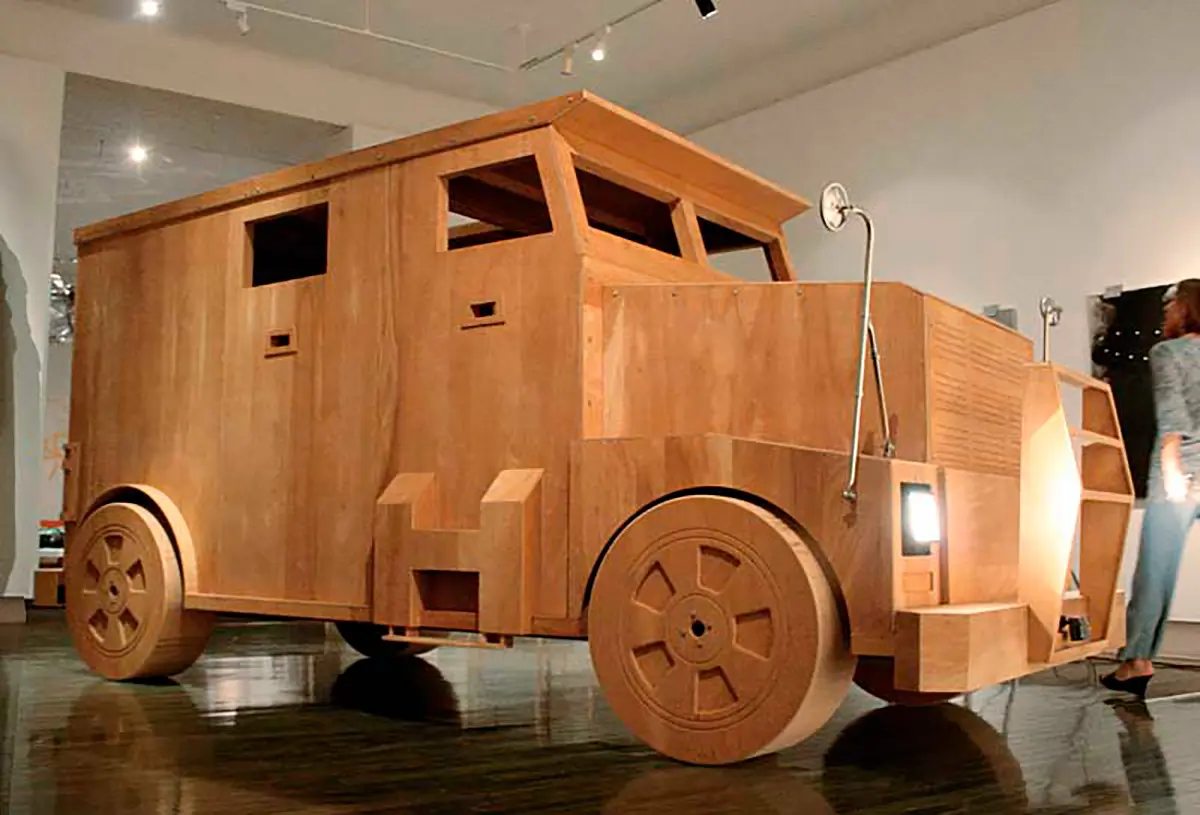
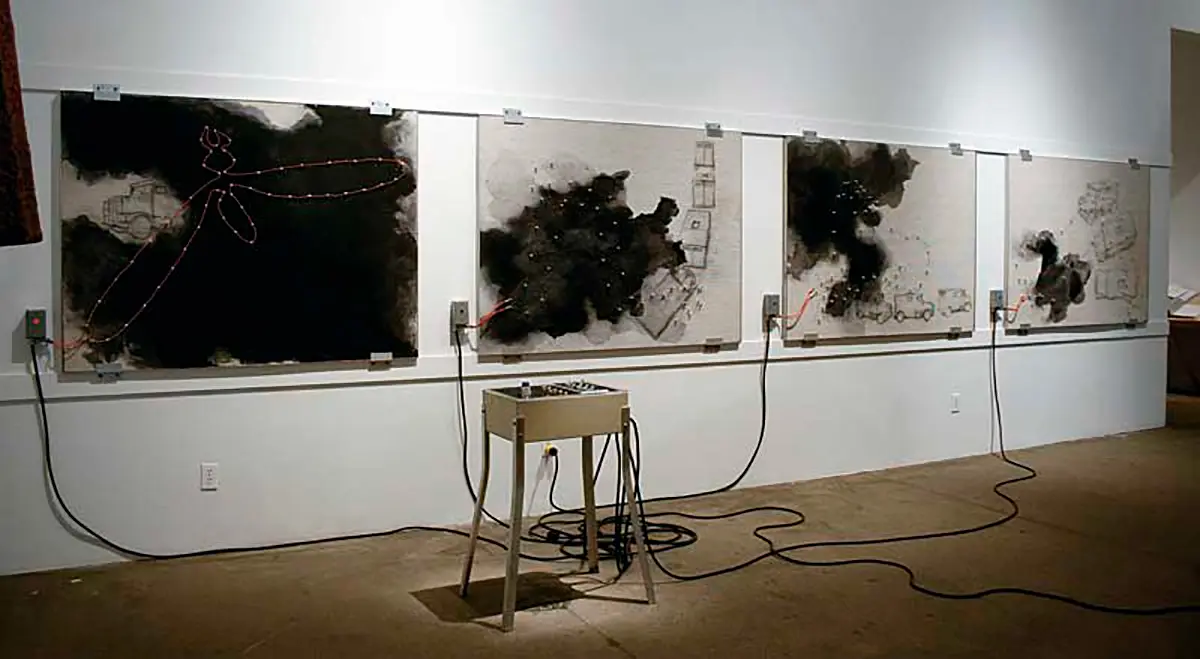
Beginning conceptually, each installation expands within the environment, and the timeframe allowed for building, responding to the particular site and process of creation. I-Scream (Resist) created for the None of the Above exhibits at Real Art Ways in 2004 is a prime example of work that responds to its setting (of Hartford, Connecticut) and elucidates one aspect of Puerto Rico’s relationship to the United States: the small, but determined independence movement. Somewhat to the consternation of the show’s curators, Juhasz-Alvarado chose to focus on the 1983 robbery of $7.1 million from a Wells Fargo warehouse in West Hartford by security guard Victor Gerena. This historic heist was followed several months later by a large toy giveaway in Hartford and San Juan by the pro-independence group Los Macheteros, who was prosecuted for the crime after a lengthy investigation. Several members went into hiding, and four were eventually convicted of robbery. In recognition of this episode, Juhasz-Alvarado built a full-size armored truck, which served as a dispensary for ice cream treats along with spoons stamped with dates and events from the Puerto Rican independence movement. The truck with working headlights is in keeping with the astounding series of vehicles constructed by the artist. In a characteristic play with scale, a gigantic popsicle accompanies the truck, with a miniature-scale model of Mount Rushmore, the monument of U.S. Presidents, at the top, as if revealed by a giant’s bite. The busts are covered in sickly green dollar bills in a parody of a public monumental sculpture. Another component of the installation is a series of cement panels imbedded with “resistance” wire, tracing the path of the Macheteros’ escape routes. The wire can be heated to become glowing red with switches controlled by the viewer. Never a one-note artist, Juhasz-Alvarado mixes participation, puns, and well-crafted artistry to tell a complicated story.
The Singapore Biennale (2006) offered an opportunity to examine Puerto Rico’s place within a global context. Juhasz-Alvarado chose to focus on the island’s indigenous roots, the native Taíno people, who were almost completely obliterated within a generation of the Spanish conquest. Juhasz-Alvarado based his installation, a gallery-size foosball game manned by Taíno ballplayers, on the pre-Columbian ceremonial ball-court, called the batey in Puerto Rico. Incorporating a sense of chance and association, the artist explains that after building a scale model of the building assigned, situated within a former military camp, “the image of the foosball table ‘accidentally’ came up … but as usual, I didn’t look away from it.”6Again process serves as a motive. When presented with a barracks-like rectangular space, he introduces some elasticity, re-imagining how to configure the project. The installation, titled Escala (Stopover) takes on almost a matryoshka, Russian nesting doll, configuration of sculpture within a sculpture, a game within a game. Using the dimensions of the gallery as the meta playing field, Juhasz-Alvarado invited other Puerto Rican artists to design five actual size foosball tables within. In a sort of Trojan Horse strategy, Juhasz-Alvarado frequently includes other Puerto Rican artists within his own works, adding their voices and additional dimensions to the piece. In this case, the other artists, Elizam Escobar, Carlos Fajardo, Teo Freytes, Carol Cordero with Juana Gallo, and Ana Rosa Rivera, designed tables expressing their strong political stances on issues ranging from AIDS research to one artist’s years as a political prisoner. Their tables brought more strident messages into the piece than Juhasz-Alvarado might have conveyed on his own. Aside from the extraordinary act of generosity to include other artists in his commissioned works, the artist’s willingness to cede control over the outcome of the piece is also unusual. He includes artists he trusts, whom he feels should receive more opportunity and recognition and allows freedom for their independent contributions.
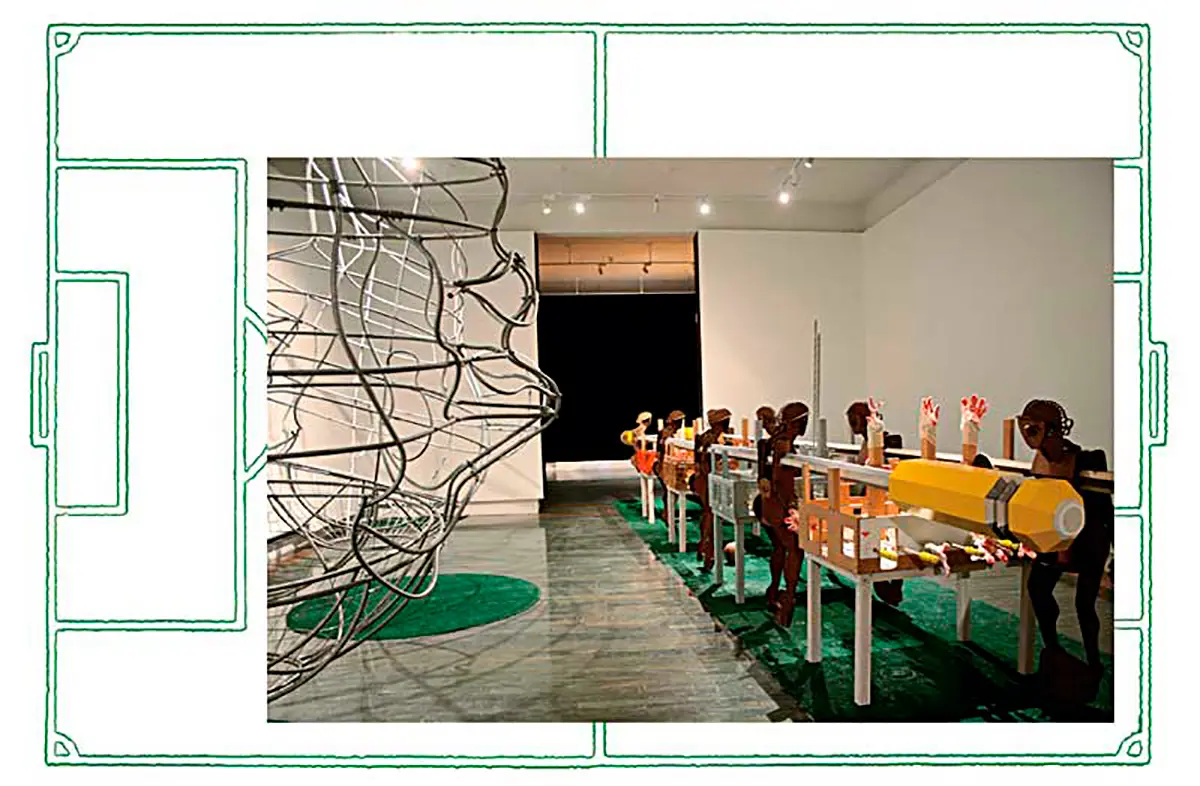
The overall theme of the biennial was faith, which inspired another point of departure. The syncretic belief system of Puerto Rico (and much of the Caribbean) is represented by placing carved wooden African orisha or Catholic saints within the bellies of the Taíno ballplayers. Again referencing the termite, which digests wood by virtue of an enzyme that lives within its gut, these figures are also an ironic commentary on the official, institutional formulation of Puerto Rican cultural identity: a triad of indigenous Taíno, African slave, and a Spanish conquistador. After over a hundred years of association, North American influence remains unacknowledged and invisible. Perhaps wondering if this obsolete image is still the one seen by the rest of the world or what relevance it holds for Puerto Ricans today, Juhasz-Alvarado also creates a space for contemplation of cultural myth-making within the gallery. The game tables are flanked by enormous steel armatures in the shape of upside-down heads, forming swings that spectators could enter. Proportionately, the heads have the same relationship to the entire gallery as the small tables have to the large game table. Like the space capsule in Punto de fuga, the artist seeks to create ways to engage playfully with his work, lightening his message and encouraging a sense of participation.
Articulating a political status fraught with contradiction, Juhasz-Alvarado engages the viewer with intelligence, wit, and play. He elaborates on the complicated stories of Puerto Rico’s history with finely planned detail, never allowing his craft to fall by the wayside in his pursuit of a conceptual message. While his work abroad has helped to throw the slippery Puerto Rican identity into contrast, he remains rooted on the island, content to draw inspiration from the insects’ hum.
NOTES
1. Charles Juhasz-Alvarado, Complicated Stories, excerpted from an interview in a documentary filmed by Exit Art, New York 2008.
2. Ursula von Rydingsvard telephone interview with the author, August 11, 2010.
3. Artist e-mail correspondence with the author, January 7, 2011.
4. Essays by Mayra Santos and Marimar Benítez, Punto de fuga, Charles Juhasz-Alvarado (San Juan: Luigi Marrozzini Gallery and Museo de Arte de Ponce 1998). Unpaginated.
5. See quotes and discussion in Laura Roulet, Contemporary Puerto Rican Installation Art: the Guagua Aérea, the Trojan Horse and the Termite (San Juan: Editorial de la Universidad de Puerto Rico 2000). p. 74-75.
6. Artist e-mail correspondence with the author, January 7, 2011.
LAURA ROULET
Independent curator and writer, based in Bethesda, Maryland.