
Towards the end of 1991, the exhibition The Bride of the Sun was being installed in the Royal Museum of Art of Antwerp.1 It was a mega show about Latin American art spanning five hundred years from colonial times to the present time. The curator was aware that there was a work by Argentine artist Lucio Fontana in the collection, wanted to include it in the exhibition, and asked to have it retrieved from the storage rooms. With the registrar unavailable, the museum workers were at a loss. They didn’t know the painter and couldn’t place the piece. After lengthy discussions and a description of his mode of working by making slashes into the canvas, one of them remembered. Excitedly he informed his colleagues: “She means the Zorro piece”, and they went to retrieve it from the basement. Two years later, in 1993, Maurizio Cattelan started a series of works slashing the letter Z into canvas, thereby mixing references both to Fontana and to Zorro. The piece is emblematic of his populist approach to art (he almost certainly was unaware of the Antwerp story when he did his Z series, nor did he need it to make his point). And the resonant contrast with Fontana is clearly important to him given the many versions in different colors that he’s included in the Guggenheim show.2
Cattelan is often perceived as a prankster, even as a clown of the arts. While occasionally this may be true, he can also be seen as a translator. Much of art can be defined as some form of translation, but it usually turns out to be a top-down translation. The artist finds, or has, some complex insight and then puts it into a formal package that makes it understandable to people who have a lesser degree of sophistication.
Cattelan deviates from this tradition in as much as in most of his work he translates from the bottom up. He starts with popular insights, wishes, and fantasies, and then brings them into the realm of artistic sophistication. Thus, his reinterpretation of Fontana’s work is not anymore about the exploration of the dimensions of space or about blurring the sculpture/painting divide that originally interested Fontana. A recent Sotheby catalog described one of Fontana’s slash paintings being put on the block (it was sold for roughly a million and a half dollars): “[T]he slashes beguile with lasting questions about the relationship between the surface and the void, about the hidden properties of the material, in the world around. Richly suggestive, we are left with a multitude of sensual hints – at slits between theatre curtains, glimmers between lips, surgical incisions and sexual openings – […]”3 Against this background, it’s possible to see that Cattelan’s Zorro title as a way of slashing back at Fontana, at Sotheby’s, at the whole of the art establishment. With his pieces, Cattelan gives popular common sense the opportunity to dress in upper-class garments.
It is probably not a coincidence that a big deal is made of Cattelan being the child of a truck driver and a cleaning woman (mentioned both in the catalog and the review in The New York Times). On the one hand, it is an unneeded classist piece of information, probably inspired by the wish to cement the optimistic myth of triumph present in “rag to riches” biographies. On the other hand, and more importantly, it also points out the consciousness and use of this perception from the bottom. During the late 1950s, Piero Manzoni carefully solidified fabric creases in his Achromes. They faithfully reappear in Cattelan (2004) as a piece of white fabric with its creases formed, but now held up by a broomstick. Nancy Spector, the curator of the exhibition and author of the lengthy and excellent catalog text, points out: “In one stroke, Cattelan demoted Manzoni from artist-seer to simple laborer […]”4
Cattelan is a progressive citizen who attacks stereotyping, racism, idolatry, and any submission to power. In a conversation with Michel Robecchi published in Interview in 2008, he describes his position during the 1980s: “What I realized at the time was that there are three different kinds of revolutionaries: those who want to change things; those who are into the fight but couldn’t care less if things change or not; and those who work following their instinct, responding to a situation in a personal way that can end up having collective results—and that can affect the world a lot more.” Cattelan classes himself with the latter one.
Because he deliberately chooses to work in a nearly instinctual manner, there is no unifying ideological framework to Cattelan’s production. There’s no overarching program, and he doesn’t sermonize. In his work, indictments are nearly always packaged in ridicule. And once the humor is bridged and the accusations are reached, often one can’t be sure where they came from. Sometimes the viewer senses the possibility that the accusations are his, and that’s when the work is most effective. This is more likely to happen when Cattelan’s pieces are seen individually.
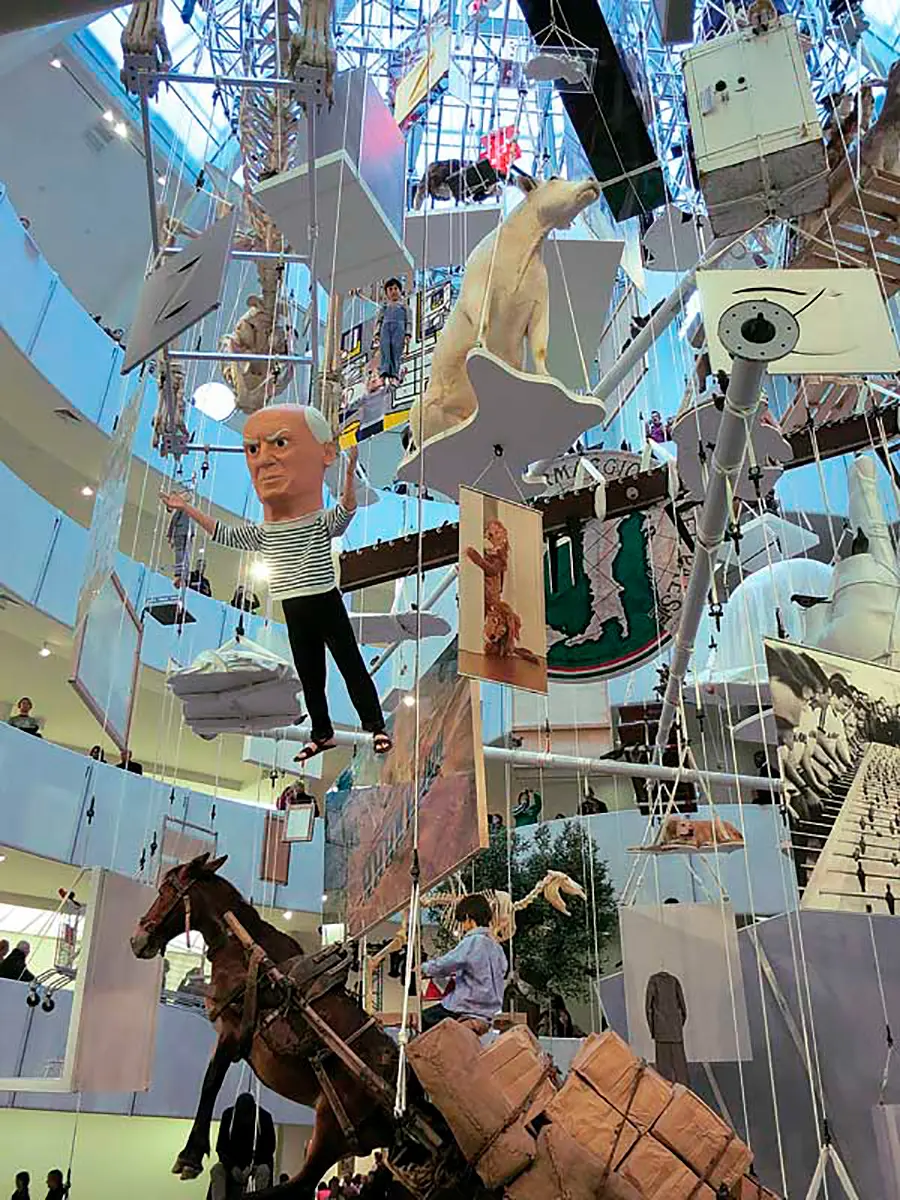
The Guggenheim exhibition does not allow for this kind of dialogue. Cattelan’s retrospective, titled All, is more or less an assembly of his oeuvre displayed as an enormous pile of objects hanging from the ceiling and filling the entire atrium. The walls of the spirals are left empty, and the crowds of visitors walk up and down the ramp gawking into the atrium and photographing.
The Guggenheim Museum in New York is a preeminent symbol of architectural design that serves as an homage to the architect rather than as housing for a specific function. Over the years, two views of the museum’s building have acquired postcard status. One is the inverted-cake image of the facade. The other is the enormous rotunda formed by the void left within the seven floors of the spiral ramp.
Admittedly, the inside space of the Guggenheim is difficult to use. Two examples of the last half a century stay in memory. One was the Alexander Calder retrospective of 1964, in which the atrium space served to display one of his mobiles. It hung in such a way that the whole building started to sing and seemed to have been designed exclusively for this particular exhibit. The second was during the first day of the Sixth Guggenheim International Exhibition in 1971. Daniel Buren’s Peinture-Sculpture, one of his typically striped canvases of 20 x 10 meters, was initially installed vertically in the center. The intention was to resonate with an equal piece suspended horizontally on the street across from the museum. Michael Heizer, Dan Flavin, and Donald Judd, who were also in the show, objected that this placement of Buren’s canvas obstructed the view of their pieces from different points across the atrium. As a consequence, Buren’s canvas was taken down within a few hours of its installation and in fact, never made it back into the show.
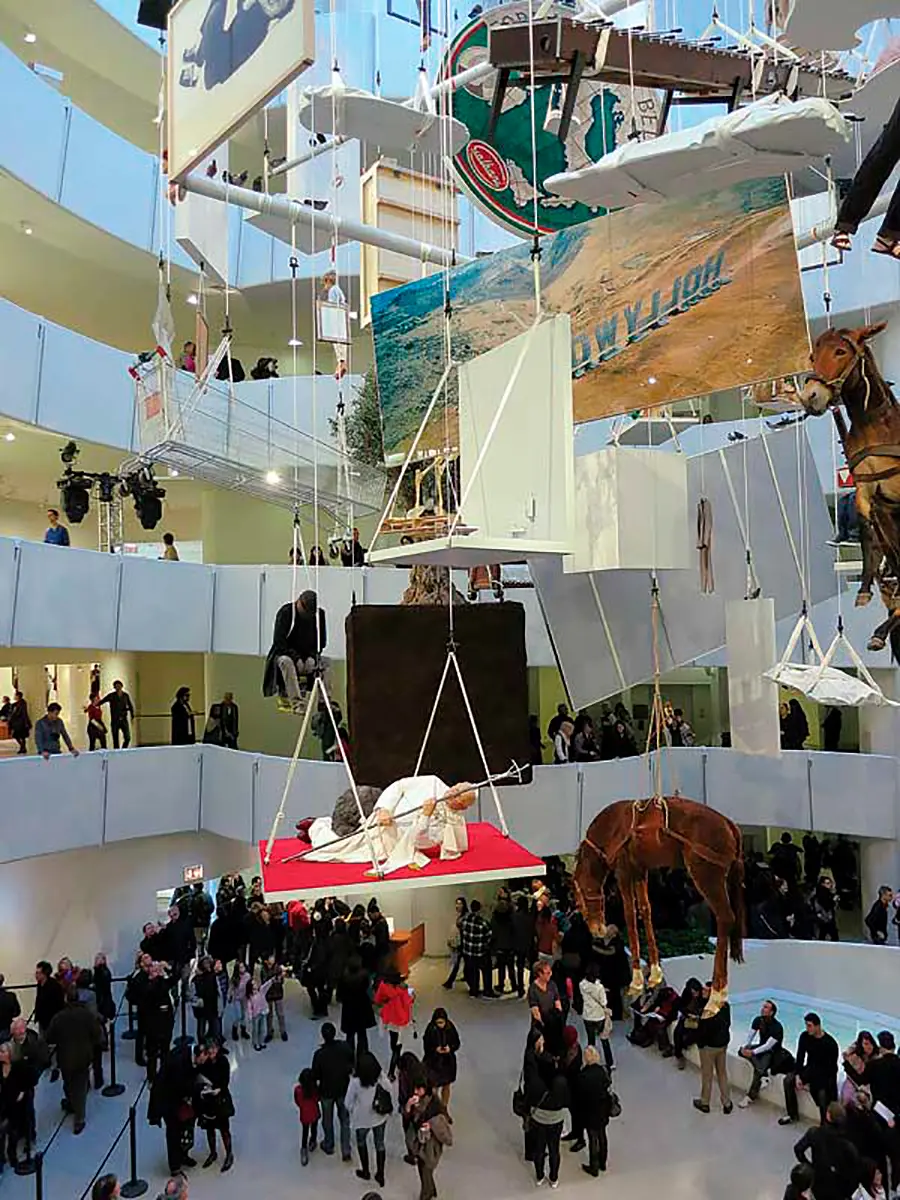
Given the spectacle it presents, Cattelan’s All installation is likely to join these others as in the category of “most memorable.” A detailed map available to the public at no cost helps orient viewers to individual pieces within what otherwise appears to be a chaotic cascade of objects. For those who know of particular pieces and want to spot them, the event becomes a treasure hunt. The crowds searching the display for individual sightings, added to the chaotic assemblage of the objects themselves, give the experience the feel of an amusement park. In one sense this completes the spectacle. And yet the set-up may not be helpful for a real appreciation of the work.
Both the effectiveness and the popularity of Cattelan’s works depend to a great extent on being accessible one-liners, resonant within a particular context. The Guggenheim installation seems to be one more one-liner, maybe his last one.
All, as a title, is a loaded statement, for it seems to refer not only to all there is but also to all there will ever be. Until now Cattelan had always refused retrospectives, and in agreeing to do this one, he used the occasion to announce his departure from art. From this point of view, the form the installation took may be read in two different ways: as the artist making a statement about his work to the museum: “Here, you can have it! I’m done with it and don’t care anymore,” and also as a statement by the Museum: “Look how very daring we are, we took our space and turned it inside out” (or outside in, whatever). In a more recent interview with Michel Robecchi, Cattelan suggests yet another interpretation of the show when he comments: “Given the impossibility of re-creating the original context in which the work was made, I rather take the concept head-on and push it to the limit.”5
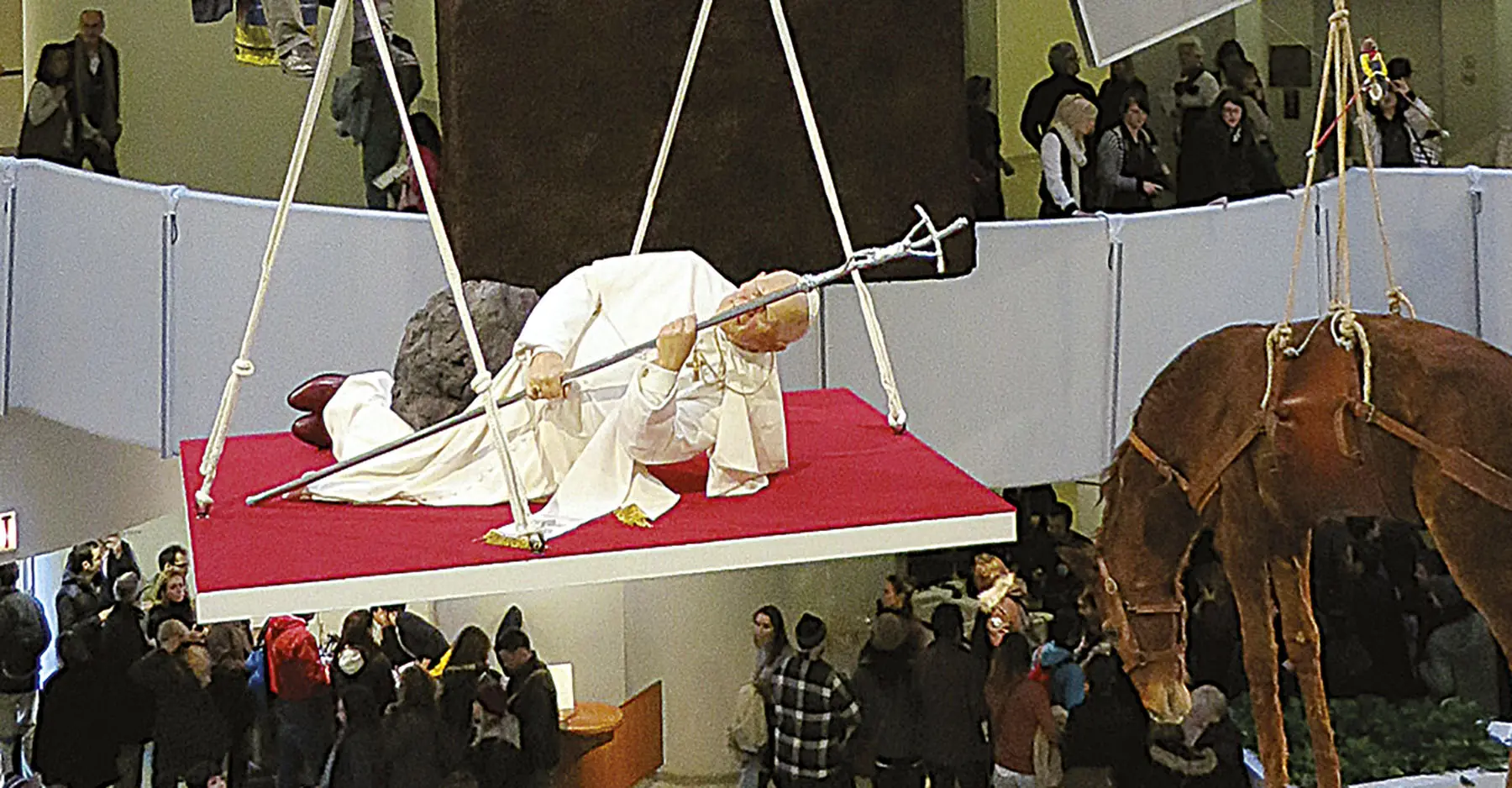
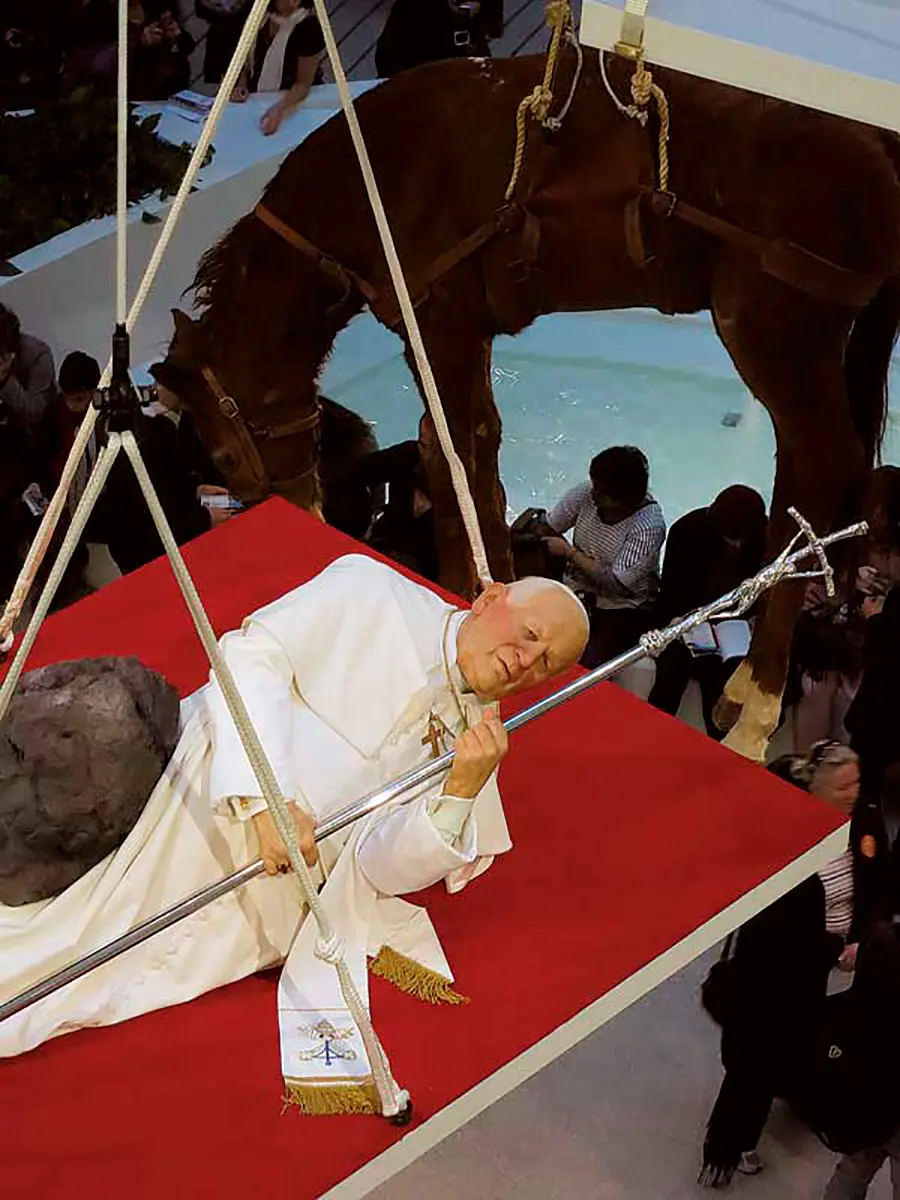
What connects all these possible interpretations is the assumption that there must be a heretical intent at work in this show, consistent with the heretical voice associated with Cattelan. Finding the heresy in this show is difficult, if not impossible. There are of course individual pieces that carry with them a story of scandal, most recognizably La nona hora (The Ninth Hour) (1999), in which Pope Wojtyla is shown lying on a red rug, having been struck down by a meteor (or with a meteor, in case it was God who did it). 6 When this piece was exhibited in the National Gallery in Warsaw in 2000, it caused a scandal. Protests that it was anti-Catholic and anti-religious escalated in the Polish parliament to the point where a rightwing deputy ended up going to the exhibition and vandalizing the piece. He defended his attack on the grounds that “this is what my voters expected me to do.”7 Cattelan’s intention had been to make a simple statement about power, that “it has an expiration date, just like milk.”8 The sculpture of the pope is unobjectionable, even elegant. It is not heretical in its formal properties, it doesn’t really contravene any art convention. And as far as the narrative is concerned, the piece itself is a single layer story with no sub-text, a straight example of one of Cattelan’s favorite strategies: the “what if” speculation. The piece in actuality is not a particularly interesting work of art—a hyper-realist sculpture lying on a red rug—and certainly not one of Cattelan’s best. It’s heretical only in the narrative of the public response. It generated a scandal, though a rather flat one.
The form of the installation in the Guggenheim breaks with exhibition convention and in that sense might be considered heretical. But whereas a meteor striking the Pope could be expected to hit a nerve with a non-artistic audience, contravening museum ritual and installation protocols aren’t really scandalizing, not even for regular museum visitors. This form of presentation doesn’t come across as either a radical reformulation or a scandal, but just as an oddity.
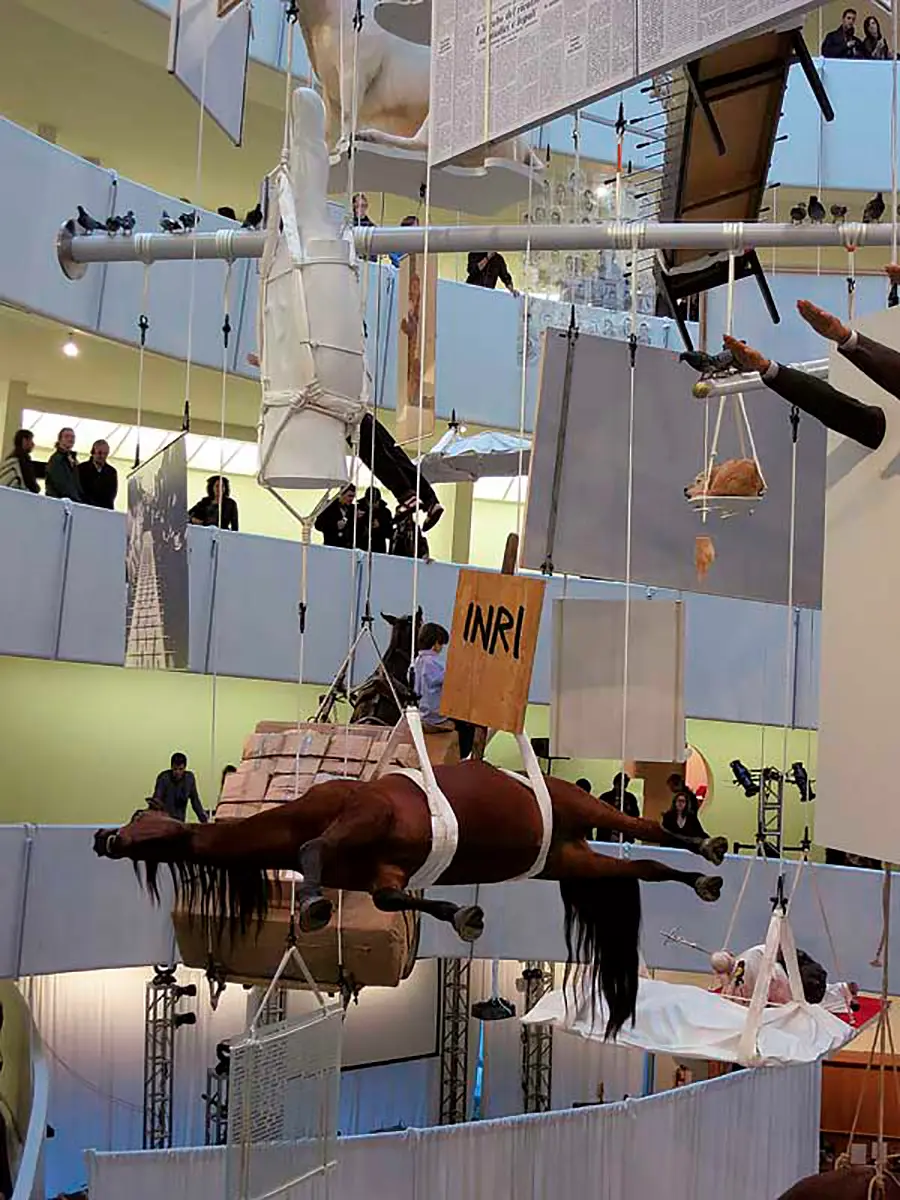
The installation reveals a general fuzziness in Cattelan’s work in terms of strategy. Cattelan suggests he’s pushing his method to a radical extreme, but that doesn’t seem to be happening here, particularly when compared to his works. Up to now, his punctual and sporadic operations have given him a somewhat mythical stature. He was one of the notorious enfants terribles of the last two decades, together with artists like Gianni Motti, Wim Delvoye, Erwin Wurm and others, though working independently. They acted as contrabandists of upheaval, smuggling their way into the establishment. As usual, the establishment remained in good health. Humor, however, became an accepted part of the aesthetic package and we have all been enriched by it.
Cattelan’s individual projects were biting and refreshing and the fact that sometimes the idea was quickly dissipated didn’t matter much. Context and resonance were crucial, and the simplest one-liner could work as leverage. The Pope piece, as it turned out, unintentionally, was ultimately about the Polish Parliament. Similarly, a thirty-foot marble hand resembling a Roman archeological artifact with all its fingers broken except the middle finger derived its power from its placement in front of the stock exchange in Milan. And a Picasso mask used by an actor to receive MoMA’s public the same as Mickey Mouse welcomes the public to Disneyworld, temporarily changed the image of the museum. A 35 feet long fussball table accommodates 11 soccer players on each side and is exhibited as an object. The catch is that one team is white and the other is black and their shirts are emblazoned with the word Rauss (“out” in German), alluding to the Nazi attempt to expel and later kill Jews. Each of these pieces was sharp and strong in context.
Once all these pieces and more are presented in a biographical heap, they become leftover props or souvenirs from another and better time. It was a very good time, a time that fills the present with nostalgia and frustration. Cattelan’s approach may have done him in here. His method is to be guided by his reaction to particular situations. In this case, he seems to have been guided by the context of a retrospective, and one in the Guggenheim with its unique atrium. For Cattelan (and possibly his patrons as well) no cost is ever spared in realizing a project, yet his pieces have never been economic show-offs, and have never come across as pompous (unless that’s been needed for the statement he’s making). What happens in this retrospective, though, is the opposite. With so many objects presented at once in the same space, there ends up being a pomposity of the whole. In reacting to “the situation,” he seems to have ended up contradicting himself.
Given the title of the show and the fact that it’s virtually complete in terms of Cattelan’s oeuvre, one can’t help thinking of the pieces that are missing. For instance, Torno subito (Back in a second) (1989), his strongest piece ever: in which the gallery where he was supposed to be showing was closed and a sign was hung on the doorknob with that text. Or the piece in which he copied the works of Carsten Höller on exhibition in the neighboring gallery and installed them in his own exhibition. Höller, coincidentally, has his own concurrent exhibition at the New Museum, but there is no leakage this time.
The catalog recognizes the problem and deals with it, allowing us to refocus. Designed by Chad Kloepfer, it is not the conventional mega coffee-table book, but a typical, old-fashioned hardcover book with the fake leather and gold imprint of faux-luxury. It is the kind of book that today is mostly found in antique shops and destined to disappear from bookstores well before bookstores disappear. Inside the publication, each piece regains its own, noiseless, space. The works are placed in the right moment of reading to illustrate the corresponding part of a clear informative text that is surprisingly short of jargon. It seems to say: “stay home and relax with a good book.” Which is not a bad message.
(Edited by Selby Hickey).
NOTES
1. The Bride of the Sun, 500 Years of Latin America and the Low Countries, Royal Museum of Fine Arts, Antwerp, January 2 – May 31, 1992.
2. Maurizio Cattelan: All, Guggenheim Museum, November 4, 2011-January 22, 2012
3. Sotheby’s catalog for the London sale, October 15, 2011, of “Concetto Spaziale, Attese,” 1968, sold for 937, 270 pounds.
4. Nancy Spector, Maurizio Cattelan: All, Guggenheim Museum Publications, NY, 2011, p.90
5. Michel Robecchi, “Maurizio Cattelan, All in One,” Art in America November 2011.
6. The title refers to Christ’s prayer about being forsaken by God during his crucifixion.
7. The right-wing deputy’s name was Witold Tomczac. http://en.wikipedia.org/wiki/Witold_Tomczak#cite_note-autogenerated1-1
8. Interview with Andrea Bellini, quoted by Nancy Spector, p. 95
LUIS CAMNITZER
Uruguayan artist. Emeritus Professor at the SUNY College, Old Westbury.