
Jerónimo López-Ramírez, aka Dr. Lakra—an intentionally sarcastic nickname his friends gave him—presents a group of over 70 recent works along with several visual interventions on walls. All the works are as diverse as the various supports this artist uses to illustrate: paper, photographs, conventional prints, periodicals, postcards, movie posters, and several other objects such as cups, glass, and plastic dolls.
This exhibition has been presented at other museums, like the Museo Amparo in Puebla (Mexico), the Museo de Arte Contemporáneo in Monterrey, and at the Drawing Center in New York; although his work is in the collection of the Museum of Modern Art in New York, this is his first solo show in the US. His work has also been exhibited in several museums and galleries in Mexico and Europe. On this occasion, the exhibition presented works created during the last 8 years. Most of the pieces belong to private collections.
The exhibition at the Museo de la Ciudad in Mexico was curated by Pedro Alonzo, curator of the Institute of Contemporary Art in Boston, where the exhibition was organized. Pedro Alonzo affirms that aided by references from popular stories, comics, and illustrations, Dr. Lakra recreated sophisticated works of art that are combined with anthropological elements and references from art history. According to Alonzo, the result is a union of the cosmic and the macabre, in an attempt to challenge traditional social conventions and structures.
Tattoos are a central part of Dr. Lakra’s work, as he himself has been a tattoo artist since the 1990s and, as a result, his work has focused on referencing this type of body art from other cultures—Chicana, M’ori, Thailand, and The Philippines. Dr. Lakra has spent a good amount of time traveling around the world to observe and study these tribal and idiosyncratic artistic manifestations from up-close. His mastery of drawing is notable and he can create great drawings on any surface.
Dr. Lakra’s wide-ranging iconography includes serpents, spiders, demons, and other figures associated with the occult and the sinister. While one day he may reference images from the Day of the Dead or other Mexican traditions, at other times he may choose to reference, for instance, the work by José Guadalupe Posada. But he also feeds from the iconography created by street gangs, like The Maras and The Cholos, by the imprisoned population, and the imagery from Pre-Columbian cultures and mystic and religious elements, among other sources.
His work also contains imagery from Japanese and other oriental cultures, as he is also constantly alluding to elements from German Expressionism, Surrealism, and the Dada avant-garde.
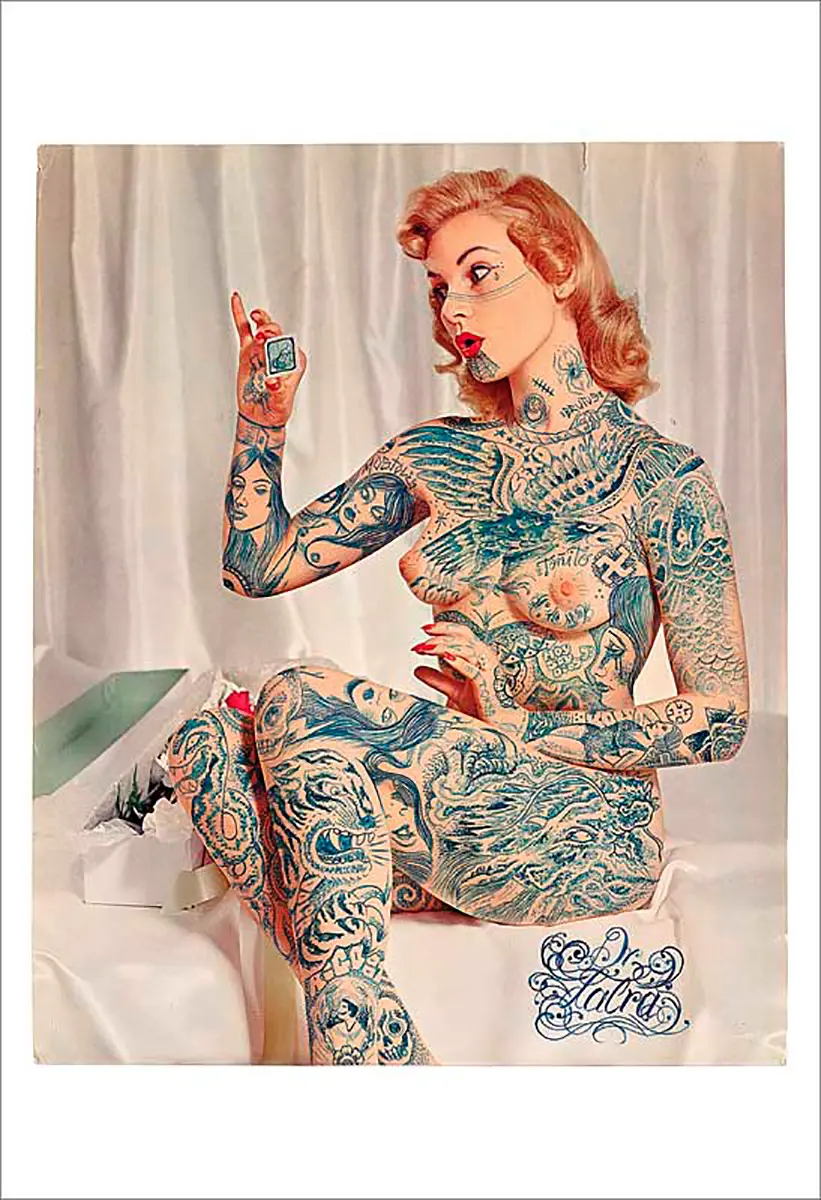
These elements are superimposed onto vintage pin-up photographs, magazine covers, and ads. Dr. Lakra transforms these into instinctive, explicit, and violent sexual scenes that are set in contrast to those innocent images from another era. The result is an interesting counterpoising of components that, through a profane look into the past—with a completely contemporary and highly unconventional gaze—allude to popular culture.
The posters, photographs, periodicals, old books, and objects found in flea markets, are resignified as soon as the characters that appear in them are satirized. Dr. Lakra began tattooing objects as a way to decorate and appropriate. But in doing so, the artist discovered the possibility of amplifying the platform of his artistic work to a wider range of mediums.
The characters in his works include politicians, historic personalities, movie stars, models from the 1950s, and wrestlers; all of them transformed through the primitive gesture of drawing on the skin. By subverting icons based on other icons, Dr. Lakra transforms the ideal of beauty or virility into interventions that are sometimes grotesque and sometimes ghostly, but that is, nevertheless, always lustful. All these forms result in a wide-ranging personal imaginary that rebels against the prevailing social conventions of modesty and moral.
Through these symbols, in a ludic but always provocative manner, Dr. Lakra’s work uncovers the base, physical, violent, fetishist, and twisted instincts that exist in contemporary society. Desire, emptiness, contradiction, and the contrast between highly dissimilar elements converge in the confusing chaos of his vast creative universe.
ISAURA RUIZ