
Venezuelan art could not exist without the “tradition of the modern,” a notion that is even more important than what Harold Rosenberg called the “new” and that was established during the 1950s and 1960s. It was the period of the military dictatorship and developmentalism in Venezuela, as well as a time of renovation and expansion in Caracas guided by the urbanistic principles of the Modern Movement and the irruption of the kinetic manifestation of geometric art led by Alejandro Otero, Carlos Cruz-Díez, and Jesús Soto. A type of art that, despite its apparent or real exoticism, had a deep impact on the mestizo, turbulent and tropical country that is Venezuela; to such degree that, even today, many young Venezuelan artists are nourished by its legacy and create works that reinterpret and update this abstract art form. Emilia Azcárate is one such artist. In December of last year, she presented at the Galería Distrito 4, in Madrid, a wonderful exhibition of her most recent work. She had already decisively used geometry in those notable visual constructions of hers. They were created with soda bottle caps found on the streets and beaches of Trinidad where she lived a few years. This time though, before paying homage to modern geometric tout court, she chose to first recognize the symbolic geometry of the mandalas. It was in Trinidad, after all, where Azcárate delved into Hinduism; she consistently practiced it for many years.
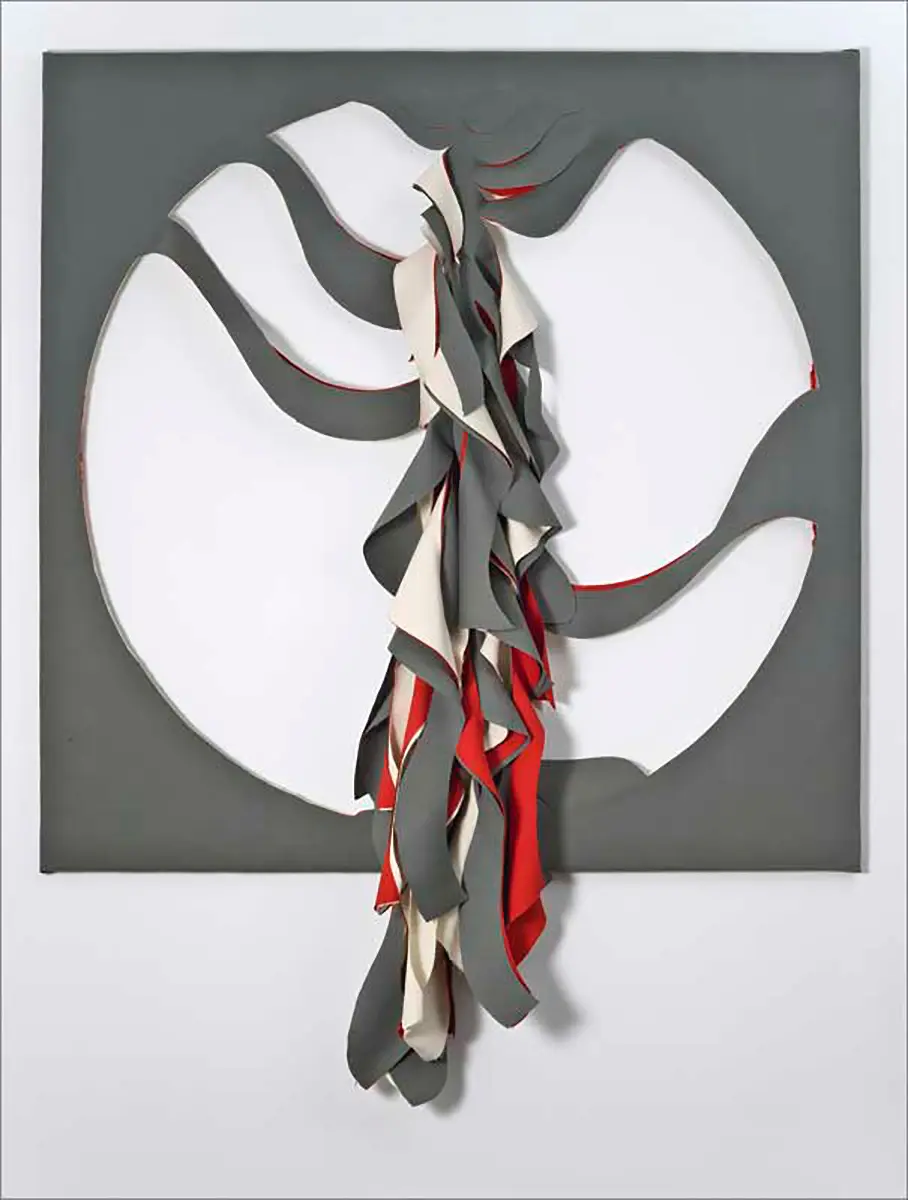
This religious element is absent in the paintings and sculptures that Azcárate exhibited at the Galería Distrito 4. In this show, geometric abstraction is exclusively assumed as a purely formal—even aesthetic—point of departure that allows the artist to approach, in those same terms, her personal appropriation of a vast modern tradition—not only in Venezuela but around the world—that she decided to rework. More specifically, she draws from the work by Lucio Fontana. His precise cuts with scalpels of monochrome surfaces are clear forerunners of Azcárate’s filigrees of the monochrome surfaces of the paintings presented in this exhibition. Filigrees that, when part of clear and firm geometric compositions, evoke the famous trompe-l’oeil techniques of Cruz-Díez or Soto. And when the cuts produce flaps that hang floppily from the painted canvas, we are reminded of the work by Eva Hesse, a student of Josef Albers at the legendary Yale School of Art and Architecture. One day, Hesse decided that she would have threads, cords, weaves, and even objects hanging from her works. Conversely, Emilia Azcárate has such a firm hold of this floppiness that she does not even leave open the possibility of someone mistakenly thinking that her work has anything to do with drip-painting—unlike Eva Hesse who purposely flirted with dripping, the cumbersome pictorial process that, as is well-known, was elevated to the category of the system by Jackson Pollock.
The exhibition also included a pair of sculptures. One was created in metal and the other one in methacrylate. In both of them, the artist used a method of—regularly repeated—clean cuts, similar to the one used in her paintings. Nonetheless, in the sculptures, this treatment leads to openly three-dimensional pieces that evoke naturally perforated large leaves from certain types of tropical plants. Placed directly on the floor, without any platform or support, they bet on the same radical approach Carl André has relied on when he uses the floor to directly arrange the pieces that give form to his sculptures.
CARLOS JIMÉNEZ